To save content items to your account,
please confirm that you agree to abide by our usage policies.
If this is the first time you use this feature, you will be asked to authorise Cambridge Core to connect with your account.
Find out more about saving content to .
To save content items to your Kindle, first ensure no-reply@cambridge.org
is added to your Approved Personal Document E-mail List under your Personal Document Settings
on the Manage Your Content and Devices page of your Amazon account. Then enter the ‘name’ part
of your Kindle email address below.
Find out more about saving to your Kindle.
Note you can select to save to either the @free.kindle.com or @kindle.com variations.
‘@free.kindle.com’ emails are free but can only be saved to your device when it is connected to wi-fi.
‘@kindle.com’ emails can be delivered even when you are not connected to wi-fi, but note that service fees apply.
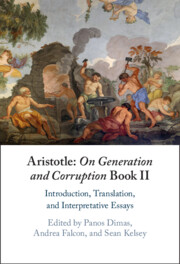
GC II 9 resumes the task announced already in GC I 3: explicating generation and corruption so as to account for the fact that these processes are ontologically distinct from alteration. Aristotle identifies the causes of generation and corruption with a view to explaining their contribution in bringing these processes about. First, the chapter discusses the material cause and identifies the kind of matter that functions as a cause of these processes. Rather than presenting matter as merely passive the chapter paints a picture of it as contributing to the causation of generation by supplying the capacities without which form would be unable to fulfill its forming function, and as contributing to that of corruption by its readiness to both lose properties and gain others. The chapter goes on to censure Aristotle’s predecessors for failing to point to an efficient cause of generation and corruption, even though they claim that identifying such a cause is a principal motivation for their theorizing. Though largely critical, this discussion is carefully calibrated to unveil essential features of the efficient cause and in that way prepare the account for this cause in GC II 10.
This essay provides an analysis of GC I and explains why we now need to investigate the “so-called elements” – the primary bodies that make up all the more complex bodies of the sublunary world. This is an important passage for understanding how the discussion of the elements fits into the overall program of the whole work. In the second section, Aristotle broaches the question of whether there is a kind of matter “beyond” these elements. He criticizes two earlier theories which (he thinks) give an affirmative answer to this question: Anaximander’s theory of the apeiron and Plato’s theory of the Receptacle in the Timaeus. In the final section, Aristotle sets out his own position. This section is evidence that he was committed to prime matter – an ultimate material substratum which partially constitutes each of the primary sublunary bodies, and which underlies the process of elemental inter-transformation.
This essay provides basic exposition of GC II 11; for though the upshot of this difficult chapter is by and large clear, the argumentative details are often hard to make out. The question of the chapter is whether there is anything that comes to be of necessity; its answer, briefly put, is that there would be if there were anything whose coming to be was everlasting, which there would be if there were anything whose coming to be was cyclical, which in point of fact there is (e.g., solstices). The argument fails, of course; the reason, I suggest, is that it does not follow, from the fact that (say) solstices come to be cyclically, that they are always in process of coming to be.
Generation and Corruption II is concerned with Aristotle's theory of the elements, their reciprocal transformations and the cause of their perpetual generation and corruption. These matters are essential to Aristotle's picture of the world, making themselves felt throughout his natural science, including those portions of it that concern living things. What is more, the very inquiry Aristotle pursues in this text, with its focus on definition, generality, and causation, throws important light on his philosophy of science more generally. This volume contains eleven new essays, one for each of the chapters of this Aristotelian text, plus a general introduction and an English translation of the Greek text. It gives substantial attention to an important and neglected text, and highlights its relevance to other topics of current and enduring interest.
Philosophical liberalism is the dominant view in the world today. Even those who reject liberalism philosophically, subscribe to its view of freedom, which is a negative view, common to liberalism, libertarianism, and anarchism. The alternative is recognition of nature, thoroughly, applied fully to human beings. The Buddha set it out as a philosophy, and he lived it. It was a practice.
It brings death back into life. The common view is that death is the opposite of life. Yet death is part of life, from the beginning. We see this in many great writers, Dostoevsky, for example. His characters find human communion in suffering, despite their differences. Contradictions are inherent in life, but we find our way, not a single way. It brings realism back, which is truth.
It has been present in human societies throughout history. It has been banished because of a false view of truth, connected to a false view of freedom. It could be recognized as philosophy. The Buddha taught people simply. There was no dogma. He did not teach them to follow him but to be masters of their own salvation. Unless this view is recognized as Philosophy, as it should be, including truth, it will again become religion, rather than a way of life, an art of living.
The ancient Greeks played a fundamental role in the history of mathematics and their ideas were reused and developed in subsequent periods all the way down to the scientific revolution and beyond. In this, the first complete history for a century. Reviel Netz offers a panoramic view of the rise and influence of Greek mathematics and its significance in world history. He explores the Near Eastern antecedents and the social and intellectual developments underlying the subject's beginnings in Greece in the fifth century BCE. He leads the reader through the proofs and arguments of key figures like Archytas, Euclid and Archimedes, and considers the totality of the Greek mathematical achievement which also includes, in addition to pure mathematics, such applied fields as optics, music, mechanics and, above all, astronomy. This is the story not only of a major historical development, but of some of the finest mathematics ever created.
Eriugena’s concept of love seems to be twofold. On the one hand, he adopts the Platonic concept of love (ἔρως). It is well known that the Platonic eros stands ‘between’ the lover and the loved. Of course, its function is anagogic but, therefore, eros, as a mediator, cannot be conceived of as God himself. On the other hand, Eriugena states that the Absolute loves itself. To be sure, God’s self-referential love is not egoistic but caritative, soteriological and eschatological. It is the outcome, in short, of divine providence (ἀγάπη). Eriugena follows Pseudo-Dionysius the Areopagite, his most important intellectual precursor, and combines both concepts of love. But how, we must ask, can he combine both concepts? How can these two different concepts become one? Or is their difference only an apparent one? We shall answer these crucial questions by considering the two most important concepts of Eriugena’s metaphysics: the transcendence and immanence of the Absolute, or God. Thinkers tend to put these terms in diametrical opposition, but this view, besides leading to confusion, is fundamentally mistaken.
Reassessing the speech on Platonic love by the interlocutor Pietro Bembo in The Book of the Courtier (1528), this essay discusses Castiglione’s Platonic love ideology both as a philosophy and as the theoretical underpinning of an amorous praxis. After an overview of the reception of Platonic love during this stage of the Italian Renaissance, it examines to what extent Bembo’s discourse reflects Ficinian Neoplatonic notions of love as enjoyment of beauty and ascent toward the divine. While Castiglione echoes Ficino in his emphasis on the role of reason, Bembo creates a more permissive standard for younger lovers and for older lovers sanctions the kiss as a pivotal point on the ascent towards spiritual love, thus reconciling contemplative aspects of Platonic love with the concrete amorous dynamics of court life. Moreover, Bembo’s speech is predicated on the awareness that desire can degenerate into fury, an aspect that is discussed in the context of the contra amorem tradition. Literary form is a constant consideration: as a Ciceronian dialogue, the text not only projects an ideal Renaissance court, but also has a mimetic function in that its medium reflects and supports its content.
This chapter moves into a much faster clip. We still look at individual authors, but we take each briefly and consider the authors as tokens for entire civilizations (I also reduce, even further, my use of endnotes: other than direct quotations, I refer in general to the Suggestions for Further Reading). More than this: the chapter is decidedly not “the history of mathematics after the Greeks.” Its subject matter is much narrower: the way in which Mediterranean civilizations, from the Middle Ages onward, responded to the legacy of ancient Greek mathematics. Specifically, our subject matter is the reception of Greek mathematics in three cultures, which we survey in sequence, one section each. “Byzantium and the Making of ‘Greek Mathematics’” looks at the Greek-language tradition of mathematics in the Middle Ages, mostly in the city of Constantinople. Its main theme is manuscript transmission, and so, finally, we get a closer look at some of the primary sources informing the book so far. The following two sections engage with more original developments. “The World Made from Baghdad” concerns the Arab-language tradition of mathematics in the Middle Ages (and glances at its satellites in other languages—which encompass medieval Latin). We mention some essential new contributions—such as the rise of algebra—as we note the continuity of Arab and Greek mathematics. The same is true, to some extent, even of the last major episode—“The Renaissance to End all Renaissances”—the final section, dedicated to the return of Greek mathematics in early modern Europe. The makers of what is now known as the scientific revolution saw themselves not as revolutionaries but as restorers, and it is impossible to understand their project apart from the history, surveyed in this book, of Greek mathematics.
We will survey the early history of Greek mathematics through two generational events: this chapter, “The Generation of Archytas,” followed by the next chapter, “The Generation of Archimedes.” This is a substantive claim: Greek cultural life was generally organized by such isolated, generational events. This is the claim of the first section, “The Hypothesis of Generational Events.” Following this general historical statement, the section “What Little We Know” surveys the evidence for Greek mathematics in the first half of the fourth century.
One very important kind of love in Plato is love of wisdom, or philosophy (philosophia). Philo-sophia is, literally, ‘friendship for wisdom’, not erōs, which is love in the sense of passionate desire, often with a sexual component. Nevertheless, I argue that philosophia in Plato often has close connections with erōs. For example, philosophia is portrayed as the object of erōs, or as a passionate desire to attain wisdom, or as the search for wisdom together with another person who is the object of erōs. Moreover, throughout the dialogues, Socrates the philosopher is characterized by his close association with both philosophia and erōs. Socrates says that he has erōs for two objects, Alcibiades and philosophia (Gorgias), and he is himself the object of erōs (Symposium, Alcibiades I). He claims to know nothing except erotic matters, and he resembles the daimōn Eros in desiring the wisdom he recognizes that he lacks (Symposium). He invents an ideal state in which the rulers are philosophers, those who have erōs for learning (Republic). In the Phaedrus, Socrates prays to Eros not to take away the erotic art that Eros has given him. Just before drinking the hemlock (Phaedo), Socrates, who has chosen to philosophize all his life, says that he does not regret that this practice has led to his execution, because after death philosophers hope to attain the wisdom that was the object of their erōs in life.
Time for a survey, for a look back. What we may call “the Greek achievement” is all in: Archytas, Archimedes, Ptolemy . . . Which does not mean, of course, that history stopped. At around the third century ce, however, there is a marked shift. “Porphyry and a New Start” is where we begin—an author of the second half of the third century whose works include a Neoplatonist commentary on past mathematical works. To understand this, we need to bring in two contexts. One is “Platonism and the Return of Number,” where we survey the history of Platonism until its remaking as Neoplatonism. This philosophy has mathematics—and especially, number—at its center. From the third century ce onward, practically all pagan philosophy becomes Neoplatonist. (To understand this process, we also note several mathematical works of the imperial era, more focused on number.) The other context, discussed in “Teachers, Commentaries, Books,” is the rise of commentary as the major form of creativity, starting in the third century ce.