To save content items to your account,
please confirm that you agree to abide by our usage policies.
If this is the first time you use this feature, you will be asked to authorise Cambridge Core to connect with your account.
Find out more about saving content to .
To save content items to your Kindle, first ensure no-reply@cambridge.org
is added to your Approved Personal Document E-mail List under your Personal Document Settings
on the Manage Your Content and Devices page of your Amazon account. Then enter the ‘name’ part
of your Kindle email address below.
Find out more about saving to your Kindle.
Note you can select to save to either the @free.kindle.com or @kindle.com variations.
‘@free.kindle.com’ emails are free but can only be saved to your device when it is connected to wi-fi.
‘@kindle.com’ emails can be delivered even when you are not connected to wi-fi, but note that service fees apply.
Moral realism in Philebus and Statesman are explored in this chapter. Plato’s later dialogues focus on this-worldly issues within a larger metaphysical framework (Section 6.1). Integrated unity according to kind is explained in relation to the good life. In Philebus Plato provides us with a criterion for the presence of manifestations of the Good: the complex unity of truth, beauty, and symmetry. The Good can be understood to be manifested in the sensible world. In Statesman, the ideal statesman turns out to be different from the philosopher (Section 6.3). The ideal for anything is integrative unity according to kind. As Plato says in Republic, the virtuous person “becomes one out of many” (Section 6.2). Plato also outlines a type of hylomorphic composition according to which the Good can be a this-worldly Demiurge instantiating goodness in the polis and in its inhabitants. The skill thus displayed is now seen to be different from that of the philosopher (Section 6.3).
Plato consistently holds that “no one does wrong willingly.” If this is the case, how is it possible for someone to be held morally responsible for his actions? Plato does seem not only to countenance the idea of moral responsibility but to make it a central notion in his political and eschatological writings (Section 5.1). The connection between personhood and embodiment is explored and the relevance of embodiment to moral responsibility is considered in Republic and Timaeus. The possibility of incontinence or akrasia reveals the divided selfhood in the emboodied person. The concept of culpable ignorance is introduced in order to account for moral responsibility. Culpable ignorance depends on the self-relexivity of rationality (Section 5.2).
The connection between virtue and knowledge is explored in this chapter. Various accounts of Plato’s ethics attempt to focus on the so-called Socratic paradoxes and then try to show how Plato can be seen to have constructed a psychology of action to defend these paradoxes. What is it that these paradoxes try to teach us about morality (Section 3.1)? What is “Socratic” knowledge knowledge of? How is knowledge of the Idea of the Good supposed to be relevant to morality (Section 3.2)? Virtue is a human good but so are health and wealth, friendship, and pleasure. How does Plato’s moral realism deal with these goods when they conflict (Section 3.3)? What does the practice of philosophy have to do with virtue? Can one be virtuous without being a successful philosopher (Section 3.4)? The gradations of virtue in the dialogues and their metaphysical foundation are discussed (Section 3.5). What does the Idea of the Good add to an account of human virtue or excellence (Section 3.6)? This is followed by a comparison of motivation in Plato and Kant (Section 3.7).
In this concluding chapter, I bring together the main themes of the book, focusing on the primacy of the Idea of the Good and its universality. I make some concluding remarks on the tensions that arise for the conflation of Plato’s moral realism and politics.
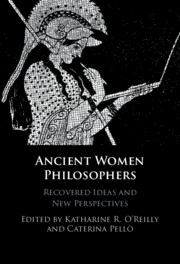
Despite the common misconception that ancient philosophy was the domain of male thinkers, sources confirm that ancient women engaged in philosophical activity. Bringing together a collection of essays on ancient women thinkers, with special focus on their ideas and contributions to the history of philosophy, this volume is about the earliest women philosophers, their breakthroughs, and the methods we can use to excavate them. The essays survey the methodological strategies we can use to approach the surviving evidence, retrieve the largely unresearched thought and the original ideas of ancient women philosophers, and carve out a space for them in the canon. The broad focus includes women thinkers in ancient Indian, Chinese, and Arabic philosophy as well as in the Greek and Roman philosophical traditions. The volume will be valuable for a wide range of researchers, teachers, and students of ancient philosophy.
For Aristotle, the main thing to grasp about a child is what it is not – a creature that has not yet reached the age of reason: childish. But Heraclitus had exploited that ‘deficit’ view of childhood to create characteristic paradoxes in which he exhibits children as however also wiser and sharper than adults. In one of his most enigmatic aphorisms (Fr. 52), he represents the dynamism that propels and sustains us right through life as that of a child at play. After analysis of that paradox and other Heraclitean sayings about children, the chapter turns to Plato’s interest in children and their play, and to his no less paradoxical thesis in the Laws that what, if anything, is truly serious in human life is playful activity, conceived as participation in the ordered play of the gods. We see here an anticipation of Huizinga’s thesis (in Homo Ludens) that in application of the concept of play lies the route to understanding not only children’s games and the place of sport in the lives of adults, but all of what may be regarded as the higher forms of culture, not least law and religious ritual.
The Cave analogy in Book 7 of the Republic admits of no single consistent interpretation. It communicates not one philosophical vision but two. One is developed in the initial narrative, which tells its own compelling story, dropping plenty of hints – varying in directness or mysteriousness – on how it is to be read. The other vision is articulated mostly in the philosophical commentary on the Cave that Plato’s Socrates supplies when he tells his interlocutor Glaucon how to decode it. We should take the commentary as enunciating inter alia a set of instructions not on what the narrative means as originally articulated, but on how it is to be reread as an allegory of the trainee philosopher’s education. The Cave as narrated begins as a moral and political allegory of the condition of ordinary people in the city – in the first instance, the democratic city – and of their need for redemption from it. The Cave as reinterpreted in philosophical commentary is an image of the reorientation of the soul which can be achieved by the practice of mathematics. Consistency of interpretation as between original narrative and subsequent commentary is therefore not mandatory.
Plato writes narrated (as distinct from dramatic) dialogues in his ‘middle’ period. Some are narrated throughout, others are introduced and sometimes interrupted by a dramatic frame dialogue, highlighting the fictiveness of the conversation being represented. In one group, Socrates himself narrates conversations he had with boys or teenagers or young men: Charmides, Lysis, Euthydemus. Here Plato pursues themes appropriate to the genre of ‘erotic’ dialogue, where narration can exhibit the comedy of interactions between his characters. Sometimes another speaker recounts a conversation in which Socrates participated: Phaedo, Symposium, Parmenides (Theaetetus is an abortive further example; Protagoras, narrated by Socrates himself, has many affinities with Symposium). These three dialogues employ distancing mechanisms coupled with ostentatious but self-defeating claims of veracity and reliability, indicating remoteness from what Socrates himself in fact taught. Finally, I take up the suggestion that Plato sticks with the mode of narrated dialogue in Republic because he has by now developed theoretical scruples about the ethical propriety of direct dramatic representation.
This volume offers perspectives on examples of key ingredients in Plato’s writing: particularly of argument, allegory, images, and myth, of intertextuality, and of paradox, but also his characterization of speakers he portrays in dialogue, now through narration, now direct dramatic presentation, and his assumed readerships. All the essays included were prompted by perception of something problematic: either in a passage within a dialogue itself, or in the way scholarship had tackled or failed to tackle a topic. First come three approaching the corpus as a whole, three different vantage points. The next group of three focus on arguments and disputants within the overall argumentative structure of three very different dialogues: Gorgias, Cratylus, and Parmenides. A third group contains two studies of celebrated imaginative fictions – the Noble Lie and the Cave – that perform key but unstraightforward roles in the philosophical strategy of the Republic. The final six chapters discuss the Laws. They explore further literary and philosophical dimensions of Plato’s writing in the last and longest of his dialogues, nowadays yielding up more philosophical rewards than was once the case.
Two intimately related topics are explored here. First is a focus on the different addresses Plato conceives of in writing the Laws. The limitations in understanding of his ‘naïve’ audiences are what are most strongly emphasized: in the first instance the elderly and insular interlocutors Cleinias and Megillus, but by implication the citizens of the community Cleinias is imagined as helping to construct, and first time readers of the dialogue itself. Those limitations will be registered by more ‘practised’ readers. For that more practised readership, some more challenging passages of writing are supplied, with sufficiently indicative reminiscences of more intellectually demanding treatments of subject matter and styles of argument familiar elsewhere in the dialogues. Second is the dominant religious framework within which the Laws mostly operates, which acts as prime vehicle for its philosophical limitation. I illustrate this principally by examination of a passage in Book 4 which includes a myth about the primeval god Cronos, but also by discussion of the strenuously argued cosmic theology of Book 10.