Refine search
Actions for selected content:
11366 results in Ancient philosophy
Index of Ancient and Medieval Thinkers
-
- Book:
- A History of Mind and Body in Late Antiquity
- Published online:
- 21 July 2018
- Print publication:
- 19 July 2018, pp 424-425
-
- Chapter
- Export citation
Chapter 7 - The Second Wave
-
- Book:
- Aristotle on the Uses of Contemplation
- Published online:
- 11 May 2018
- Print publication:
- 31 May 2018, pp 123-153
-
- Chapter
- Export citation
Chapter 2 - Useless Contemplation as an Ultimate End
-
- Book:
- Aristotle on the Uses of Contemplation
- Published online:
- 11 May 2018
- Print publication:
- 31 May 2018, pp 13-41
-
- Chapter
- Export citation
Copyright page
-
- Book:
- Aristotle on the Uses of Contemplation
- Published online:
- 11 May 2018
- Print publication:
- 31 May 2018, pp iv-iv
-
- Chapter
- Export citation
Bibliography
-
- Book:
- Aristotle on the Uses of Contemplation
- Published online:
- 11 May 2018
- Print publication:
- 31 May 2018, pp 217-236
-
- Chapter
- Export citation
Chapter 9 - The Anatomy of Aristotelian Virtue
-
- Book:
- Aristotle on the Uses of Contemplation
- Published online:
- 11 May 2018
- Print publication:
- 31 May 2018, pp 183-205
-
- Chapter
- Export citation
Contents
-
- Book:
- Aristotle on the Uses of Contemplation
- Published online:
- 11 May 2018
- Print publication:
- 31 May 2018, pp v-vii
-
- Chapter
- Export citation
Chapter 5 - The Utility Question Restated – and How Not to Address It
-
- Book:
- Aristotle on the Uses of Contemplation
- Published online:
- 11 May 2018
- Print publication:
- 31 May 2018, pp 78-102
-
- Chapter
- Export citation
Chapter 10 - Some Concluding Reflections
-
- Book:
- Aristotle on the Uses of Contemplation
- Published online:
- 11 May 2018
- Print publication:
- 31 May 2018, pp 206-216
-
- Chapter
- Export citation
Chapter 8 - The Third Wave
-
- Book:
- Aristotle on the Uses of Contemplation
- Published online:
- 11 May 2018
- Print publication:
- 31 May 2018, pp 154-182
-
- Chapter
- Export citation
Acknowledgments
-
- Book:
- Aristotle on the Uses of Contemplation
- Published online:
- 11 May 2018
- Print publication:
- 31 May 2018, pp viii-ix
-
- Chapter
- Export citation
Chapter 6 - The First Wave
-
- Book:
- Aristotle on the Uses of Contemplation
- Published online:
- 11 May 2018
- Print publication:
- 31 May 2018, pp 103-122
-
- Chapter
- Export citation
Index Locorum
-
- Book:
- Aristotle on the Uses of Contemplation
- Published online:
- 11 May 2018
- Print publication:
- 31 May 2018, pp 237-253
-
- Chapter
- Export citation
Chapter 1 - How Can Useless Contemplation Be Central to the Human Good?
-
- Book:
- Aristotle on the Uses of Contemplation
- Published online:
- 11 May 2018
- Print publication:
- 31 May 2018, pp 1-12
-
- Chapter
- Export citation
Note on Texts, Translations, and Abbreviations
-
- Book:
- Aristotle on the Uses of Contemplation
- Published online:
- 11 May 2018
- Print publication:
- 31 May 2018, pp x-x
-
- Chapter
- Export citation
Chapter 4 - Authoritative Functions, Ultimate Ends, and the Good for Living Organisms
-
- Book:
- Aristotle on the Uses of Contemplation
- Published online:
- 11 May 2018
- Print publication:
- 31 May 2018, pp 56-77
-
- Chapter
- Export citation
Chapter 3 - The Threptic Basis of Living
-
- Book:
- Aristotle on the Uses of Contemplation
- Published online:
- 11 May 2018
- Print publication:
- 31 May 2018, pp 42-55
-
- Chapter
- Export citation
Index
-
- Book:
- Aristotle on the Uses of Contemplation
- Published online:
- 11 May 2018
- Print publication:
- 31 May 2018, pp 254-262
-
- Chapter
- Export citation
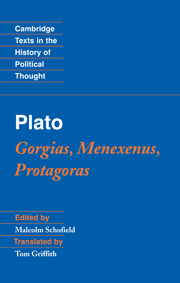
Plato: Gorgias, Menexenus, Protagoras
-
- Published online:
- 28 May 2018
- Print publication:
- 19 November 2009
-
- Textbook
- Export citation

Aristotle: Nicomachean Ethics
-
- Published online:
- 28 May 2018
- Print publication:
- 20 November 2014
-
- Textbook
- Export citation
