To save content items to your account,
please confirm that you agree to abide by our usage policies.
If this is the first time you use this feature, you will be asked to authorise Cambridge Core to connect with your account.
Find out more about saving content to .
To save content items to your Kindle, first ensure no-reply@cambridge.org
is added to your Approved Personal Document E-mail List under your Personal Document Settings
on the Manage Your Content and Devices page of your Amazon account. Then enter the ‘name’ part
of your Kindle email address below.
Find out more about saving to your Kindle.
Note you can select to save to either the @free.kindle.com or @kindle.com variations.
‘@free.kindle.com’ emails are free but can only be saved to your device when it is connected to wi-fi.
‘@kindle.com’ emails can be delivered even when you are not connected to wi-fi, but note that service fees apply.
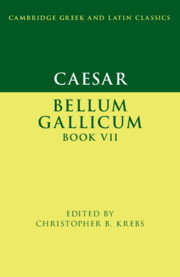
This is the first commentary on Caesar's Bellum Gallicum to approach it as a literary text. It attempts a contextualized reading of the work through the eyes of a contemporary Roman reader, who was trained in rhetoric, versed in Greek and Roman literature, and familiar with the same political and cultural conventions and discourses as its author. In appreciating Caesar as a writer and situating the seventh book of the Bellum Gallicum within its 'horizon of expectations' and especially its historiographical tradition, it reveals much that rewards careful attention, including: a dramatized narrative, sustained intertextual borrowings and allusions (especially from and to Thucydides and Polybius), (in)direct speeches telling of Rome's second-greatest speaker, and word- and sound-play telling of the leading linguist, not to mention artful technical descriptions that lack parallels in the Roman republic. Ultimately, both author and text emerge as quite different from their grossly generalized reputations.
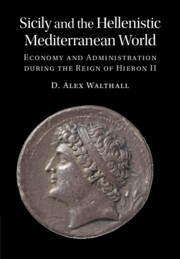
In Sicily and the Hellenistic Mediterranean World, D. Alex Walthall investigates the royal administration of Hieron II (r. 269-215 BCE), the Syracusan monarch who leveraged Sicily's agricultural resources to build a flourishing kingdom that, at one time, played an outsized role in the political and cultural affairs of the Western Mediterranean. Walthall's study combines an historical overview with the rich archaeological evidence that traditionally has not been considered in studies of Hellenistic kingdoms. Exploring the Hieronian system of agricultural taxation, he recasts the traditional narrative of the island's role as a Roman imperial 'grain basket' via analysis of monumental granaries, patterns of rural land-use, standardized grain measures, and the circulation of bronze coinage— the material elements of an agricultural administration that have emerged from recent excavations and intensive landscape survey on the island. Combining material and documentary evidence, Walthall's multi-disciplinary approach offers a new model for the writing of economic and social history of ancient societies.
This chapter brings the sensory potentialities of material objects used in Roman ritualized activities into discourse concerning the nature and production of ancient religious knowledge. By combining perspectives derived from lived religion and material religion it is argued that religious agency should be understood as the product of the intertwining of human and more-than-human things within assemblages. Lived experiences of this production of agency, in turn, cause people to feel and consequently think in certain ways, ultimately producing what can be categorized as distal and proximal forms of religious knowledge. The chapter uses the example of the frieze of the Vestal Virgins from the Ara Pacis Augustae to argue that different forms of ancient religious knowledge were actively created through a multiplicity of lived experiences of ritualized action that brought human and more-than-human material things together, rather than existing only as something that was expressed through ritual behaviours. Exploring the Vestals’ experience of ritualized encounters with material things makes it possible to establish new understandings of the real-world lived experiences and identities of these priestesses, offering significant insights into how individualized forms of religious knowledge could be sustained even in the context of shared communal or public rituals.
The entwinement of Attica and Boiotia brought with it challenges and opportunities. This geographical entanglement will be analysed to understand how the geological situation influenced neighbourly relations. The entwinement ensured considerations of proximity were always at the forefront of decision-makers’ minds. It also created a distinct relationship between the Athenians and Boiotians. Scholarship previously focused on border disputes as the governing mode of interaction in the borderlands, yet the lived experience was different, as this investigation shows. Analysis of the Mazi and Skourt plains, and the adjacent lands of Plataia and Oropos, demonstrates that these contested lands were not the cause of hostilities, but often a consequence of a pre-existing war; that is, territorial disputes were the result rather than the cause of enmity. Boiotia’s maritime connectivity through its harbours provided another strategic consideration for the Athenians, whose interest in the region was partially predicated on the function of these harbours as strategic hubs in the Corinthian Gulf. Finally, Boiotia’s role as a buffer is investigated and how that influenced neighbourly relations. The security it provided Athens meant that the latter consistently aimed to obtain Boiotia as a shield for its hinterland, whether through force or willingly.
This chapter explores how religious knowledge, including rituals, was learned and transmitted by putting forward a novel, cognitive-based, theoretical framework for analysing ritual practices in the Graeco-Roman world. This framework, termed the Religious Learning Network (RLN) theoretical model, is tested within a case study of archaeological and epigraphic evidence of Nutrices Augustae, a cult of local Pannonian healing mother-goddesses. Applying the Religious Learning Network model provides an insight into the types of rituals that may have taken place within this cult as well as the cognitive and social effects that these rituals may have produced upon the ritual participants. This chapter demonstrates that rituals were learned and transmitted within intimate circles through cult members’ interaction with objects, places, and events; forming a dynamic network of memory associations that helped in the encoding, storage, and retrieval of religious and ritual memories.
From painted embellishments on altars and temples, marble flooring, dyed sacrificial ribbons and even the colouration of ritual animals, colour was an inescapable aspect of religious experience. Polychromy was not only decorative, it created a visual medium with which those navigating sacred spaces could interact, together with the written word and the language of shape and form. Colour could communicate to the ancient viewer associations of its source; the significance of both where its pigment or dyestuff was harvested and the journey it undertook, both in terms of manufacture and simple geography, in order to arrive before the observer. The very conception of ancient sight, with rays reaching from the eyes in a particularly haptic process of sensory feedback, meant that looking at colours was for the ancient viewer an experience in itself. How would visitors to the sacred spaces of the ancient world have ‘read’ the visual cues surrounding them, and how could the design of colours in ritual spaces influence the reactions and emotions of those witnessing sacred activity? This paper seeks to investigate and unpick some of the chromatic language found in religious spaces to better inform an understanding of ritual activity in Greco-Roman society.
Processions were among the earliest ‘moving pictures’ in which the brain could develop the cognitive process of ‘reading’ a landscape and embedding a memory through sensory experiences. Salutaris’ foundation, a text inscribed outside the theatre at Ephesus which records the organization of a ritual procession for Artemis, tends to be treated as a factual guide by scholars, rather than as aspirational script for an event: repeated legal clauses, claims of control and permanency, and the white marble on which it was carved, underwrite the vivid sensual experience and transiency of a ritual event. This paper endeavors to contextualize Salutaris’ foundation by incorporating directives of the text together with an analysis of the procession as a practical event and an emotional experience. As a sensorial experience, one can explore aspects of the performance that could not be controlled: the weather, the attitude of the audience, and the behaviour of the performers. Did aspirational directives of ritual behavior come to fruition in a ritual event? How did the experience of an event shape its role and meaning? This cognitive approach provides insights to both the ritual event and the ways that processions could be read by the viewer.
How do we experience ritual? What role does this experience play in the perception and codification memory? This chapter begins by considering the relationship between senses, cognition, and memory in ritual experiences, in particular, the complex interplay between ritual performance, emotions, and material objects, together with the limitations of script-based approaches to surviving accounts. Situating the volume within current debates on religious ritual in the ancient world from the perspectives of cognitive science of religion and sensory studies, this chapter explores how variability in ritual experiences can be assessed through cognitive approaches to rituals as lived experiences. Having outlined why this volume is timely, necessary, and how it contributes to challenging established views and furthering debate surrounding ritual experiences in the Roman world, the introduction also addresses the challenges of cognitive assessments and how these challenges are met across the volume, through a variety of different contexts and approaches. Lastly, the introduction briefly presents each of the five case studies, drawing on common themes and issues explored in each case study, and considering the global relevance and transdisciplinary applications of scholarship in this volume.