To save content items to your account,
please confirm that you agree to abide by our usage policies.
If this is the first time you use this feature, you will be asked to authorise Cambridge Core to connect with your account.
Find out more about saving content to .
To save content items to your Kindle, first ensure no-reply@cambridge.org
is added to your Approved Personal Document E-mail List under your Personal Document Settings
on the Manage Your Content and Devices page of your Amazon account. Then enter the ‘name’ part
of your Kindle email address below.
Find out more about saving to your Kindle.
Note you can select to save to either the @free.kindle.com or @kindle.com variations.
‘@free.kindle.com’ emails are free but can only be saved to your device when it is connected to wi-fi.
‘@kindle.com’ emails can be delivered even when you are not connected to wi-fi, but note that service fees apply.
In the concluding Chapter 6, I suggest other inquiries unfold when we take seriously the notion of the citizen as free and empowered. The approach to freedom and power developed throughout these chapters provides another way to interpret and understand Athenian political thought from the ground up. Recognizing democratic freedom as autonomy calls for a reassessment of ancient critiques of that freedom, such as Plato’s criticisms in the Republic. Likewise, expanding our view of power beyond power over others in order to allow multiple, simultaneous agents with the power to act uncovers often overlooked individuals with power, such as women and metics. In terms of modernity, democratic freedom offers a form of liberty before liberalism separate from republican or neo-Roman conceptions that is still able to protect a multiplicity of individual values.
In Chapter 4, I offer a new theory of citizen power. Every adult male citizen would have been free, but this also made him kurios, or empowered, as opposed to ceding his power to a slave master. When substantivized, kurios indicated a male citizen’s institutionalized role as the head of a household. The lens of the household kurios generates an understanding of citizen power that encompasses both private and public domains. Not simply power as domination, kurios also indicated a shared power to act. As a conceptual metaphor, kurios was applied to the political sphere and structured thought across these different domains. Thus, qualities of the term kurios in its original domain, the household, corresponded systemically in the applied domain, the city. The laws and the corporate citizen body, too, were understood as kurioi. While there may be competing claims to power, the identification of the citizen as sharing in power with and through the laws and the dēmos is distinct from the modern conception of the individual versus the state. The negotiation of power in this way has repercussions for debates regarding sovereignty and the rule of law.
Following attacks by Syriac Orthodox Christians around 792, a group of Maronite monks in northern Syria appealed to Timothy I, the Catholicos of the Church of the East, to intervene on their behalf with the Caliph, with whom the Catholicos was believed to have a close relationship. In his response, Timothy encouraged the Maronites to join his own church, noting that its many martyrs established its theological purity:
For if anyone says that the soil of the east is the soil of holy martyrs, he is never far from the truth. For [during a period of] about four hundred years of Persians [rule], violence and murder did not cease from the Church of the East (ʿedtā d-madnḥā). And in all this time and duration of killing and persecution, Satan could never pillage the riches of their confession, nor make any addition or diminution [therefrom].1
Timothy also urged the Maronites to read “the books of Martyrdoms, that is, from the acts of the martyrs who suffered martyrdom in the East” and to witness his followers’ veneration of the “bones of the holy martyrs.”2 Timothy’s remarks invoke the East Syriac Church’s longstanding glorification of martyrdom, particularly in defiance of the Sasanian Empire, reflected in its copious martyrological literature and in the many martyr shrines that dotted the East Syriac landscape, which served as sites of annual commemorations and pilgrimage.3
While presiding over a legal dispute, Rav Naḥman’s student persistently pestered him with questions. Exasperated, Rav Naḥman reprimanded the student:
Did I not say to you that when I am sitting in judgment you should not say anything to me, for Huna our colleague said with reference to me that I and King Shapur are brothers in respect of judgement (dina) … ?1
The comparison Rav Naḥman draws between himself and King Shapur has traditionally been understood as a reference not to the Sasanian king himself, but to the third-century Babylonian rabbi Shmuel. This is based on another talmudic pericope discussed in the introduction of this book, where a rabbi boasts that he will say something “that not even King Shapur said,” which an anonymous gloss there suggests refers not to King Shapur, but to a nickname of the rabbi Shmuel.2 As I argued there, there is no reason to accept the late anonymous explanation, and there is certainly no compelling reason to apply it here to the story of Rav Naḥman where no such interpolation appears.3 Taking the above story on its own terms, Rav Naḥman is not comparing his expertise in judgement to Shmuel, but to King Shapur himself.
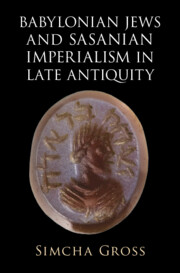
From the image offered by the Babylonian Talmud, Jewish elites were deeply embedded within the Sasanian Empire (224-651 CE). The Talmud is replete with stories and discussions that feature Sasanian kings, Zoroastrian magi, fire temples, imperial administrators, Sasanian laws, Persian customs, and more quotidian details of Jewish life. Yet, in the scholarly literature on the Babylonian Talmud and the Jews of Babylonia , the Sasanian Empire has served as a backdrop to a decidedly parochial Jewish story, having little if any direct impact on Babylonian Jewish life and especially the rabbis. Babylonian Jews and Sasanian Imperialism in Late Antiquity advances a radically different understanding of Babylonian Jewish history and Sasanian rule. Building upon recent scholarship, Simcha Gross portrays a more immanent model of Sasanian rule, within and against which Jews invariably positioned and defined themselves. Babylonian Jews realized their traditions, teachings, and social position within the political, social, religious, and cultural conditions generated by Sasanian rule.
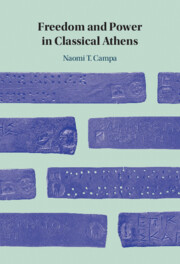
Athenian democracy was distinguished from other ancient constitutions by its emphasis on freedom. This was understood, Naomi T. Campa argues, as being able to do 'whatever one wished,' a widely attested phrase. Citizen agency and power constituted the core of democratic ideology and institutions. Rather than create anarchy, as ancient critics claimed, positive freedom underpinned a system that ideally protected both the individual and the collective. Even freedom, however, can be dangerous. The notion of citizen autonomy both empowered and oppressed individuals within a democratic hierarchy. These topics strike at the heart of democracies ancient and modern, from the discursive principles that structure political procedures to the citizen's navigation between the limitations of law and expression of individual will to the status of noncitizens within a state. This title is part of the Flip it Open Programme and may also be available Open Access. Check our website Cambridge Core for details.
This final substantive chapter looks in detail at the festival of the Kalends of January as an extended case study for the persistence of popular culture in late antiquity. This distinctively late antique festival is examined from a number of angles, looking at its official and informal, public and private dimensions. Next, the longstanding ecclesiastical critique of the festival as ‘pagan’ is discussed. Key themes of the festival are then considered in turn, starting with the role of festive licence, often seen as a central feature of popular culture more broadly. The Kalends masquerades, including dressing up as animals and in the clothes of the opposite sex, are explored. Next the important element of gift exchange is discussed, providing a way in to look at the social and economic dimensions of the festival. In this way this chapter shows the continuing role of the festival in negotiating the unequal yet broadly stable social relations of late antique Provence, despite the hostility of the church.
This chapter looks at popular culture through the lens of lived religion, with a particular focus on the late antique countryside. After an initial discussion exploring the dimensions of ‘lived religion’, it is then explored through two extended case studies. The first looks at ritual practices associated with the midsummer feast of John the Baptist, including ritual bathing. The second case study looks at ritual activities aimed at mitigating the effects of hail, a persistent threat to agriculture and viticulture in the region. These rituals, and the responses from church and secular elites and authorities alike, are examined in their social and economic context. A range of different types of evidence is considered, from charms through to imperial legislation, as well as ecclesiastical texts of various kinds.
This chapter examines the countryside of late antique southern Gaul as a context for the development of popular culture at this time, making use of archaeological as well as literary evidence. It covers Provence, with a particular focus on the territorium of the city of Arles, although areas of western Languedoc are also considered due to the exceptional archaeological data available. Key themes and questions arising from recent scholarship are introduced to shape the discussion that follows before the landscape of the region is introduced. The inhabitants of the region are discussed next, in terms of their social and legal status, while the following section considers developments in settlement and social organisation, including the fate of the villa. A detailed look at livelihoods and patterns of productive activity follows. The final section looks at religious structures and landscapes, including the impact of the church in the late antique countryside.