To save content items to your account,
please confirm that you agree to abide by our usage policies.
If this is the first time you use this feature, you will be asked to authorise Cambridge Core to connect with your account.
Find out more about saving content to .
To save content items to your Kindle, first ensure no-reply@cambridge.org
is added to your Approved Personal Document E-mail List under your Personal Document Settings
on the Manage Your Content and Devices page of your Amazon account. Then enter the ‘name’ part
of your Kindle email address below.
Find out more about saving to your Kindle.
Note you can select to save to either the @free.kindle.com or @kindle.com variations.
‘@free.kindle.com’ emails are free but can only be saved to your device when it is connected to wi-fi.
‘@kindle.com’ emails can be delivered even when you are not connected to wi-fi, but note that service fees apply.
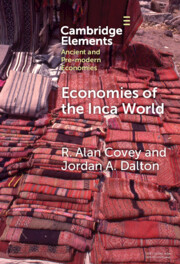
The Inca Empire (c. 1400–1532) was the largest Indigenous state to develop in the Americas, spanning the extraordinarily rich landscapes of the central Andes. Scholarly approaches to Inca-era economies initially drew on Spanish colonial documents that emphasized royal resource monopolies, labor tribute, and kin-based land tenure. Anthropologists in recent decades have emphasized local economic self-sufficiency and the role of reciprocity in Inca economics. This Element adds to the existing literature by reviewing recent archaeological research in the Inca capital region and different provinces. The material evidence and documents indicate considerable variation in the development and implementation of Inca political economy, reflecting an array of local economic practices that were tailored to different Andean environments. Although Inca economic development downplayed interregional trade, emerging evidence indicates the existence of more specialized trading practices in Inca peripheral regions, some of which persisted under imperial rule.
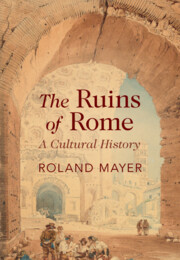
The beguiling ruins of Rome have a long history of allure. They first engaged the attention of later mediaeval tourists, just as they do today. The interest of travellers was captured in the Renaissance by artists, architects, topographers, antiquarians, archaeologists and writers. Once the ruins were seen to appeal to visitors, and to matter for their aesthetic quality, their protection and attractive presentation became imperative. Rome's ruins were the first to be the object of preservation orders, and novel measures were devised for their conservation in innovative archaeological parks. The city's remains provided models for souvenirs; paintings of them decorated the walls of eighteenth-century English country houses; and picturesque sham Roman ruins sprang up in landscape gardens across Europe. Writers responded in various ways to their emotional appeal. Roland Mayer's attractive new history will delight all those interested in the remarkable survival and preservation of a unique urban environment.
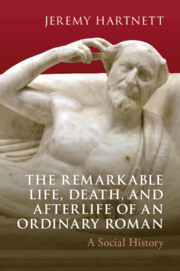
When we think of Romans, Julius Caesar or Constantine might spring to mind. But what was life like for everyday folk, those who gazed up at the palace rather than looking out from within its walls? In this book, Jeremy Hartnett offers a detailed view of an average Roman, an individual named Flavius Agricola. Though Flavius was only a generation or two removed from slavery, his successful life emerges from his careful commemoration in death: a poetic epitaph and life-sized marble portrait showing him reclining at table. This ensemble not only enables Hartnett to reconstruct Flavius' biography, as well as his wife's, but also permits a nuanced exploration of many aspects of Roman life, such as dining, sex, worship of foreign deities, gender, bodily display, cultural literacy, religious experience, blended families, and visiting the dead at their tombs. Teasing provocative questions from this ensemble, Hartnett also recounts the monument's scandalous discovery and extraordinary afterlife over the centuries.
Imperial gardens in ancient Rome and China were as much a physical arrangement of place as they were discursive realms, evoking imagination and invective alike. Starting from semantic observations on ancient Latin and Chinese terminologies, Wentian Fu explores the divergent contexts and concepts of imperial gardens in each culture. The first section traces the respective origins: while inextricably intertwined with ideas of visibility, citizenship, and republican traditions in Rome, the chapter argues for a conspicuous absence of those vectors in China prior to Western Han traditions. The analysis of odes from the Book of Songs reveals, on the contrary, close connections with the power-invested charge of palatial structures. In the second section, the author showcases how Roman aristocratic gardens evolved over time from aristocratic domains into imperial properties, dynamically growing in size and scope. The gardens in Nero’s Golden House, which are given exemplary consideration, both resembled and reversed the order of human spheres and nature. In doing so, they paralleled Shanglin Park and the Jianzhang Palace outside of Chang’an: the chapter explains how those sites were critical to the emperor’s pursuit of immortality. In the concluding section, Fu fully capitalizes on his findings, immersing the argument in the ambiguities of imperial gardens both as seductive spaces of transgression, indulgence, and debauchery, and as role model instantiations of good governance.
At some point in the first century BCE, Yang Yun, one of nine ministers at the Western Han court, fell from the emperor’s grace. His uprightness, incorruptibility, and administrative skills were appreciated far and wide, but Yang Yun’s tendency to brag about these abilities, combined with a personality that appeared somewhat aloof, was destined to create friction. In 56 BCE, a series of charges led to his denouncement and his being stripped of his official position and noble title. Yang Yun was spared the death penalty, at least for the time being, to live a commoner’s life beyond the imperial palace. In his own words, ‘I lead my wife and children, and they join my efforts in plowing fields and planting mulberries, in watering orchards and kitchen gardens, in managing money-making ventures from which we pay taxes to the state thereby’.
The chapters assembled in this part turn to the key question of how the exercise of power was subject to a broad array of performative practices, in places as diverse as the administration of the state, public spectacles, agricultural production, and literature. Taco Terpstra kicks off with the performative dimension of statecraft. Due to their substantiated degree of structured hierarchies, standardized procedures, and the ability to employ officials with specific assignments, the imperial administrations of Rome and Han China capture, in exemplary fashion, the design of premodern statehood. Yet both governments looked rather different. While the Chinese relied on a large apparatus of officials who were appointed and paid by the state, Rome governed via a notoriously narrow pool of magistrates whose bureaucratic powers quintessentially built on the support of countless unsalaried local elites. Terpstra’s discussion of these differences departs from an analysis of how administrative rank and agency were expressed through clothing and other symbols of power. Prima facie minor aspects of the grand scheme of empire, the study of Sima Biao’s (third century CE) Treatise on Carriages and Robes, and On the Magistracies of the Roman State by John the Lydian (sixth century CE) offer exciting insight into the ways in which state power was conceived of and articulated throughout the empire. The chapter then segues into the question of state formation and the emergence of bureaucratic structures. Terpstra discloses how, in China, the thrust toward performance-based appointments and promotions preconditioned the rise of a professional bureaucratic corps, whereas the Romans, he argues, actively discouraged such a development. Both dispositions had eminent consequences for the longue durée of state power.
Russell opens the book with a plea for a new approach to the comparative study of ancient cities. Past scholars – with Rykwert as the foremost example – have pointed to claims in ancient Chinese and Roman literary materials that link cities with the cosmos. They have, furthermore, used these claims to argue that, in both ancient Rome and China, the idea of the city as a microcosmos is what led to what we might call ‘placemaking’, the process by which abstract space is made meaningful to humans. Rather than disproving these claims, Russell shows the limited reach of the literary materials. First, whatever the texts claim, real cities are never scaled-down models of the cosmos: whereas the texts may seek to imbue features of the human landscape with symbolic meaning, these are most often later ascriptions, explaining features of the city that have arisen for much more concrete, mundane reasons. Second, starting from the observation that both ancient China and ancient Rome are civilisations that take great pride in their past traditions, Russell shows how the theories that associate cities with cosmological ideas are, in fact, classicising constructions of a fairly late date (last two centuries BCE), part of a growing body of technical literature, that itself was spurred into being by the cultural and intellectual changes that attended Chinese unification and Roman imperial expansion. Thus, the similarities between Roman and Chinese cities turn out to hinge on highly abstract and relatively marginal concepts of space. By showing this, Russell frees up the field for a historical investigation of cities, not as spaces but as concrete, complex places with multiple and constantly evolving social meanings. This mode of investigation gets fully underway in subsequent chapters of the book.
This chapter explores the idea of gendered social performance through the texts of Plutarch and Sima Qian. Chandra Giroux investigates two categories of social performance in particular: friendship and authority, and death and grief. Both categories are approached from the perspective of each author’s own social performance in these scenarios as well as how they represent the social performance of women in them. Through an investigation of Plutarch’s and Sima Qian’s self-representations of their own social performances, she argues that both authors attempt to establish themselves as exemplary figures, ones that focus on the idea of the maintenance of harmony. In this way, Plutarch’s and Sima Qian’s actions are meant as a mirror for their readers’ own lives. In comparison, the chapter analyzes the examples of Timokleia and Timoxena in Plutarch’s corpus, as well as that of Nie Ying in Sima Qian’s work, to explore the authors’ notions of the ideal female reaction to friendship and authority, as well as that of death and grief. In this analysis, Giroux finds that both authors’ representations of women are based in the gender expectations of their respective societies. It is thus the differences between their cultures’ approaches to gender relations that dictate how Plutarch and Sima Qian understood the ideal female reaction to death, grief, friendship, and authority.
Martin Mohr’s chapter extends issues of urban space and infrastructure to the critical theme of Sacred Roads. It thus complements the chapters on neighborhoods, water supplies, and public gardens. Within the city and beyond its urban environment, roads have been both a facilitator of mobility and a conveyor of meaning at all times and in all cultures. Acknowledging the fundamental difference in the basic configuration of ancient Greek and Qin and Han Chinese societies, Mohr’s exploration of the significance of monumental roads emanates from the careful crafting of a meaningful matrix of comparison. He finds this in the typology of ancient societies as modelled in the works of Christoph Ulf; although tied to observations in the ancient Mediterranean, Mohr explains how the model is applicable to ancient worlds in general. Reliance on bureaucratic structures and techniques set Chinese building projects apart from the notoriously small scale of Greek roads. The question of physical disproportions set apart – note how Chang’an contained a monumental grid of multi-lane passage fares – the chapter demonstrates how the Direct Road, from Yunyang to Jiuyuan, was the religious and topographical backbone of Chinese society, much like sacred procession roads in ancient Greece, for instance on the island of Samos. In both cases, the purpose of reinforcing central strategies to establish physical connections between political and religious centres went hand in hand with the goal of achieving societal cohesion. The comparison concludes with further insight into regions between China and the Mediterranean, whose monumentally and ideologically inflated palatial cities once again accentuated an intriguing foil for the Greek example.
Zhou Yiqun, in her chapter, draws attention to the performance of power by rulers who, having won military victories, bring the surrendered foreigners into their territories. Both Emperor Wu and Nero entertained foreign ruling groups with elaborate performances that included, in the case of Nero, the emperor himself taking the stage and, in the case of Emperor Wu, an attempt to show how his country was able to best foreigners at their own forms of entertainment. Both emperors were severely criticized by their contemporaries, either for being too militaristic (Emperor Wu) or for failing to uphold Rome’s military values (Nero). Through a careful analysis of these two emperors’ performances involving foreigners (through the eyes of their critics), Zhou Yiqun manages to draw out important contrasts between Western Han and imperial Rome. Like Tian Tian, Zhou notices, in the case of Han China, a strong focus toward material things and monetary cost. Zhou locates this both in Emperor Wu’s motivations to engage with foreigners and in the historians’ critiques of these engagements, and attributes it to a near total lack of appreciation for the cultural achievements of the foreign places surrounding Han China. Nero, on the other hand, seems driven by a desire to absorb some of the cultural values and practices of Parthia and Greece, two places that Rome has subdued, and is therefore willing to defy Rome’s behavioral codes.
The chapters in this final part deal with places that permeate peripheries and accentuate endpoints – of individuals and of states. Their focus is, first, on how borders were experienced as markers of the confines of one civilization and zones of transition to another and, second, what types of performance were established to deal with the existential crisis of death. Alex McAuley begins with the discussion of the Hindu Kush region, typically considered a realm in between: at its most western stretches, the city of Ai Khanoum has been labelled an outpost of Hellenism, while in the east, the city of Dunhuang in today’s Gansu province is understood as a fringe settlement on the edges of the Western Han. Traditional views of centre and periphery highlight the remoteness of both sites from the cultural core of their civilization and the corresponding centres of political authority. McAuley, too, asserts that the cultural traditions of Ai Khanoum and Dunhuang were designed to stand out from their environments. He takes this distinction as indicative of a peculiar dynamic between imperial centre and periphery, and between place and political culture. Seleucids and Western Han established remarkably similar mechanisms to link distant reaches to their domain. McAuley explores two means in particular: the strengthening of imperial integration through urban connections and designs, and the establishing of dynastic networks that linked client kings to the central core. Prevailing orthodoxies view these measures from the centre. McAuley’s chapter distinguishes itself by bringing local experience on the periphery to life, that is, by demonstrating how the central regions of empire, around Chang’an and the Seleucid tetrapolis, were transported by these measures to the edge of empire, where they wielded their own dynamic in place – and whence they radiated back to the imperial court. Effectively, this chapter not only enriches perspectives on the Hellenistic world and Han China from the vantage point of the Hindu Kush but also demonstrates how the imperial frontiers of both civilizations overlapped in Central Asia, suggesting that the divide between East and West in antiquity is shrinking.
Neighborhoods are a universal feature of sedentary societies. Despite differences in meaning functionality, their inherent qualities derive from the sheer amount of lifetime individuals spend in them. In premodern societies, they often demarcate the radius of quotidian agency. Ryan Abrecht approaches the vibrant cities of Rome and Chang’an, microcosms of the respective empires they represented, through the decentered lens. In the shadow of polished public places, typically modeled to serve as monumental stages for the conduct and the performance of politics, he explores the lived experience in less shiny places of town. The academic quest for neighborhoods is not confined to archaeohistorical endeavors. Rather, turning to Henry Lefebvre’s groundbreaking work on rhythmnanalysis, Abrecht demonstrates the value of tracing daily patterns within cities – the places people navigate in their quotidian lives – and the sensory experience this generates among those who share a neighborhood space. In doing so, the article brings to life the perspective of tenants in insulae (“blocks”) and vici (“villages”), and in Chang’an residential districts respectively. Abrecht diagnoses a deep difference in neighborhood experience as such: Rome’s open community structures, with porous and permeable boundaries between vici, are contrasted with circumstances in Chang’an, where affiliations mattered more and were also regulated through official controls. The concluding discussion of poems from the Hanshu and Liu Yiqing reveals how corresponding patterns of behavior played out over time to shape unique neighborhood experiences and local cultures.
Death constitutes a deep life crisis to the living – depending on the departed, to families, communities, and societies. In this chapter, the author discusses the eminent strategies of overcoming this crisis, that is, funeral and burial practices, and the ritual sequences that connect the two. Both the Roman and the Chinese cases have received much scholarly attention. Armin Selbitschka’s chapter distinguishes itself through its comparative perspective and the theoretical charge with which it is enriched from performance theory and sociologies of place. In the study of each culture, careful consideration is given to the historical development across time. Embarking from conceptual debates on the disruption of the social order and the innate capacity of social performances to restore it, he discusses various practices revolving around the dead, including the preparation of the departed, funerary cortèges, and orations. The subsequent section extends the analysis to the inherent meaning of tombs – their place in the urban landscape, their commemorative force, and their embodiment of social hierarchies. In so doing, it reveals a curious spatial dynamics between the funeral’s beginning in the private sphere and its transition into the public arena. Due to the different configuration of public in Rome and in China, Selbitschka in conclusion makes visible the culture-specific traits in the performances that accompanied mourners on their way to the tomb and beyond, into a future where the social crisis of death was resolved, for the time being.