To save content items to your account,
please confirm that you agree to abide by our usage policies.
If this is the first time you use this feature, you will be asked to authorise Cambridge Core to connect with your account.
Find out more about saving content to .
To save content items to your Kindle, first ensure no-reply@cambridge.org
is added to your Approved Personal Document E-mail List under your Personal Document Settings
on the Manage Your Content and Devices page of your Amazon account. Then enter the ‘name’ part
of your Kindle email address below.
Find out more about saving to your Kindle.
Note you can select to save to either the @free.kindle.com or @kindle.com variations.
‘@free.kindle.com’ emails are free but can only be saved to your device when it is connected to wi-fi.
‘@kindle.com’ emails can be delivered even when you are not connected to wi-fi, but note that service fees apply.
Enzymes are biological catalysts. Recall that a catalyst is a substance that accelerates a chemical reaction without itself being consumed by the reaction. Enzyme catalysis holds a special place in the history of chemistry. The law of mass action was enunciated in the nineteenth century in a thermodynamic context by Guldberg and Waage. By the early twentieth century, the law of mass action was supported by a growing mass of both thermodynamic and kinetic evidence. Nevertheless, some reactions had complex rate laws which were not obviously compatible with mass action. Enzyme catalysis posed such a difficulty. In fact, there was some debate as to whether enzyme molecules even had to come in contact with the reactant molecules to accelerate the reaction. In 1902, Victor Henri showed, with some help from Max Bodenstein, that enzyme kinetics is in fact compatible with the law of mass action. The complex rate law obeyed by enzyme-catalyzed reactions was simply a manifestation of a complex mechanism. Although debates with respect to the mode of action of enzymes persisted for some time, it was at least clear from this point on that enzyme catalysis was compatible with the then-emerging theory of chemical kinetics. This is the vein we will pick up in this chapter. Our study of enzyme kinetics will particularly emphasize the derivation of rate laws and the analysis of data from initial rate experiments.
This book covers all aspects of the chemical behaviour of the muon - a rare, short-lived, elementary particle having a mass intermediate between that of the proton and the electron. Muons provide an exceptional opportunity to investigate basic chemical interactions, simply because they are so short-lived: they can thus be studied using the powerful technique of muon spin rotation, in which the yield, decay rate and identity of the muon in several different states is observed. Although originally of principal interest to nuclear and particle physicists, muons have recently become important as probes in solid-state physics and in all phases of chemistry. This book will be a valuable source of information for research scientists, university teachers and graduate students interested in physical chemistry, chemical physics and the application of nuclear science to the life sciences.
The overall theme of Volume 2 is water in crystalline solids: the ice polymorplis, salt and organic hydrates. from simple molecules to proteins, and the nature of the equated proton in solid hydrates (and in the vapour phase). The advent of neutron diffraction, coupled with major instrumental and theoretical developments has led to insights into the structure, energetics and dynamics of hydrated solids.
Jane Haldimand Marcet (1769–1858) was a pioneer in the field of education who wrote accessible introductory books on science and economics. Noting that women's education 'is seldom calculated to prepare their minds for abstract ideas', she resolved to write books that would inform, entertain and improve a generation of female readers. First published anonymously in 1805, her two-volume Conversations on Chemistry swiftly became a standard primer going through sixteen editions in England alone, and is credited with having influenced the young Michael Faraday. Presented as a series of discussions between a fictional tutor, Mrs. Bryan, and her two female students, the flighty Caroline and earnest Emily, Conversations combines entertaining banter with a clear and concise explanation of scientific theories of the day. Volume 2 contains spirited exchanges on topics including 'shells and chalk', borax, decomposing vegetables and 'animal economy', which will interest historians of both science and education.
Ion-selective electrodes are widely used for non-destructive, rapid, sensitive and precise determination of many ions in a great variety of media and therefore, provide a powerful analytic tool. Since the appearance of the first edition of Professor Koryta's book in 1975 progress in the whole field of ion-selective electrodes has been rapid and a vast amount of diverse data has appeared. In this edition, based on the literature to mid-1981, a compact and unified treatment of the theory of ion-selective electrodes is presented along with an updated account of their analytical, biomedical and physicochemical applications. The book will be of interest to advanced undergraduate and graduate chemists, biophysicists, physiologists, biochemists and environmental scientists, as well as research workers in both universities and industry.
Molecular Rydberg states have many unusual properties, lending themselves to a diverse range of experimental applications. This book is designed to unravel the mysteries of molecular Rydberg states that lie beyond the scope of accepted spectroscopic theories. It is the first single-authored text to focus on the application of multi-channel quantum defect theory (MQDT) and ab initio theory to this special class of molecular systems, introducing readers to novel theoretical techniques. The scattering techniques of MQDT are examined, along with a unified description of bound states and fragmentation dynamics. Connections with established spectroscopic theory are also described. The book concludes with an account of the spherical tensor and density matrix theories required for the interpretation of multi-photon experiments. While the main text focuses on physical principles and experimental applications, appendices are used to handle advanced mathematical detail. This is a valuable resource for researchers in chemical, atomic and molecular physics.
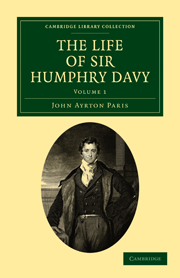
Sir Humphry Davy (1778–1829) was a hugely influential chemist, inventor, and public lecturer who is recognised as one of the first professional scientists. He was apprenticed to an apothecary in 1795, which formed his introduction to chemical experiments. A chance meeting with Davis Giddy in 1798 introduced Davy into the wider scientific community, and in 1800 he was invited to a post at the Royal Institution, where he lectured to great acclaim. These volumes, first published in 1831, contain Davy's official biography. Researched and written by John Ayrton Paris, the work describes in detail Davy's life and his scientific studies. Organised chronologically with excerpts from his private correspondence, Davy's early life and his experiments and lectures at the Royal Institution and his Presidency of the Royal Society between 1820 and 1827 are explored in vivid detail. Volume 2 describes his life and work between 1812 and 1829.
Sir Humphry Davy (1778–1829) was a hugely influential chemist, inventor, and public lecturer who is recognised as one of the first professional scientists. He was apprenticed to an apothecary in 1795, which formed his introduction to chemical experiments. A chance meeting with Davis Giddy in 1798 introduced Davy into the wider scientific community, and in 1800 he was invited to a post at the Royal Institution, where he lectured to great acclaim. These volumes, first published in 1831, contain Davy's official biography. Researched and written by John Ayrton Paris, the work describes in detail Davy's life and his scientific studies. Organised chronologically with excerpts from his private correspondence, Davy's early life and his experiments and lectures at the Royal Institution and his Presidency of the Royal Society between 1820 and 1827 are explored in vivid detail. Volume 1 describes his life and work until 1812.
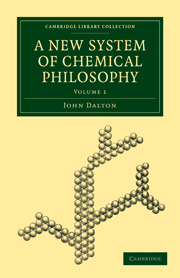
The chemist and meteorologist John Dalton (1766–1844) published A New System of Chemical Philosophy in two volumes, between 1808 and 1827. Dalton's discovery of the importance of the relative weight and structure of particles of a compound for explaining chemical reactions transformed atomic theory and laid the basis for much of what is modern chemistry. Volume 1 was published in two parts, in 1808 and 1810. Part 1 offers an account of Dalton's atomic theory. It contains chapters on temperature, the constitution of bodies, chemical synthesis and a number of plates including his famous table of symbols for the atoms of various elements. Part 2 contains a chapter on elementary principles and twelve sections on different groups of two-element compounds. Dalton's work is a monument of nineteenth-century chemistry. It will continue to be read and enjoyed by anybody interested in the history and development of science.
Joseph Priestley (1733–1804) was an eighteenth-century English polymath with accomplishments in the fields of science, pedagogy, philosophy and theology. Among his more notable achievements were the discovery of oxygen and his work in establishing Unitarianism. Often a controversialist, Priestley's efforts to develop a 'rational' Christianity and support for the French Revolution eventually made him unwelcome in his native land. His 1807 Memoirs relate the story of his life until the time of his 1794 emigration to America and include other biographical materials written by his son. This first volume also contains five appendices discussing his philosophy, scientific work and religious opinions. Priestley's memoirs are an important source for anyone interested in the state of epistemology, rationalism, and religious belief in the age of the Enlightenment, and in a man who, in the words of his son, 'gave unremitting exertions in the cause of truth'.
Multichannel quantum defect theory uses scattering methods to provide a uniform treatment of spectroscopic and fragmentation phenomena. It rests on the idea that the exchange and correlation interactions between an outer Rydberg electron and the positive ion core act over a relatively short range, so that the detached electron moves in a purely Coulomb field at larger distances. One therefore thinks, even in the bound state context, of the scattering effect of the non-Coulomb core on the Coulomb wavefunctions. Put in explicit terms this means that the outer parts of the Rydberg orbitals are solutions of the Coulomb equation, the phases of which are determined by matching to the inner wavefunction at the core boundary. There can also be more complicated situations, in which the non-Coulomb interactions lead to energy transfer from the core, which ‘auto-ionizes’ the detached electron from a bound to a continuum state. The general solutions are normalized to allow a uniform description at energies above and below the ionization limit. Further ramifications, which are deferred to a later chapter, allow the inclusion of simultaneous ionization and dissociation. Reviews that emphasize molecular aspects of the theory are given by Greene and Jungen [1] and Ross [2]. There is also a collection of seminal papers, edited by Jungen [3].
This exposition starts with a description of the properties of Coulomb wavefunctions at arbitrary energies, using definitions that provide a uniform description of both bound and continuum states.
The properties of molecular Rydberg states are most commonly observed experimentally by photo-excitation and photo-ionization, and it is impossible to ignore the explosion of interest in multiphoton phenomena over the past twenty years. It is, however, beyond the scope of this book to attempt anything like a comprehensive treatment. Attention is therefore restricted to the weak field theory, in which light acts as a perturbation. Readers are referred to Lambropoulos and Smith for a fuller discussion [1]. Explicit results are restricted to one and two photons, leaving the reader to consult the literature for extension to n photons. This chapter concerns excitation between discrete bound states, either by single-photon absorption or n + 1 resonant multiphoton ionization (REMPI) [2, 3, 4].
The first of the following sections outlines the perturbation theory of one- and two-photon absorption, as initiated by Göppert-Mayer, and the extension to three-photon processes is indicated [5]. Aspects of the theory, such as the point group symmetries of the resulting dipole (n = 1), polarizability (n = 2) and hyperpolarizability (n = 3) operators are readily deduced in a Cartesian formulation [6]. However, the relevant angular momentum manipulations including the selection rules for the various n-photon linear and circular polarization possibilities are often most easily performed in a complex spherical tensor representation, which is outlined in Section 6.3 [6, 7]. There are also advantages, for resonant processes, in employing an alternative density matrix, which focuses on spatial characteristics of the excited angular momentum, rather than the overall excitation probability.