To save content items to your account,
please confirm that you agree to abide by our usage policies.
If this is the first time you use this feature, you will be asked to authorise Cambridge Core to connect with your account.
Find out more about saving content to .
To save content items to your Kindle, first ensure no-reply@cambridge.org
is added to your Approved Personal Document E-mail List under your Personal Document Settings
on the Manage Your Content and Devices page of your Amazon account. Then enter the ‘name’ part
of your Kindle email address below.
Find out more about saving to your Kindle.
Note you can select to save to either the @free.kindle.com or @kindle.com variations.
‘@free.kindle.com’ emails are free but can only be saved to your device when it is connected to wi-fi.
‘@kindle.com’ emails can be delivered even when you are not connected to wi-fi, but note that service fees apply.
This chapter provides a case study of how the rule of law was temporarily strengthened in one subbranch of health and medical law. The authors are doctors who ensured wider access to HIV/AIDS services to three key populations by setting up primary healthcare clinics for drug users, men who have sex with men, and sex workers. Providing services is challenging as the latter two groups are engaged in behavior considered criminal, and their very existence is officially denied. Sex between men and adultery can be punishable by death. The doctors’ harm-reduction approach was gradually expanded province- and nation-wide during Khatami’s presidency (1997-2005), allowing even for methadone treatment and needle exchanges. Under President Ahmadinejad, the government returned to the revolutionary “war on drugs” and policing approach, closing the triangular clinics and forcing the authors into exile. The chapter illustrates how legal challenges intertwine with cultural, religious, and political responses to Iran’s HIV/AIDS pandemic.
This chapter examines the rights situation of religious and ethnic minorities in the Islamic Republic. All state institutions are in some ways responsible for the Islamic Republic’s discriminatory policies. The intelligence and security apparatus intimidate and arrest members of minority groups, and the judiciary usually issues harsh sentences against them. The executive branch also engages in discriminatory action, such as denying higher education and public sector employment to minorities. The parliament, having passed discriminatory laws, does not hold other state organs responsible for extra-legal actions against minorities. Nor has it conducted investigations necessary to determine the extent of discriminatory practices in the country. Courts have reacted to minority cases in diverse ways, often validating discrimination but in some cases also protecting them against rights abuses. If this diversity in court rulings indicates anything, it is that not all courts are completely on the government’s line but retain some modicum of political independence. The bigger picture is, however, that minority cases are often treated as politically sensitive irrespective of the nature of the case and are therefore tried in the revolutionary rather than the general courts.
The independence of the legal profession suffered immeasurably when the bar associations were dissolved after the 1979 Revolution. They only gradually recuperated and reorganized in the 1990s, being allowed to hold internal elections again in 1997 and regain a degree of political independence. Since the early 2000s, however, hardliners have ensured that regimist lawyers dominate the bars’ boards, with the effect that the human rights work of the bar associations came to a halt. What has undermined the work of the bar associations most, however, is the parallel training and examination mechanisms set up in the judiciary for a different kind of lawyer, so-called Article 187 legal advisors. These do not take a bar exam and also otherwise are not organized by the Bar. They are required to seek renewal of their accreditation from the judiciary every year, thus making them highly dependent on the judiciary’s goodwill.
This chapter focuses on the police and other law enforcement agencies. Mapping their transformation since the 1979 Revolution, it highlights the tensions and overlapping jurisdictions between different law enforcement agencies and units, arguing that their security mission has expanded alongside their disciplinary and religious morality mission, especially since the disputed 2009 elections. To maintain order, the Islamic Republic has taken several measures, such as the expansion of law enforcement units, the establishment of several special forces for crowd control and anti-riot missions, and heavy investment in the training and equipment of these forces. The police force has also dramatically intensified its ideological programs for the indoctrination of its members and has made changes to recruitment by shifting focus toward more conservative parts of society. Despite some attempts at reform, Iran’s various police forces are not consistently subject to the rule of law, nor are they accountable to elected institutions.
The authors – Iranian lawyers working in international trade law – examine the rule-of-law effects of the Joint Comprehensive Plan of Action (JCPOA), which limited Iran’s enrichment activities and implemented enhanced monitoring of its nuclear program in exchange for relief from all UN and European Union nuclear-related sanctions. From January 16, 2016, financial transactions and a range of associated service sectors in Iran were opened up for international trade. These included banking and insurance; oil, gas, and the petrochemical sector; shipping and transport sectors; metals; and software. At the same time, restrictions on the transfer of sensitive goods and ballistic missiles, as well as measures against certain entities, remained in force. The US withdrawal from the agreement in 2018 has led to increased trade between Iran China, and, overall, has reversed the Iranian state’s forced withdrawal from certain branches of the economy, thereby resolidifying both its political and economic power.
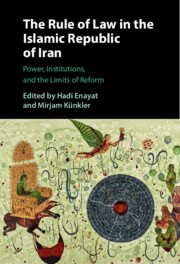
After Iran's 1979 Revolution, Ayatollah Khomeini denounced the secular legal system of the Pahlavis and pledged his commitment to distinctly Islamic conceptions of law and justice: the application of both the shariʿa and the rule of law (hākemiyat-e qānun) became major ideological pillars of the Islamic Republic. This precipitated the Islamization of the legal system, the judiciary and the courts, a process which still continues today and is the subject of intense ideological and political contestation. The Rule of Law in Iran is the first comprehensive analysis of judicial and legal institutions of the Islamic Republic of Iran in their social, political and historical contexts. Scholars and practitioners of law, many with experience of working in Iran, shed light on how the rule of law has fared across a variety of areas, from criminal law to labour law, family law, minority rights, policing, the legal profession, the visual and performing arts, trade law, and medicine.
The chapter delves into the iconic imagery and contested legacy of Moshe Dayan as the “minister of victory” during the Six-Day War. It examines the strategic decisions and military maneuvers orchestrated by Dayan, shedding light on his pivotal role in shaping the objective and management of the war. The emphasizing his focus on neutralizing the Egyptian military threat and avoiding unnecessary entanglements with other Arab armies. Dayan’s adaptability and opportunistic approach to seizing fleeting opportunities are highlighted, underscoring his influence on major decisions while attempting to minimize intervention in routine management. Furthermore, the chapter delves into Dayan’s considerations of international sensitivities, particularly regarding the Holy Basin and the potential involvement of the Soviet Union. The controversy surrounding the war’s objectives and priorities, as well as the tensions between the political and military echelons, is also examined. Additionally, the chapter delves into Dayan’s interactions with political figures and military leaders, revealing the complexities and challenges he faced in navigating the rapidly evolving dynamics of the war.
The chapter offers a unique perspective on strategy development and the role of a strategist, highlighting the importance of context-specific thinking, flexibility, and reflection. The chapter begins by examining Dayan’s early experiences as a revolutionary guerrilla fighter, which shaped his view of war as a phenomenon that can only be understood in its local, concrete geographical, cultural, and political contexts. This dismissal of rigid, established military patterns is central to Dayan’s approach to strategy development throughout his career. The chapter then explores Dayan’s unique approach to strategy development, which was characterized by contextualized learning, the application of the 80:20 principle for setting priorities, delegation and empowerment, time management for maximum flexibility, and the use of meetings to generate and test new ideas. Dayan’s ability to hold two opposing points of view simultaneously and his love for the land of Israel are also discussed. Overall, the chapter offers valuable insights into the development of a strategist and the importance of context-specific thinking and flexibility in strategy development.
This chapter examines the post-Six-Day War period and the challenges faced by Moshe Dayan, particularly in governing the West Bank and Gaza Strip, home to a significant Palestinian population hostile to Israel. Dayan grapples with the complexities of governing non-citizen residents and contemplates the future of the occupied territories, seeking a final arrangement with the Palestinians and the broader Arab world. The chapter also sheds light on Dayan’s experiences in Vietnam, where he gained insights into the challenges faced by the US military. He would use his experience in Vietnam later on in his career. Dayan’s observations on the need for precise intelligence, the importance of winning hearts and minds, and the struggle against Communist ideology offer valuable lessons for military strategy. Additionally, the chapter explores Dayan’s personal experiences, including his profound connection to the historic sites of Jerusalem and his recognition of the need for intense work to regulate the complex situation in the region and preempt potential conflicts.
This chapter provides a comprehensive analysis of the War of Attrition, a conflict between Israel and Egypt that lasted from 1967 to 1970. The chapter explores the political and social processes triggered by the war, as well as the significant involvement of the Soviet Union and increased US aid to Israel. It also delves into the limited scope of the war, with both sides aiming for a strategy of exhaustion The chapter highlights the role of Israeli Defense Minister Moshe Dayan in shaping the country’s military strategy during the war. Dayan’s advocated for Israeli concessions and partial settlement with Egypt, arguing that the opening and reconstruction of the Suez Canal could generate positive dynamics for promoting peace. Another aspect is the social impact of the war on Israeli society, revealing the emergence of cracks in the national consensus. The war was long-lasting and resulted in heavy losses, leading to discontent and criticism from various levels of society. Despite this, the war ultimately demonstrated Israel’s military strength and ability to withstand pressure from a much larger opponent.
The Sinai Campaign of 1956 was shaped by significant geopolitical developments, including the end of colonialism and the emergence of the Cold War. As former colonial powers relinquished control over territories, the Middle East became a focal point for global power struggles. Great Britain and France, seeking to protect their interests in the region, became involved in the conflict, aligning with Israel to achieve their strategic goals. Amidst these shifting dynamics, the Sinai Campaign unfolded as a pivotal military endeavor. The campaign was characterized by the emphasis on speed in battle, as articulated by Moshe Dayan. Dayan’s strategic vision prioritized the relative advantage of the Israel Defense Forces (IDF), focusing on areas where they could create a decisive edge over their adversaries. This approach led to a reevaluation of force-building principles, with an emphasis on offense and rapid execution capabilities. Furthermore, the campaign revealed the formidable power of the IDF’s armored corps, triggering a genuine revolution in Israeli military strategy. The Sinai Campaign thus stands as a multifaceted historical event, shaped by geopolitical realignments, military innovations, and ethical dilemmas.
The chapter provides a detailed account of the decision-making processes that led to strategic surprise in the Yom Kippur War 6 of October 1973 and the battles during the first days of the war. The chapter highlights the differences in opinion among Israeli military leaders regarding the best approach to defending against an Egyptian attack, with some advocating for a flexible defense and others favoring a rigid defense with strongpoints. Ultimately, political considerations led to the adoption of a rigid defense strategy integrated with some mobile units. The chapter also explores the misunderstandings and communication issues that occurred during the first hours of the war that led to Israel’s military failures, particularly with regards to the delayed call-up of reserve units but also the air force. Israel’s counter offensive on the 8 of October failure in its southern front is also analyzed.