To save content items to your account,
please confirm that you agree to abide by our usage policies.
If this is the first time you use this feature, you will be asked to authorise Cambridge Core to connect with your account.
Find out more about saving content to .
To save content items to your Kindle, first ensure no-reply@cambridge.org
is added to your Approved Personal Document E-mail List under your Personal Document Settings
on the Manage Your Content and Devices page of your Amazon account. Then enter the ‘name’ part
of your Kindle email address below.
Find out more about saving to your Kindle.
Note you can select to save to either the @free.kindle.com or @kindle.com variations.
‘@free.kindle.com’ emails are free but can only be saved to your device when it is connected to wi-fi.
‘@kindle.com’ emails can be delivered even when you are not connected to wi-fi, but note that service fees apply.
The introduction sets out the approaches, sources, and scope of the book. It acquaints the reader with the main features of classical education and places the book within the modern historiography.
Chapter 2 analyzes two works related to the Juan Manuel de Rosas era, one actually produced during this time and the other from the late nineteenth or early twentieth century. In both, Afro-Porteños are present in large numbers, and their representation conflicts with literary discourses. While the writings are filled with defamatory adjectives that seek to create a chaotic and barbaric image of Afro-Porteños, the paintings present a pleasing and orderly image. After Rosas’s defeat in 1852, his opponents worked tirelessly to associate the group with Rosas and his barbaric era. This conception of Afro-Argentines has become a stereotype. They are thus confined to an abominable past that must not be repeated. This strategy constitutes one more way of rendering invisible a population whose extinction was prophesied as inevitable since the mid-nineteenth century. These ideas persist to this day, despite the actual presence of Afro-descendants in our territory, and they, in turn, clearly influence the racial classifications that operate in Argentine society.
This chapter explores how the Declaration of Independence was drafted and ratified. Congress created and assigned the task of drafting a declaration of independence to a committee of lawyers. When the draft went to the Congress, lawyers like Edward Rutledge had their chance to weigh in. The draft document and the final version was a legal document designed to place rebellion on a legal foundation. Jefferson later recalled that his draft of the Declaration of Independence merely recombined ideas that had long been discussed, and terminology long adopted, by Congress. The Declaration assumed independence, otherwise it would have had no foundation. Following this logic, as the members did, surely Jefferson among them, the Declaration was simply stating the reasons – a justification like the Declaratory Act of 1766, by which Parliament explained its authority over the colonies – for an event already transpired. The ringing elaboration of the rights of mankind, various borrowings from John Locke, echoes of natural law, and the language of prior resolves and declarations were not really pertinent to a declaration for the independence of a continent, but make sense in the more limited framework of Virginia constitutional change.
This chapter situates the Declaration of Independence in relation to another founding document of the United States, the federal Constitution. It assesses the Declaration’s role in debates over the Constitution, first during the latter’s framing in 1787, then in the struggle for ratification, and then later as political actors sought to interpret each document in light of the other. From the outset, debate over the Constitution highlighted the Declaration’s multivalence as well as its rhetorical power. Both defenders and opponents of the Constitution have sought to show how their cause best aligned with the ideals and aspirations expressed in the Declaration. Anti-federalists and their successors constructed a powerful narrative which juxtaposed the Declaration’s call to liberty with the Constitution’s blueprint for authority. Yet there was from the beginning an equally strong tradition that saw the Constitution as a consummation of the Declaration’s promise. Either way, this chapter argues, the Declaration continues to help shape the meaning of the Constitution – and to have its own meaning remolded in turn.
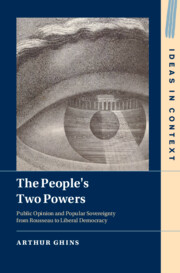
The People's Two Powers revisits the emergence of democracy during the French Revolution and examines how French liberalism evolved in response. By focusing on two concepts often studied separately – public opinion and popular sovereignty – Arthur Ghins uncovers a significant historical shift in the understanding of democracy. Initially tied to the direct exercise of popular sovereignty by Rousseau, Condorcet, the Montagnards, and Bonapartist theorists, democracy was first rejected, then redefined by liberals as rule by public opinion throughout the nineteenth century. This redefinition culminated in the invention of the term 'liberal democracy' in France in the 1860s. Originally conceived in opposition to 'Caesarism' during the Second Empire, the term has an ongoing and important legacy, and was later redeployed by French liberals against shifting adversaries – 'totalitarianism' from the 1930s onward, and 'populism' since the 1980s.
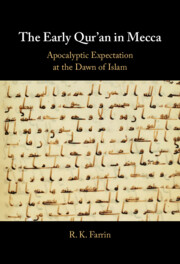
In this study, R. K. Farrin offers a fresh perspective on the emergence of Islam by tracing the structural and thematic development of the Qur'an in Mecca. He analyzes the form and content of the Qur'an at its earliest stage (ca. 609–14 CE), when it grew from a few verses to a scriptural corpus. From quantitative and literary evidence, Farrin argues that a Qur'anic nucleus – carrying a particularly urgent message – most likely formed during this period, to which units were then added as revelation continued in Mecca and Medina (ca. 615–32 CE). His study also situates the emerging Qur'an in the context of late antique Arabia, where monotheism's spread was still resisted by resident pagans. It also draws connections to contemporary Jewish and Christian ideas, especially regarding the anticipated Last Day. Significantly, Farrin's study peels back layers of Islamic history to consider the Qur'an and the environment in which it was first being recited.
Dante's Divina Commedia/Divine Comedy (completed c. 1321) is considered one of the greatest works in Western literature, and its three canticles – Inferno, Purgatorio, and Paradiso – have had a powerful influence on subsequent literature and thought. Dante shares the classical idea that political philosophy aims to defend the philosophic life, and in Paradiso he does just that, defending philosophy, understood as a way of life, against its subordination to Christianity. Paul Stern shows the contribution Dante's reflection on political life makes to his theoretical defense of the philosophic life, a life whose character and goodness are conveyed by his intensely self-reflective poetry. On his account, Dante's approach can guide our judgment of any proposal for the comprehensive transformation of human existence. It enables us, in short, to think more clearly about just what we should mean by paradise.
Why do supposedly accountability-enhancing electoral reforms often fail in young democracies? How can legislators serve their constituents when parties control the necessary resources? Unity through Particularism sheds light on these questions and more by explaining how parties can use personal vote-seeking incentives in order to decrease intra-party dissent. Studying a unique electoral reform in Mexico, the book provides a detailed description of how institutional incentives can conflict. It draws on a variety of rich, original data sources on legislative behavior and organization in 20 Mexican states to develop a novel explanation of how electoral reforms can amplify competing institutional incentives. In settings where legislative rules and candidate selection procedures favor parties, legislators may lack the resources necessary to build voter support. If this is the case, party leaders can condition access to these resources on loyalty to the party's political agenda.
The book discusses the transition that took place between 1944 and 1953, allowing Italian dressmaking to move from being considered a practice of copying Parisian models to achieving the status of ‘couture’, an attribution of value and recognition of individual originality. Building up from what has been researched so far on commissionaire Giovanni Battista Giorgini, the book sets out to demonstrate that the Italian High Fashion Shows were not so much an ingenious intuition of Giorgini but rather his clever attempt at consolidating trends and sentiments that invested several Italian and American fashion intermediaries of the time. The book contextualizes the earliest appearances of discourses on an ‘Italian fashion scene’ in US magazines and newspapers, mapping their descriptions of a collective identity of Italian fashion exports and highlighting the attention on simplicity and ingenuity. The same attributes are then examined in the promotions of Italian fashion merchandise operated in the United States and, with less success, in Italy until 1951. The six chapters document the gradual expansion of Italian fashion exports to the United States: from handcrafted accessories and textiles; to a small series of sportswear, knitwear, and the quintessentially Italian moda boutique; to the eventual inclusion in the early 1950s of high-end sartorie, finally recognised as original representatives of the new Italian couture.
Communism in Eastern Europe was consigned to the dustbin of history in the late 1980s. Stalinist purges and mass repression 'died' with their creator in the mid-twentieth century. Many scholars argue that state-sponsored terror represented the very essence of communist governance, not just in Stalin's Russia, but in modified form throughout the world wherever and whenever communist parties established themselves in power. The sheer scale of wartime and post-war Stalinist terror in the eastern half of the continent left few completely untouched. This book adopts an unusually broad geographical scope, including not only the nominally independent 'sovietised' lands lying between the Union of Soviet Socialist Republics (USSR) and Germany (Poland, Czechoslovakia and Hungary), but also four regions that were incorporated into the Soviet Union in the 1940s: Estonia, Latvia, Lithuania and Moldavia. The term 'Stalinist terror' commonly refers to the murderous elite purges and mass repressions that engulfed Soviet officialdom and society in the late 1930s and beyond. It is intimately associated with the aims and actions of the Soviet dictator, Josef Stalin. 'Stalinist terror' denotes the conscious attempt by communist leaderships to crush civil society and its autonomous institutions primarily by means of mass arrests, forced labour, relocation of suspect peoples, police brutality and judicial and non-judicial executions.
Hariulf’s history of St Riquier, written at the end of the eleventh century, describes the history of his monastic community in Northern France from its origins in the seventh century until his own time. Although local in its coverage, it illustrates themes essential to an understanding of the Middle Ages: how medieval monks worshipped, the part they played in wider society and the role of relics that were believed to mediate divine power in medieval religious and political experience. In four books Hariulf narrates the life of the founder and patron, Richer, in whom he portrays the virtues to be admired and emulated by the monks; the development of the community under emperor Charlemagne’s friend and adviser, the poet, Angilbert; its period of literary and monastic excellence in the early ninth century and subsequent devastation in a Scandinavian raid. As the narrative approaches his own time, Hariulf’s work becomes a valuable source for the tenth- and eleventh-century history of Northern France, while the abbey’s relations with the local lords of Ponthieu shed light on the emergence of the so-called territorial principalities, which emerged after the break-up of the Carolingian empire. Diplomatic exchanges with Normandy before 1066 about the community’s relic collection are described and the history also provides insights from an early and detached commentator on events surrounding the Norman Conquest of England. As a piece of historical writing, Hariulf’s work shows us how monastic history might be presented to foster a sense of communal identity in a changed and changing society.
The American Revolution of the late eighteenth century, like the earlier mid-seventeenth-century English Revolution and the later French and Russian Revolutions – all featuring or about to feature in this series – were partly civil wars. Any attempt to review the historiography of the American Revolution over more than two centuries is by any estimate presumptuous, foolhardy and overly ambitious, especially when undertaken by a Welsh-born, English and American trained historian who has the privilege of teaching early American history in what was once termed 'one of the dark corners of the land'. The historiography of the American Revolution is vast and any attempt to grapple with it requires tough choices to be made over what to put in rather than what consciously to leave out. The author adopts a thematic structure which reflects the changing historiography of the Revolution. The book deals with the explosion of new work from the mid-1960s onwards but their starting point is the original historiography when the subjects of these chapters – African Americans, women and Native Americans – were first included in histories of the Revolution. This entails some overlap in the subject matter of some chapters but not in their historiographical treatment. As late as 1976 Alfred Young's ground breaking collection of essays The American Revolution: Explorations in the History of American Radicalism – which included essays on African Americans, women and Native Americans – caused one reviewer to refer to their presence as 'incongruous'.
Histories of Latin literature have often treated the period from the second to the seventh centuries as an epilogue to the main action – and yet the period includes such towering figures as Apuleius, Claudian, Prudentius, Augustine, Jerome, Boethius, and Isidore. The Cambridge History of Later Latin Literature, with fifty chapters by forty-one scholars, is the first book to treat the immensely diverse literature of these six centuries together in such generous detail. The book shows authors responding to momentous changes, and sometimes shaping or resisting them: the rise of Christianity, the introduction of the codex book, and the end of the western Roman Empire. The contributors' accounts of late antique Latin literature do not shy away from controversy, but are always clear, succinct, and authoritative. Students and scholars wanting to explore unfamiliar areas of Late Antiquity will find their starting point here.
With the outbreak of the First World War and British expansion into the Middle East, certain Bahá’í, Muslim and Jewish leaders found it necessary to form new relationships with the British government and its representatives, relationships which would prove to be of pivotal importance for each and have a lasting impact on future generations. This book, based upon extensive archival research, explores how Bahá’ís in England and Palestine, Muslim missionaries from India based in Woking and Jews in England on both sides of the Zionist debate understood interactions with the British state and larger imperial culture prior to and during the war. One of the most significant findings of this study is that while an appreciation of diversity tends to be regarded as a modern, postcolonial phenomenon, a way to remedy the unjust remnants of an imperial past, the men and women of the early twentieth century whose words and actions come to life of the pages of this book understood diversity as a defining characteristic of the empire itself. They found real meaning and value in the variety of religions, races, languages, nations, cultures and ethnicities that comprised that vast, global entity. This recognition of its diversity, along with certain British liberal ideals, allowed extraordinary individuals to find common ground between that state and their own beliefs, goals and aspirations, thus helping to lay the foundation for the eventual development of the Bahá’í Faith as a world religion, a new era of Muslim missionary activity in the West and a Jewish state in Palestine.
According to its 2022 national glacier inventory, Chile is home to 26,169 glaciers and roughly 80 percent of the glaciers in South America. Yet much of this ice is not legally protected. Diverse local communities whose lifeworlds depend on the spiritual and material integrity of Andean glaciers and their meltwaters are placing growing demands on Chilean glaciologists to accompany grassroots campaigns to defend these ecosystems from the direct impacts of anthropogenic interventions amid the climate crisis and years of megadrought. This article builds off a feminist glaciology framework to examine if, how, and to what extent an emerging generation of Andean glacier scientists is learning to question the masculinist and Western modes of knowledge, thinking, and action embedded in their disciplinary training. Through ethnographic fieldwork with glacier scientists, arrieros (herders), and grassroots organizations in the municipality of Putaendo in Central Chile, and the author’s participation in codesigning a knowledge exchange between Mapuche communities and glacier scientists in the province of Araucanía, this article analyzes the possibility for dialogues between ancestral, local, and technoscientific knowledges to transform the dominant discourses and practices of glaciology. It demonstrates the ontological openings that occur when knowledges that have been systematically marginalized from the technoscientific domain of glacier science are taken seriously in conversations over the present and future of the cryosphere. And it argues that these ontological exchanges not only impact the possibility of climate justice for those communities most directly affected by glacier loss but also can contribute to building more feminist, plural, and decolonial praxis within contemporary glaciology.
This chapter elucidates the relationship between the Bahá’í movement, the English people who were attracted to it and the British Empire, focusing on the early twentieth century and especially the First World War period. As British troops expanded into the Ottoman Middle East during that conflict, all three intersected in ways that would prove pivotal for Bahá’í history, marking the beginning of that persecuted movement’s establishment as a major world religion. This chapter explains how individual historical actors, from the movement’s leadership in the Haifa–Acre area, to the Bahá’ís in England, to (although to a lesser extent) the British officers and administrators in Palestine, were able to sift through a variety of principles, beliefs and representations culturally available to them in order to create systems of meaning that made new Bahá’í–British relationships possible. Areas of common ground included certain shared liberal, democratic ideals; a global perspective that included people from many different ethnic, racial, religious and national backgrounds; and a willingness to cross familiar boundaries between “East” and “West,” even as those concepts were created and recreated in the process.
Following the Sasanian conquest of Bactria-Tukhāristān in the third century CE, Kushan cultic traditions centred on the veneration of anthropomorphic divine images continued to thrive under the new Persian rulers. Rather than imposing aniconic Zoroastrian practices, the Sasanians actively patronised local religious customs, commissioning statues of Persian deities such as Anāhitā while incorporating Bactrian gods into their visual and ritual repertoire. Numismatic and architectural evidence reflects this synthesis: Kushano-Sasanian coinage preserves the Kushan pantheon, with deities depicted in novel forms, including enthroned figures and busts emerging from fire altars, while temples at Surkh Kotal and Dilberjin combined divine statues with the veneration of the sacred fire. The coexistence of Bactrian and Middle Persian in inscriptions suggests a broader process of cultural adaptation. The persistence of these practices under subsequent Hunnic rule, and their later diffusion into Sogdiana, demonstrates their long-term impact on the religious landscape of Central Asia. The Kushano-Sasanian period thus marks the emergence of a distinctive cultic tradition, shaped by the cultic fusion, which continued to influence the region long after the decline of Sasanian rule.