To save content items to your account,
please confirm that you agree to abide by our usage policies.
If this is the first time you use this feature, you will be asked to authorise Cambridge Core to connect with your account.
Find out more about saving content to .
To save content items to your Kindle, first ensure no-reply@cambridge.org
is added to your Approved Personal Document E-mail List under your Personal Document Settings
on the Manage Your Content and Devices page of your Amazon account. Then enter the ‘name’ part
of your Kindle email address below.
Find out more about saving to your Kindle.
Note you can select to save to either the @free.kindle.com or @kindle.com variations.
‘@free.kindle.com’ emails are free but can only be saved to your device when it is connected to wi-fi.
‘@kindle.com’ emails can be delivered even when you are not connected to wi-fi, but note that service fees apply.
This chapter extends the book’s arguments beyond the context of Argentina to explore their applicability in two of the world’s largest democracies: India and Mexico. It investigates the conditions under which a party can successfully challenge a hegemonic machine in areas marked by segregated vulnerability, and the factors that prompt brokers to switch party allegiances. In both India and Mexico, hegemonic machine parties maintained a quasi-monopoly over broker networks in vulnerable areas for decades, until parties lacking prior territorial bases began to recruit their own networks to challenge these dominant machines. This chapter examines the party linkages to vulnerable poor communities in Mexico and India and analyzes how parties with no prior territorial presence emerged to challenge these established machines. It explores the strategies these challengers used to build networks in areas previously dominated by hegemonic parties, highlighting the broader relevance of the dynamics observed in Argentina.
For the 2019 election, as President Mauricio Macri’s popularity waned, Cambiemos mayors needed to decouple their reelection prospects from those of their presidential candidate. This endeavor required broker networks capable of supporting their campaigns by customizing messages, resources, and ballots to align with voters’ electoral preferences. This chapter explores how Cambiemos mayors in the Conurbano turned to these territorial network strategies. Using in-depth interviews and extensive fieldwork, the chapter illustrates how local Cambiemos candidates leveraged these strategies to survive the election. The chapter also quantitatively tests the hypothesis that brokers are crucial for mayoral candidates’ electoral survival when their presidential candidate is underperforming. It particularly focuses on ticket splitting as a key method for candidates to detach from their parties, serving as an effective proxy for assessing their network strategies. Analyzing the distribution of clipped ballots across electoral circuits offers a deeper understanding of how Cambiemos mayors used their punteros to strategically separate from Macri.
The commodification of brokers and intense Peronist infighting created a window of opportunity for Cambiemos candidates to build their own networks, challenging the Peronist monopoly over broker networks in vulnerable areas. This chapter employs ethnographic research to illustrate how Cambiemos mayors recruited brokers. Drawing on in-depth interviews with mayors and brokers in four Conurbano Bonaerense municipalities – Lanús, Pilar, Quilmes, and Tres de Febrero – it provides a unique account of how these new networks were established over time. The chapter details how mayors recruited militants from Cambiemos allies, disenchanted Peronist brokers, and community leaders who previously had no political experience, thereby strengthening their local networks.
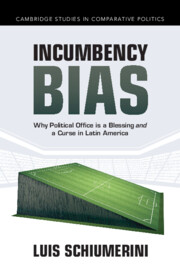
The conventional wisdom in political science is that incumbency provides politicians with a massive electoral advantage. This assumption has been challenged by the recent anti-incumbent cycle. When is incumbency a blessing for politicians and when is it a curse? Incumbency Bias offers a unified theory that argues that democratic institutions will make incumbency a blessing or curse by shaping the alignment between citizens' expectations of incumbent performance and incumbents' capacity to deliver. This argument is tested through a comparative investigation of incumbency bias in Brazil, Argentina and Chile that draws on extensive fieldwork and an impressive array of experimental and observational evidence. Incumbency Bias demonstrates that rather than clientelistic or corrupt elites compromising accountability, democracy can generate an uneven playing field if citizens demand good governance but have limited information. While focused on Latin America, this book carries broader lessons for understanding the electoral returns to office around the world.
The traditional narrative of Europe’s first wave of democratization is that elites extended the franchise in response to revolutionary threats and reformed majoritarian electoral systems to limit rising working-class parties. This stylized account does not fit early twentieth-century South America, where democratization was driven by internal competition within incumbent parties, without strong working-class parties to contain. I study Argentina’s 1912 electoral reform that introduced elements of democracy (secret and compulsory voting) and simultaneously changed the electoral system from multi-member plurality to the limited vote. To study the motivations behind the electoral system change component of the reform package, I analyze expert surveys, legislative debates, and a 1911 public opinion poll. Granting representation to political minorities was regarded not as an electoral containment strategy to benefit incumbents, but a progressive measure to make opposition parties more competitive. An analysis of roll-call votes shows that legislators who supported the reform were those expecting to not be adversely affected.
In the Introduction, we define a coup d’état as the unconstitutional replacement of the incumbent executive by military officers or civilians supported by the armed forces, an act that is often accompanied by the suspension of civil guarantees and liberties as well as the nullification of legislative power. We then provide an overview of the economic underpinnings of twentieth-century Latin America and describe the main characteristics of the Cold War in the subcontinent (from the role of the US to the impact of Cuba’s integration into the socialist bloc, from the changing role of the military as an institution to the Doctrine of National Security). We examine the role of the Catholic Church, one of the key actors during this period, in political stability. We close by offering two possible ways to read this book, taking advantage of the comparative framework that its structure offers. Our collective goal in this volume is to explain the end of an era – the Cold War – that conditioned the subcontinent’s transition to democratic regimes, regardless of whether subsequent governments have slanted neoliberal or neo-populist.
The Afterword provides an overview of the different cases and identifies points of convergence and divergence, or of “lumping” and “splitting.” It offers a second reading of the book, one that does not get bogged down in rehashing each case but rather offers a consideration of the whole, providing new ways of thinking about the lessons that can be derived from the previous chapters. It explores the advantages and shortcomings of the various approaches, and helps the reader take away from the volume big and challenging questions for further research.
The history of Guatemala is, sadly, one of Latin America’s richest in coups d’état and bloody civil wars. This chapter analyzes the processes that combined to result in Efraín Ríos Montt’s bloodless coup against Romeo Lucas García in 1982. In the 1970s, the military fought rural guerrillas while expropriating peasants of their land to benefit new landowners from the officer corps. In the cities, the military assassinated numerous leaders of political, union, and student movements. As the Comité de Unidad Campesina attempted to unite indigenous peasants and poor ladinos, the military responded with repression. In this context, the Partido Guatemalteco del Trabajo became less important than the Ejército Guerrillero de los Pobres and the Organización Revolucionaria del Pueblo en Armas. The military unleashed a counteroffensive in 1981, supported by Israel, as the US government, under Jimmy Carter, had less tolerance for human rights violations. Under the pretext that peasants were arming themselves to fight the guerrillas, Ríos Montt led a group of junior officers in the overthrow of Lucas García, who had lost legitimacy in the eyes of soldiers. The coup initiated a new strategy against the guerillas and promoted Evangelical Protestantism to marginalize progressive elements in the Catholic Church.
On June 27, 1973, Juan María Bordaberry, the democratically elected president of Uruguay, dissolved the general assembly and remained in office, sharing executive power with the military command. Uruguayans mention this date when asked when was the last coup d’état in their country. However, political and social actors have long disagreed over the exact meaning of this event and few would now reject that it was just one, albeit final and dramatic, step in a relatively long path toward authoritarianism. Things were different after that date in terms of state institutions as well as freedoms and rights for the citizenry, but many analysts have shown that most of these changes were in the making since at least 1968, when Jorge Pacheco Areco took power and governed under repressive measures of exception. A more recent body of literature has gone further back in time to show the importance of previous steps that aligned national politics with the polarized order of the Cold War. This chapter aims at offering a plausible narrative of what happened in the fifteen years before the date of the coup, combining basic historical facts with the changing interpretations that placed and displaced meaning and importance among them.
This chapter examines the coup d’état carried out by General Juan Velasco Alvarado in 1968, a coup that radically differed from the series of military takeovers in the Southern Cone of South America during the height of the Cold War. It seeks to analyze the causes that led to the coup, its principal objectives, and how the United States, in particular the Nixon administration, responded to Peru’s challenge to relations with the US. It further addresses a series of questions such as who the coup makers were, what their social backgrounds were, and what kind of resistance the new regime faced in what became, over the next several years, a radical effort to transform one of the most tradition-bound countries in Latin America in order to modernize it and bring it into the twentieth century.
On March 11, 1973, after seven years of de facto government, Argentina celebrated its return to democracy in an electoral act that seemed to announce a new era. Although the alternation between the military and civilians was not unprecedented, two things led many to assume that coups were being left behind forever. First, after years of proscription, clean elections had led the Peronist movement to the government. Second, the new leader, after eighteen years of exile, was the founder of that movement, Juan Perón. “They’re leaving and never coming back!” – referring to the military – was the chant with which demonstrators celebrated the transfer of power and change of regime. Less than three years later, however, on March 24, 1976, a new military coup broke the constitutional order, with no resistance from either the armed forces or civil sectors. This chapter analyzes the main causes, internal and external, that enabled the military’s return to power. Based on the role played by the most relevant political and social actors, the chapter explains the conditions that made it possible for what was considered buried in 1973 to appear as the only way out in 1976, at least to numerous civil sectors.