To save content items to your account,
please confirm that you agree to abide by our usage policies.
If this is the first time you use this feature, you will be asked to authorise Cambridge Core to connect with your account.
Find out more about saving content to .
To save content items to your Kindle, first ensure no-reply@cambridge.org
is added to your Approved Personal Document E-mail List under your Personal Document Settings
on the Manage Your Content and Devices page of your Amazon account. Then enter the ‘name’ part
of your Kindle email address below.
Find out more about saving to your Kindle.
Note you can select to save to either the @free.kindle.com or @kindle.com variations.
‘@free.kindle.com’ emails are free but can only be saved to your device when it is connected to wi-fi.
‘@kindle.com’ emails can be delivered even when you are not connected to wi-fi, but note that service fees apply.
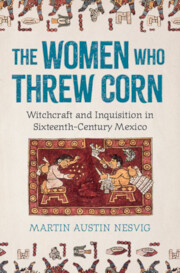
This book tells the stories of women from Spain, North Africa, Senegambia, and Canaries accused of sorcery in sixteenth-century Mexico for adapting native magic and healing practices. These non-native women – the mulata of Seville who cured the evil eye; the Canarian daughter of a Count who ate peyote and mixed her bath water into a man's mustard supply; the wife of a Spanish conquistador who let her hair loose and chanted to a Mesoamerican god while sweeping at midnight; the wealthy Basque woman with a tattoo of a red devil; and many others – routinely adapted Native ritual into hybrid magic and cosmology. Through a radical rethinking of colonial knowledge, Martin Austin Nesvig uncovers a world previously left in the shadows of historical writing, revealing a fascinating and vibrant multi-ethnic community of witches, midwives, and healers.
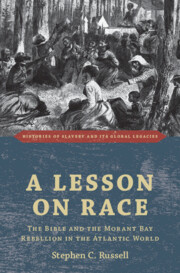
Stephen C. Russell tells the story of the Bible's role in Jamaica's 1865 Morant Bay rebellion and the international debates about race relations then occupying the Atlantic world. With the conclusion of the American Civil War and arguments about reconstruction underway, the Morant Bay rebellion seemed to serve as a cautionary tale about race relations. Through an interdisciplinary lens, the book demonstrates how those participating in the rebellion, and those who discussed it afterward, conceptualized events that transpired in a small town in rural Jamaica as a crucial instance that laid bare universal truths about race that could be applied to America. Russell argues that biblical slogans were used to encode competing claims about race relations. Letters, sermons, newspaper editorials, and legal depositions reveal a world in the grips of racial upheaval as everyone turned their attention to Jamaica. Intimately and accessibly told, the story draws readers into the private and public lives of the rebellion's heroes and villains.
This chapter lays out the geographical context in which the political dynamics explained in this book take place and examines how, in these areas the relevance of party ground-level organizations has vanished while brokers – leveraging their personal relationships with neighbors and politicians – have gained substantial social and political influence. It describes the Conurbano Bonaerense in Argentina and uses historical analysis, descriptive statistics, and qualitative fieldwork data to show the evolution of political links to areas of segregated vulnerability. It explains that, in response to the problems faced in these areas, citizens seek solutions within their own neighborhoods and communities. This process of territorialization of politics results in the increased importance of neighborhood political brokers. The distribution of state resources through the personal networks of brokers has replaced party organization in vulnerable neighborhoods where the demand for resources is almost boundless. The chapter argues that local candidates, including mayors and council city members, regardless of their political affiliations, soon realized that their chances of winning elections were higher if they had a network of brokers active in every poor neighborhood in their municipalities.
This chapter explores the commodification process through which Peronist brokers started to demand payment for their political services, downplaying party loyalties and ideological preferences. Qualitative evidence and descriptive statistics are used to demonstrate how three factors influence this process in the municipalities of the Conurbano Bonaerense in Argentina: Poverty makes brokers crucial channels for politicians to meet the demands of the territory; the brokers themselves are affected by poverty and informality; and party leaders are increasingly detached from party ideology, weakening the party’s traditional structures. The chapter argues that this commodification has exposed the Peronist Party to competition from other parties willing to recruit its brokers. It also outlines the average fees brokers charge for various political services, illustrating this process.
This chapter uses the story of a Peronist broker mobilizing electoral support in an Argentine slum for the center-right coalition Cambiemos – the opposition to the Peronists – to introduce the central questions of this book: Why do parties rely on brokers to reach voters in slums? How can challenger parties recruit brokers to credibly compete with, and beat, hegemonic machine parties in impoverished districts? Why would brokers switch to work for a nonmachine party? The case of Cambiemos’ 2015 victory over Peronism in poor municipalities in Argentina offers valuable insights into how parties can unexpectedly challenge entrenched machine parties in democracies in the Global South and under what conditions brokers might change their party affiliation.
Chapter 4 delves into the role of political brokers, referred to as punteros or referentes in Argentina, who are central figures in local political dynamics. The chapter is based on ethnographic research and provides a detailed description of these political actors, highlighting their skills and the resources that enable them to gain influence in their neighborhoods. Brokers function as key operatives for political parties, performing essential tasks throughout the year, not just during election periods. Their roles include the distribution of public goods and services, as well as the implementation of state programs in underprivileged areas. During election campaigns and on election day, brokers are not only engaged in clientelistic activities but also participate in traditional campaign efforts like canvassing and overseeing polling stations. The chapter shows that brokers, not parties, hold the resources and skills to connect with the poor. It underscores the pivotal role that brokers play in both the governance and electoral strategies of political parties, making them indispensable actors in the local political landscape.
This chapter offers the final remarks. First, it recapitulates that slums and vulnerable neighborhoods’ spatial segregation compels their residents to seek out brokers who can facilitate their access to state resources. Machine parties excel in recruiting brokers to connect with voters in pockets of poverty, with the Peronist Party (PJ) in Argentina, the Institutional Revolutionary Party (PRI) in Mexico, and the Indian National Congress (INC) in India traditionally viewed as classic examples. However, this book challenges the conventional perception of these parties by demonstrating that segregated vulnerability imposes conditions on any party seeking electoral competitiveness in these areas. Specifically, it details how challengers to the PJ, PRI, and INC developed their networks and ultimately disrupted the long-standing dominance of these machine parties. This chapter reviews how the book challenges the notion that some parties are inherently more machine-based than others. Second, the chapter recalls that it is misleading to assume that the disappearance of brokers would necessarily benefit the poor. The root of clientelism and its associated issues lies not in the existence of brokers but in the segregated vulnerability and isolation of these territories – in essence, poverty shapes politics. This perspective reframes the role of brokers as a response to structural conditions rather than a cause of political dysfunction.
This chapter presents the theoretical argument and the contributions of the book to the existing literature on clientelism, machine parties, and party adaptation. It offers a novel perspective on how strong competitors to dominant machine parties emerge in impoverished districts. Challenging parties can defy hegemonic machine parties, not by altering their policy programs, but by recruiting brokers to compete for the votes of the poor. Brokers’ commodification and machine parties’ factionalism can provide challengers with the opportunity to build their own broker networks to compete with machine parties. In the Global South, it is not economic development but rather poverty and vulnerability that can create the conditions for the rise of party competition against dominant machines.
This chapter uses qualitative and quantitative evidence to demonstrate that internal strife among the Peronist Party’s candidates was crucial in Cambiemos’ rise to power in Argentina in 2015. These divisions even paved the way for Cambiemos to secure the executive positions in eleven of the thirty-three municipalities in the Conurbano Bonaerense, a traditional Peronist stronghold. Peronist infighting benefited Cambiemos in two ways: First, it weakened the electoral competitiveness of Peronist mayoral candidates; second, it left defeated Peronist brokers from the primaries available for recruitment by the opposition. Cambiemos’ local candidates capitalized on this opportunity, building their own networks to challenge Peronist candidates in poor municipalities.