To save content items to your account,
please confirm that you agree to abide by our usage policies.
If this is the first time you use this feature, you will be asked to authorise Cambridge Core to connect with your account.
Find out more about saving content to .
To save content items to your Kindle, first ensure no-reply@cambridge.org
is added to your Approved Personal Document E-mail List under your Personal Document Settings
on the Manage Your Content and Devices page of your Amazon account. Then enter the ‘name’ part
of your Kindle email address below.
Find out more about saving to your Kindle.
Note you can select to save to either the @free.kindle.com or @kindle.com variations.
‘@free.kindle.com’ emails are free but can only be saved to your device when it is connected to wi-fi.
‘@kindle.com’ emails can be delivered even when you are not connected to wi-fi, but note that service fees apply.
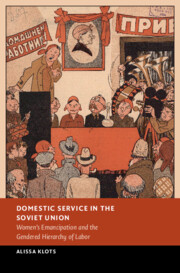
This innovative study is the first to explore the evolution of domestic service in the Soviet Union, set against the background of changing discourses on women, labour, and socialist living. Even though domestic service conflicted with the Bolsheviks' egalitarian message, the regime embraced paid domestic labor as a temporary solution to the problem of housework. Analyzing sources ranging from court cases to oral interviews, Alissa Klots demonstrates how the regime both facilitated and thwarted domestic workers' efforts to reinvent themselves as equal members of Soviet society. Here, a desire to make maids and nannies equal participants in the building of socialism clashed with a gendered ideology where housework was women's work. This book serves not only as a window into class and gender inequality under socialism, but as a vantage point to examine the power of state initiatives to improve the lives of household workers in the modern world.
This Element examines the emergence of comprehensive plague management systems in early modern France. While the historiography on plague argues that the plague of Provence in the 1720s represented the development of a new and 'modern' form of public health care under the control of the absolutist monarchy, it shows that the key elements in this system were established centuries earlier because of the actions of urban governments. It moves away from taking a medical focus on plague to examine the institutions that managed disease control in early modern France. In doing so, it seeks to provide a wider context of French plague care to better understand the systems used at Provence in the 1720s. It shows that the French developed a polycentric system of plague care which drew on the input of numerous actors combat the disease.
This article analyses the self-perceived health of the population surveyed by the European Health Interview Survey (EHIS), with 316,277 observations. The main novelties of this research are: first, we use the econometric technique of quantile regression, which will allow us to distinguish the respondent’s income level. Second, the personal, social, lifestyle and macroeconomic context dimensions of the respondents are considered simultaneously as determinants of self-perceived health. In this way, we will be able to see what the determinants of health are, and whether they vary with income. Finally, it is evident that there are indeed different responses to the same stimulus depending on the level of income, especially in the elasticity of the response, seeing how the higher the income, the more or less the same stimulus influences a person. In addition, it is established that age, nationality and employment status are the most influential variables in self-perceived health.
This article seeks to rethink the nature and significance of the fortnightly magazine Private Eye during its first two decades. Existing accounts have interpreted it almost exclusively through the lens of the “satire boom” (1961–63), and suggest that, in the final analysis, the magazine neither desired nor advanced any substantial critique of the political status quo. Besides neglecting its investigative facets, among other elements, these readings make the mistake of seeking to frame the significance of the magazine in conventional ideological terms. This article puts these neglected elements back into the picture and argues that the magazine is best understood as enacting a militant form of the kind of cynicism—at once outrageous and morally outraged—analyzed by Peter Sloterdijk and Michel Foucault, and other scholars in their wake. This provides a much more satisfying account of the many facets of Private Eye as these evolved during the 1960s and 1970s, including its affinities with various currents in postwar journalism and countercultural expression. Above all, it allows us to recast the politics of Private Eye as a form of moral protest that was expressed in the assumption of an intrinsically antagonistic relation toward “politics” and authority per se.
Security measures aimed at the repression of corsairing continued apace in the wake of 1816. ‘Barbary piracy’ remained a subject of negotiation and cooperation during the late 1810s and early 1820s. It was dealt with at ambassadorial conferences in London, during meetings of the Congress of Aix-la-Chapelle (Aachen), in combined talks with the Ottoman Porte, and through an Anglo-French expedition to the coasts of North Africa. Increasingly ambitious efforts to enact maritime security and an increasingly vocal opposition to such efforts marked the eight years following the Anglo–Dutch bombardment of 1816. The authorities of the regencies managed to thwart several European security practices, ranging from concerted communications to defensive alliances. To understand the starts, stops and reversals of the fight against Mediterranean piracy, local activity needs to be analysed. This chapter foregrounds the role of actors who were deemed piratical threats. The contestations of these threatening actors influenced the shape and success of European security practices.
The purpose of the article is to determine the degree of influence of international migration issues on the process of transformation of European identity and to assess the prospects for applying this experience in the countries of Central Asia. The methodological base of the study was built on the basis of a combination of methods of structural-functional, comparative, institutional analysis and forecasting with elements of a descriptive method. The results of the scientific work consist of characterizing the concept of European identity and the main problems of its development in connection with the intensification of migration processes in the world, formulating the features of the incorporation and integration of foreign citizens in the EU states, as well as highlighting the principles and norms used by members of the Commonwealth to regulate migration flows. The materials of this work can be applied in research and applied fields: the article can be useful for scientists whose interests include the formation and development of regional identity in a globalized world, as well as the topics of migration processes and linguistic, cultural and social adaptation of immigrants.
The creation of a new order of security in the Mediterranean revolved around shared conceptions of threat and a common apparatus of cooperative repressive practices. This conclusion explains how the repression of ‘Barbary piracy’, which European contemporaries perceived as one of the most urgent and persistent threats to security, was used to bring significant changes to the traditional diplomatic and maritime practices of the Mediterranean region. In fact, the fight against this imputed piratical threat fostered new ideas of the Mediterranean as a regional whole that could be rendered secure through policing efforts and imperial interventions. As a result, the political appearance of the Mediterranean Sea and its shorelines changed profoundly between 1815 and the closing years of the 1850s, when the Mediterranean seemed perfectly secure from piratical threats.
The Anglo-Dutch bombardment of Algiers on 27 August 1816 indicated how, after the Congress of Vienna, a new order based on collective security was taking shape, not just on the continent, but also in the Mediterranean Sea. This chapter suggests that 1816 was a moment of departure from past traditions and signified the creation of a new Mediterranean order. Defining features of that order – such as modes of cooperation, the linkage to the Congress System, the use of security as a legitimizing discourse and the important roles of smaller and non-European powers – all came into play during the Anglo–Dutch bombardment. Additionally, this Anglo–Dutch cooperation shows how various states took the lead in the fight against piracy, dependent upon the situation. There was not a single naval hegemon who executed the repressive effort. At this early stage, smaller powers initially drove the repression of ‘Barbary piracy’, later to be followed by Great Britain, Russia and France. The effort became a truly pan-European reorganisation of security in the Mediterranean.
In order to appreciate the imperial impact of the new security culture, the French invasion of Algiers in 1830 ought to be seen within the framework of the post-1815 Congress System and the Concert of Europe. Though the invasion of Algiers was essentially a unilateral action undertaken under the national flag, it nevertheless took shape through extended multinational deliberation and involved a fair share of diplomatic concertation among the different European Great Powers. French imperial aspirations became intertwined with the repression of Mediterranean piracy, which was understood as a shared, European project. In attacking Algiers, members of the French government sought to reassert the country’s position as a nation on par with the other Great Powers of the European continent. The conflict with Algiers allowed French officials to assert status through the much more ‘disinterested’, ‘European’ goal of ending piracy and bringing security to the Mediterranean Sea.
The Congress of Vienna in 1814–1815 delineated territorial settlements, coronated several newly independent monarchs and resulted in an official declaration on the abolition of the slave trade, but it did not treat the issue of piracy. This paradox is the key concern of this chapter. Vienna’s Final Acts were the end product of these talks, and though they did not mention ‘Barbary piracy’, their conclusion would nevertheless have a great impact on the international treatment of this newly perceived threat to security. The years 1814–1815 were an important turning point because they initiated a period of transition. The congress created an international context in which North African corsairing could be reconceived as a threat to security. This new perception of threat hinged upon misconceptions of the supposed fanaticism and irrationality that allegedly characterised North African privateering. It also disregarded the long history of diplomatic and commercial contact between both sides of the Mediterranean Sea.