To save content items to your account,
please confirm that you agree to abide by our usage policies.
If this is the first time you use this feature, you will be asked to authorise Cambridge Core to connect with your account.
Find out more about saving content to .
To save content items to your Kindle, first ensure no-reply@cambridge.org
is added to your Approved Personal Document E-mail List under your Personal Document Settings
on the Manage Your Content and Devices page of your Amazon account. Then enter the ‘name’ part
of your Kindle email address below.
Find out more about saving to your Kindle.
Note you can select to save to either the @free.kindle.com or @kindle.com variations.
‘@free.kindle.com’ emails are free but can only be saved to your device when it is connected to wi-fi.
‘@kindle.com’ emails can be delivered even when you are not connected to wi-fi, but note that service fees apply.
Latinx children’s and young adult literature offers Latinx children opportunities to step into another world and also see themselves represented in what they read. By giving Latinx child readers, in particular, worlds unlike and like their own, authors like Lilliam Rivera, Edwidge Danticat, and Marcia Argueta Mickelson also challenge dominant national narratives about Latinx experiences in the United States. In the stories these writers tell, young protagonists are confronted by various symptoms of US imperialism, such as racism, xenophobia, and homophobia. The protagonists’ journey often includes learning more about the oppressions that plague them and their communities and finding ways to dismantle said oppressions. Recognizing the role that the United States had in the forced (im)migration of many people of Latin American descent allows for a narrative shift away from the “immigration story” to a story of US imperialism and its consequences. Examining race and empire in Latinx children’s literature creates possibilities for alternative ways of knowing and existing where Latinx children can step in and out of worlds unlike and like their own.
This chapter looks at the interplay between Latinx literature written in Spanish or English, and discusses translanguaging and the complexities of translating an accented or bilingual text into either Spanish or English. The chapter also discusses the vicissitudes of self-translation and the global dimension of Latinx literatures as well as the translation of Latinx literature into languages other than English or Spanish, specifically into German. These aspects of translation promote a reading of Latinx literature beyond the merely representational, highlighting the critical roles of cultural production, distribution, and the literary marketplace instead.
Some key dates in recent US history help us understand the paths of Latinx literature since 1992. This chapter considers five key years: 1992, 1994, 2001, 2008, and 2016. The Columbian quincentenary catalyzed decolonial thinking as writers think about the shared histories of colonization that unite Latinx groups. The events of 1992 help frame NAFTA’s 1994 enactment as a form of neocolonialism that rewrote the terms of national belonging. 9/11 further tears the social order asunder as the US violently reacted. While some writers provide accounts of the persistent grief and trauma experienced by Latinxs after 9/11, others critique US militarism and consider Latinx complicity in state violence. Ramón Saldívar poses the election of Barack Obama in 2008 as inaugurating a period in which Latinx writers turn to speculative forms to articulate new racial imaginaries. If Obama’s election produced possibility, the 2016 presidential election stimulated Latinx writers to contest the administration’s anti-immigration policies, while other writers examine the white supremacy that underlies the administration and festers in some quarters of Latinidad.
This chapter examines an array of antebellum American literary texts for their constructions of working- and middle-class identities during the emergence of market capitalism. While establishing historical and cultural context for a number of popular novels published in the early 1850s, this case study compares the middle-class discourses of moral reform and individual responsibility expressed in conventional novels like The Old Brewery (1854) and the working-class discourses of artisan republicanism and cross-racial sympathy in sensational novels like Hot Corn (1854) and Walt Whitman’s recently discovered serial Life and Adventures of Jack Engle (1852). The analysis reveals the ways that class-accented sensational novels develop a counternarrative to American exceptionalist ideology that was championed by the middle class through documenting the impact of larger socioeconomic forces on the lived experience of the working poor, challenging prevailing stereotypes leveled against the white working classes, and insisting that class matters.
Critical eating studies provides an important framework for understanding the construction of whiteness. This methodology allows literary critics to trace the material history of food, its marketing as well as its production, and the metaphorical valence of the body politic. Because of the tense relationship between white racial ideals and bodily pleasure, US literature often juxtaposes purity politics with the desirous, hungering body. This chapter gives an overview of major scholars at the intersection of food, literature, and race (Doris Witt, Anita Mannur, Kyla Wazana Tompkins) as well as readings of works by Toni Morrison, James Baldwin, F. Scott Fitzgerald, and Vladimir Nabokov that feature whiteness as an ideal impossible to embody and food as a challenge to its ineffability. Contemporary foodie culture reveals the appropriative impulses of whiteness, while satires by Ben Lerner and Jordan Peele perhaps show the way to bite back against the reign of biopolitical purity.
This chapter provides an overview of the emergence of a body of literature that emplots Indigenous material realities and forms of knowledge into Latinx literature’s representational horizon. These texts mark a significant transition, moving away from an understanding of Latinx identity rooted in a mythological Indian past, and focusing instead on a diverse array of issues grounded in Indigenous identities, experiences, and epistemologies. These include explorations of the liberatory potential in transnational feminist solidarities, the thematization of contemporary manifestations of settler colonialism, the foregrounding of land-based knowledge, and the celebration of the creative power and insurgent force of the erotic. Focusing on works by Graciela Limón, Kali Fajardo-Anstine, Natalie Diaz, and Alan Pelaez Lopez, the chapter argues that these writings collectively depict Latinx Indigeneity at the intersections of race, gender, sexuality, and colonialism, raising complex issues with respect to overlapping and ongoing histories of colonization and fostering an opportunity for centering Indigenous experiences while interrogating the multiracial character of Latinidad.
This chapter attends to Valeria Luiselli’s Lost Children Archive (2019) as an exemplary text in the burgeoning corpus of Latinx solidarity narratives in the United States in the twenty-first century. The chapter focuses on the narrative innovations that Luiselli orients toward the task of envisioning new terms for pan-ethnic solidarity. The chapter shows how, at a time of renewed Latinx literary attention to the experiences of Central Americans fleeing violence in the isthmus, Lost Children Archive stylizes a narrative of pan-ethnic solidarity through strategies of scrupulous narratorial self-awareness and an ethical refusal to represent the experiences of ethnic others. In spite of these innovations, however, the chapter also demonstrates how the novel reiterates and amplifies certain essentializing expressions of unity that characterize Sanctuary Movement–era narratives from the 1980s and 1990s.
This chapter names and surveys a racially attuned subgenre of US historical fiction, the historical novel of whiteness. It studies a variety of authors from the nineteenth, twentieth, and twenty-first centuries, all of whom used the historical novel form to question the coherence and ontological status of “whiteness” as a racial concept. The essay focuses on three historically situated companies of works that epitomize the subgenre: novels of European–Native American contact from the 1820s, “color-line” novels from the Jim Crow era, and African American historical fiction from the post-1945 period. In all the novels under review, whiteness is shown to be a mutable, contingent, surprisingly unstable phenomenon, even as it is also shown to have been a powerful, all but hegemonic force throughout US history.
This book recovers an important set of American literary texts from the turn of the nineteenth century to the Civil War that focus on bodies that seem to have minds of their own. Artists such as Charles Brockden Brown, Robert Montgomery Bird, Edwin Forrest, Henry Box Brown, Elizabeth Stuart Phelps, and Herman Melville represented the evocative expressiveness of these literary bodies. With twitches and roars, flushes and blushes, these lively literary bodies shaped the development of American Literature even as they challenged the structures of chattel slavery, market capitalism, and the patriarchy. Situated within its historical context, this new story of nineteenth-century American Literature thus reveals how American literary expression-from novels to melodramas, from panoramas to magic tricks-represented less repressive, more capacious possibilities of conscious existence, and new forms of the human for those dehumanized in the nineteenth century.
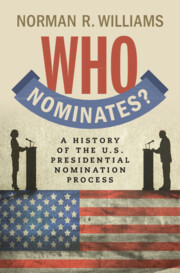
Who Nominates? is an accessible and non-partisan examination of the presidential nomination process, untangling the byzantine web of legal rules that govern modern nomination procedures in both major political parties. Beginning with the Constitutional Convention of 1787, noted constitutional law scholar Norman R. Williams traces the evolution of party rules and state laws regarding which individuals are entrusted with the power to choose the parties' presidential nominees. Only in the 1970s were ordinary voters fully included in the process, and even today, the rules governing nominations exclude or devalue a large number of voters. Williams' analysis provides context for modern debates about the role and influence of party elites, such as the Democrats' “superdelegates,” and examines how the rules governing the process today contribute to the increasingly divisive ideological polarization of presidential contests.
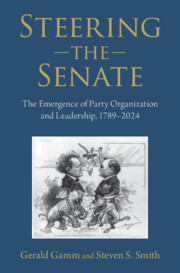
The Senate majority and minority leaders stand at the pinnacle of American national government – as important to Congress as the speaker of the House. However, the invention of Senate floor leadership has, until now, been entirely unknown. Providing a sweeping account of the emergence of party organization and leadership in the US Senate, Steering the Senate is the first-ever study to examine the development of the Senate's main governing institutions. It argues that three forces – party competition, intraparty factionalism, and entrepreneurship – have driven innovation in the Senate. The book details how the position of floor leader was invented in 1890 and then strengthened through the twentieth and twenty-first centuries. Drawing on the full history of the Senate, this book immediately becomes the authoritative source for understanding the institutional development of the Senate – uncovering the origins of the Senate party caucuses, steering committees, and floor leadership.
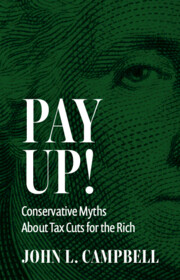
Since the Reagan era, conservatives in the United States have championed cutting taxes, especially for wealthy individuals and corporations, as the best way to achieve economic prosperity. In his new book, Pay Up!, John L. Campbell shows that while these claims are highly influential, they are also wrong. Using historical and cross-national evidence, the book challenges and refutes every justification conservatives have made for tax cuts – that American taxes are too high; they hurt the economy; they facilitate government waste; they constitute an unfair downward redistribution of income; and they threaten individual freedom – and conversely shows that countries can actually benefit from higher taxes, especially when tax increases fall most heavily on those most able to pay them. Through clear prose and a well-reasoned argument, Campbell's book provides an accessible, engaging, and much-needed perspective on the role of taxes in American society.
August Wilson was born in 1945 in the Hill District of Pittsburgh, Pennsylvania. The community where he spent the early part of his life notably served as the geographic location for nine of the ten plays in his American Century Cycle. This chapter provides historical background and cultural context for the Hill District and spotlights the ways Wilson dramatizes the specificity of the community in his plays.
Within August Wilson’s century-long odyssey, the survival of the past is symbolized through its most significant character, Aunt Ester Tyler. The mistress of 1839 Wylie Avenue, Aunt Ester represents the ingenuity and will of the African spirit to survive the horrors and the degradation of the conditions of slavery and dehumanization. This chapter teases out some of these elements of memory, illuminating how the American Century Cycle structurally signifies Passover themes, while arguing that Wilson dramaturgically deploys such cues as a strategy towards a cultural rehearsal of remembering.