To save content items to your account,
please confirm that you agree to abide by our usage policies.
If this is the first time you use this feature, you will be asked to authorise Cambridge Core to connect with your account.
Find out more about saving content to .
To save content items to your Kindle, first ensure no-reply@cambridge.org
is added to your Approved Personal Document E-mail List under your Personal Document Settings
on the Manage Your Content and Devices page of your Amazon account. Then enter the ‘name’ part
of your Kindle email address below.
Find out more about saving to your Kindle.
Note you can select to save to either the @free.kindle.com or @kindle.com variations.
‘@free.kindle.com’ emails are free but can only be saved to your device when it is connected to wi-fi.
‘@kindle.com’ emails can be delivered even when you are not connected to wi-fi, but note that service fees apply.
Realist narrative genres, such as memoir and autobiography, are the most prevalent women’s prison writing. Contemporary readers rely on these narrative elements in order to believe stories. However, when the writer disassociates during a traumatic event and does not remember details that would ground their telling in recognizable details, their narratives cannot reliably reference them. As incarcerated women authors grapple with what they’ve suffered and what they’ve done, their narratives inevitably intersect with social realities that form the background violence that created the conditions for the discrete, traumatic events of harmdoing. While carceral culture essentializes people into stagnant categories of worth – good/flawed, criminal/victim, innocent/guilty – incarcerated women’s stories show how facile these conceptions are, how much harm they cause, and that incarceration does nothing to address these issues and often actively prohibits healing.
In this paper I examine what I call an Afrogothic aesthetic inherited from Black occult traditions, the Harlem Renaissance and the Negritude movement. I argue that it is useful to read Afrogothicism through the lens of Black spirituality and the blues instead of the legacy of slavery through which it has generally been studied, as this evokes Richard Hurd’s argument of Gothicism partaking of the “terrible sublime.” Ultimately, I argue that the avant-garde American poetry movements of the 1950s develop out of this Afrogothic poetic aesthetic that begins with Black poets and novelists.
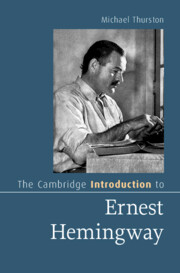
One hundred years after the publication of his first major work, Ernest Hemingway remains an important author. His work addressed the search for meaning in the wake of a 'Great War' and amid the challenges of rapidly changing social conventions, and his prose style has influenced generations of journalists and writers. Hemingway was wounded on the battlefield and caught up throughout his life in conflicting desires. He was also a deeply committed artist, a restless experimenter with the elements of narrative form and prose style. This book's detailed discussions, informed both by close formal analysis and by contemporary critical frameworks, tease out the complexity with which Hemingway depicted disabled characters and romantic relationships in changing historical and cultural contexts. This introduction is especially useful for students and teachers in literary studies and modernism.
How did women come to be seen as 'at-risk' for HIV? In the early years of the AIDS crisis, scientific and public health experts questioned whether women were likely to contract HIV in significant numbers and rolled out a response that effectively excluded women. Against a linear narrative of scientific discovery and progress, Risk and Resistance shows that it was the work of feminist lawyers and activists who altered the legal and public health response to the AIDS epidemic. Feminist AIDS activists and their allies took to the streets, legislatures, administrative agencies, and courts to demand the recognition of women in the HIV response. Risk and Resistance recovers a key story in feminist legal history – one of strategy, struggle, and competing feminist visions for a just and healthy society. It offers a clear and compelling vision of how social movements have the capacity to transform science in the service of legal change.
This paper traces the way(s) Republican political leaders have infused a right-wing populist ideology at the heart of Republican Party programs over thirty years. It does so through analysis of the institutional supports and historical factions that have shaped the evolution of the Republican Party over the last century. A change in coalition forces that control the Republican Party has encouraged the emergence of a Republican Party that holds, among other things, that some radical political actions (such as the 6 January insurrection) are legitimate, while other radical political action (such as the George Floyd protests) is not. For many Republicans in the newly dominant Trump coalition, some seemingly anti-state action is in fact legitimate when undertaken in defense of a “true” US Constitution, while other action, even when clearly legal, is inherently a threat to the “true” US Constitution.
This article explores a new generation of Caribbean writers in the early twenty-first century who wrestle with self-representations, when the model-minority myth and strategies such as wealth accumulation and property acquisition became the only forms of resistance to urban displacement possible, once the equity structures that were hard won by the civil rights movement were dismantled. Specifically, I explore the affordance of the romance novel genre in Olga Dies Dreaming (2022) and Neruda on the Park (2022) to discuss this dilemma between confrontational struggle and assimilation. Ultimately, this article illustrates a shift in Latinx literature toward historically commercial genres that have become key cultural spaces to discuss pressing contemporary political themes.
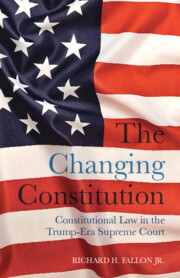
In The Changing Constitution, Richard H. Fallon Jr. explores the constitutional law of the United States as reflected in decisions of the Supreme Court, including recent blockbusters. The author analyses controversial rulings addressing topics such as freedom of speech and religion, the Second Amendment right to bear arms, abortion, affirmative action, gay rights, and the powers and prerogatives of the President. Examining modern controversies from a historical perspective he argues that it's impossible to understand U.S. constitutional law without recognizing the political and institutional forces that always have brought, and will continue to bring, innovations and occasional reversals in constitutional doctrine. Fallon also highlights distinctive aspects of the current era, including the judicial philosophies of the sitting Justices. This intellectually sophisticated overview of constitutional law and Supreme Court practice additionally discusses anxieties about whether and how the Justices, who can overrule their own precedents, are meaningfully constrained by law.
How do adults form preferences over education policy? Why do Democrats and Republicans disagree about how schools should work and what they should teach? I argue that public opinion follows a “top-down” model, in which rank-and-file voters largely adopt the positions of prominent national leaders in their parties. This causes policy preferences to become polarized. I illustrate these dynamics with four case studies: (1) public opinion toward school reopening during the COVID-19 pandemic; (2) debate about Common Core education standards; (3) voting behavior on a 1978 California initiative that sought to ban gay teachers; and (4) voting behavior on a 1998 California initiative that banned bilingual education in that state.
In the final analysis, James and a cohort of literary modernists fractured the abstraction known as “the public” by showing that it is composed of individuals, each with their distinctive mental lives and social roles. The modernist ethic of radical empiricism holds that everyone has a responsibility to test their beliefs against reality and to seek multiple perspectives from sources that are accountable to the truth. James’s life’s work, along with that of later modernists who dramatized the productive varieties of dissociative experience, helped provide a scaffolding for democratic thought by exhorting readers to fortify their minds against the persuasive energy of powerful institutions and charismatic leaders. The book closes with a reflection upon our contemporary media ecology, drawing on philosopher Catherine Malabou’s concept of the brain’s “plasticity,” a term that in French encompasses both its regenerative and destructive capabilities. If we better understood these divergent mental processes and their complex neuroanatomy, we humans may be better equipped to take responsibility for our minds, and more rigorous stock of the limitations of our beliefs, our choices, and our actions.
I combine a national dataset on high-profile education culture wars – dealing with school mascots, curriculum, religion, sexuality, and evolution – with information on student achievement on standardized tests to examine how adult political conflicts impact student learning in the classroom. I show that student achievement declines after an outbreak of controversy, an effect that persists for several years and appears driven mostly by controversies involving evolution and race. In addition to a large-N, “difference in differences” analysis, the chapter provides two detailed case studies, over a controversial school mascot in California and a federal court case involving a Pennsylvania’s district policy to teach intelligent design.
This chapter surveys current doctrine concerning the scope of Congress’s regulatory, taxing, and spending powers. The Court’s historic pattern of decisions both presents a study in constitutional change and illumines factors that sometimes make change difficult. Prior to the Great Depression and the New Deal, the Court struggled uncertainly to cabin Congress’s powers under Article I. But the Court, seemingly in response to political pressures, substantially abandoned that effort in 1937, when it began to interpret the Commerce Clause as giving Congress vast powers to regulate the national economy and the Taxing and Spending Clause as allowing it to create largesse-dispensing programs that the Founding generation could not have imagined. At least since the 1980s, a strain of conservative scholarship has maintained that the modern, swollen national government finds no justification in the original Constitution and that the Court should enforce the original design. This chapter traces the Court’s limited success in implementing a course correction and identifies the considerations that have given pause to conservative justices. It also describes the Court’s more aggressive efforts to limit congressional power under the Thirteenth, Fourteenth, and Fifteenth Amendments, all of which include express authorizations of Congress to “enforce” their substantive guarantees.
Against the rise of fascism, American literary modernists confronted the psychodynamics of conversion that underlie pernicious forms of conspiracism and racist public discourse. William Faulkner’s Light in August (1932) and Jean Toomer’s unpublished writings on racial psychology, for example, reverse-engineer the psychodynamics of racism by putting readers in the uncomfortable position of seeing themselves from the point of view of the other (whether a literary text or another human being). Forcing a kind of double consciousness upon the reader, Faulkner and Toomer provoke disgust toward conspiracism’s self-appointed vigilantes. The paranoid public sphere is thus the diametrical opposite and sinister shadow of the pluralistic public sphere that James theorized. By fracturing and fragmenting the monolith of race, Faulkner and Toomer render epistemological doubt a powerful ally to critical thought.
In response to First World War propaganda campaigns and the emerging science of behaviorist psychology, which downplayed or even denied the existence of “mind” (understood as an agency directed by human cognition and will), American modernists performed the mind in and as writing: as a potentiating agent of mental plasticity to reshape habits, modifiy beliefs and behaviors, and dramatize the strategies by which consent is “manufactured.” An American modernist literary “aesthetics of exposure” sought to arrest habitual thought by exposing the behaviorist strategies of conditioning behavior and regimenting beliefs. The major works examined in this chapter – Ernest Hemingway’s A Farewell to Arms (1929) and John Dos Passos’ the U.S.A trilogy (1936) – deploy strategies of psychological and textual fracture and fragmentation in order to make state-sponsored propaganda technique visible and available for critique.
Chapter 2 locates the history of firearms litigation over the past sixty years as a progression through four distinction waves, in the context of the arc of mass tort litigation. The chapter surveys initial gun litigation in the 1960s–1970s based on conventional tort theories sounding in negligence and product defect, noting that virtually all these lawsuits failed. During the 1980s and 1990s, firearms litigation followed the mass tort pattern of attempted aggregation of claims, but courts still did not allow these suits to progress. The second wave of firearms litigation occurred in the early twentieth century, following the 1998 tobacco Master Settlement Agreement. This new litigation model was based on governmental entity lawsuits seeking redress for communities harmed by gun violence. The third wave of gun litigation occurred after Congressional enactment of PLCAA in 2005. Plaintiffs in these PLCAA suits sought relief under PLCAA’s six exceptions. These suits also largely failed to gain traction. And the fourth and current wave of firearms litigation post-2019, after the successful Sandy Hook litigation, is being pursued by state attorneys general under new, targeted consumer protection and public nuisance accountability statutes.
Humor functions as a form of civic engagement and social protest in Zora Neale Hurston’s Moses, Man of the Mountain (1939) and Gertrude Stein’s Mrs. Reynolds (1947), novels that respond to the rise of fascism with complex satire. Despite a common view of Hurston and Stein as either apolitical or conservative, both authors reveal a keen understanding of conversion’s historical legacy in the justification of imperialism. The point both Hurston and Stein make is that humorous incongruity keeps the mind turning and, in the process, forestalls the “settling” of thought into place and “the fixation of belief” associated with totalitarianism. As outsiders for whom conversion—religious or secular—could mean a form of psychic death, they developed distinctive modes of ironic humor involving self-lacerating and self-satirizing critique.
This chapter provides a preliminary sketch of the Supreme Court of the current era. It describes the distinctive political environment in which the sitting justices were appointed and in which they function. It highlights the role that a conservative legal organization, the Federalist Society, has played in vetting potential nominees and in ensuring that the sitting justices who were appointed by Republican presidents are reliably conservative in their commitments. The chapter also discusses the rise of originalism as a theory of constitutional interpretation and frames issues about the relationship between originalist methodology and substantively conservative values that will be a focus of attention through the remainder of the book. Finally, it gives introductory, capsule biographies of each of the current justices. As later chapters will elaborate, it is impossible to understand the Court’s dynamics without a grasp of how the individual justices, taken one by one, approach their jobs.
Chapter Three develops the argument in favor of strong judicial review to correct malfunctions in our electoral system. The first section analyzes flaws in our current electoral system, explaining why the market for elective office is not sufficiently competitive. The next section reviews the Warren Court’s decisions in key malapportionment cases: Wesberry v. Sanders and Reynold v. Sims. Those cases provide a helpful model for strong judicial review to correct flaws in our electoral system. The chapter then presents a critique of four election law decisions since 1976 where the Supreme Court has contributed to democratic decay by engaging in antidemocratic judicial review. The final section presents several proposals for new constitutional rules that build on the principles articulated in Wesberry and Reynolds. The proposed rules are designed to enhance competition in the market for elective office and improve the quality of democratic self-government in the United States.