To save content items to your account,
please confirm that you agree to abide by our usage policies.
If this is the first time you use this feature, you will be asked to authorise Cambridge Core to connect with your account.
Find out more about saving content to .
To save content items to your Kindle, first ensure no-reply@cambridge.org
is added to your Approved Personal Document E-mail List under your Personal Document Settings
on the Manage Your Content and Devices page of your Amazon account. Then enter the ‘name’ part
of your Kindle email address below.
Find out more about saving to your Kindle.
Note you can select to save to either the @free.kindle.com or @kindle.com variations.
‘@free.kindle.com’ emails are free but can only be saved to your device when it is connected to wi-fi.
‘@kindle.com’ emails can be delivered even when you are not connected to wi-fi, but note that service fees apply.
Chapter 1, “‘We Are Not Immune’: A New Branch of the Feminist Women’s Health Movement,” begins by describing the emergence of a new coalition of feminists who turned their attention to the HIV epidemic in an attempt to understand how the virus would impact women. Together they realized that HIV was killing women more often than the those in charge of the AIDS response acknowledged. The failure to recognize and respond to issues facing women with HIV was due, in part, to the Centers for Disease Control and Prevention definition of AIDS that did not include gynecological infections. The incomplete definition of AIDS resulted in a lack of data on women with HIV and impacted the Social Security Administration’s determinations of who should receive benefits. Allying with lawyers and fellow activists, feminists set out to challenge the law and science of the epidemic.
Chapter 2, “Litigating Risk: The Law and Politics of Disease in the Administrative State,” turns to the litigation and activism that resulted in the shift in the Centers for Disease Control and Prevention definition of AIDS and turned attention to women’s risk of contracting HIV. The chapter tracks how litigation and advocacy were central to the shift in the CDC definition of AIDS. Feminist success would result in many more women being diagnosed with HIV, resulting in a greater ability to access benefits. This life-changing shift would mark a major victory for the feminist women’s health movement.
As heterosexual sex became a driving explanation, feminist debates about sex and power took center stage in the AIDS response. At the heart of this feminist struggle is the question of sex work. Some feminists, carceral antitrafficking feminists, saw sex work as the objectification and exploitation of women. Others saw it as a site of agency and power. Chapter 5, “The Sex Wars Come to AIDS: Risk and Consent,” follows these debates as they moved into public health and the AIDS response. Sex workers were (and continue to be) among the hardest hit with HIV. They were also some of the most powerful advocates of harm reduction. Empowering sex worker communities would turn out to be one of the most reliable ways to slow the spread of HIV. But for feminists who saw sex work as exploitation, these public health interventions were aiding in the exploitation of women. Buoyed by political conservatives and the antitrafficking movement, carceral antitrafficking feminists successfully lobbied for restrictions on funding sex worker projects. The consequences were deadly.
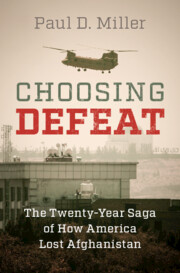
A truly unique all-embracing narrative of the American war in Afghanistan from the own words of its architects. Choosing Defeat takes an unparalleled inside look at America's longest war, pulling back the curtain on the inner deliberations behind the scenes. The author combines his own extensive experience in the Army, the CIA, and the White House, with interviews from policymakers within the Bush, Obama, and Trump administrations, to produce a groundbreaking study of how American leaders make wartime decisions. Transporting you inside the White House Situation Room, every key strategic debate over twenty years – from the immediate aftermath of 9/11, to Obama's surge and withdrawal, to Trump's negotiations with the Taliban, and Biden's final pullout is carefully reconstructed. Paul D. Miller identifies issues in US leadership, governance, military strategy, and policymaking that extend beyond the war in Afghanistan and highlight the existence of deeper problems in American foreign policy.
This Element explores misinformation as a challenge for democracies, using experiments from Germany, Italy, and the UK to assess the role of user-generated corrections on social media. A sample of more than 170,000 observations across a wide range of topics (COVID, climate change, 5G etc.) is used to test whether social corrections help reduce the perceived accuracy of false news and whether miscorrections decrease the credibility of true news. Corrections reduce the perceived accuracy of misinformation, but miscorrections can harm perceptions of true news. The Element also assesses the mechanisms of social corrections, finding evidence for recency effects rather than systematic processing. Additional analyses show the characteristics of individuals who have more difficulties identifying false news. Survey data is included on characteristics of people who write comments often. The conclusion highlights that social corrections can mislead, but also work as remedy. The Element ends with best practices for effective corrections.
In 2008, Senator Barack Obama promised to win the war in Afghanistan.Yet the story of 2009 is the story of his administration losing hope in Afghanistan. While Obama approved a new strategy in the early months of his presidency, over the course of the year it became apparent he was unwilling to pay the price his new strategy required in the face of mounting challenges. Obama then faced the need to develop an Afghanistan strategy he was prepared to execute, which turned out to be different from the vision he initially promised.
The Trump and Biden administrations have spent an enormous amount of energy blaming each other for the final collapse. Pompeo excoriated Biden in his memoir, fully blaming him and claiming the Doha agreement had nothing to do with Afghanistan’s subsequent collapse. In turn, the Biden White House released a twelve-page document in April 2023 with their version of events, placing blame on the Trump administration. In their mutual finger-pointing, they are both right: Trump signed the deal, and Biden implemented it. Trump was determined to withdraw from Afghanistan irrespective of what the Taliban said or did, weakening the United States’ diplomatic and military position to the point of collapse. Biden, despite having campaigned on a promise to undo Trump’s legacy, inexplicably followed Trump’s example and implemented Trump’s strategy. Thanks to Trump, Biden inherited an extremely difficult situation – one he managed to make even worse. He played a bad hand badly. And he did so, in large part, because when he looked at Afghanistan, he saw Vietnam.
The American and allied military presence in Afghanistan peaked between late 2010 and mid 2011. For the next ten years, the major debate in Washington was how many troops to withdraw, how quickly. The announced unilateral American withdrawal was the defining fact of the war for its final decade. Policymakers treated the debate over troop numbers as a proxy for a debate over larger goals. But there are other aspects of strategy, like reconstruction and diplomacy, that simply cannot be subsumed within a debate about troop numbers, aspects that went unaddressed during the US’s gradual withdrawal from Afghanistan. Withdrawing troops without achieving the other objectives is how the United States gradually abandoned the rest of its war aims as slowly and expensively as possible.
President Obama spent almost his entire presidency talking about withdrawing from Afghanistan, which ended up being the one thing he managed not to accomplish. Endless and repetitive strategy reviews had all come to similar conclusions – that the US should stay for the long haul and do more to rebuild Afghanistan – conclusions which Obama resisted until the logic of events forced his hand. The timetable was not the single point of failure of the Afghanistan war, nor the only driver of all the problems with Obama’s handling of it. It is, however, the most potent symbol of Obama’s war. The timetable was the product of the defeatism and cynicism that pervaded every aspect of Obama’s handling of the war even as it undermined the surge, obviated reconstruction, and hamstrung negotiations, worsening the very failures and disappointments that Obama used to justify lowering his ambitions in the first place, made all the worse by how predictable the consequences would be.
Why did the United States lose the war in Afghanistan? Only a repeated habit of decision-making explains consistent strategic miscalculation. Policymakers in every administration prioritized counterterrorism – a comparatively simple, easily defined, “realistic,” concrete mission. They subordinated broader, more ambiguous, harder-to-define, morally aspirational, long-term goals, such as counterinsurgency and nation building. Policymakers did so even though – as repeated strategy reviews showed – the Taliban and al-Qaida were linked; success in the war against either depended on success in both; and counterinsurgency and nation building were necessary, alongside counterterrorism operations, to achieve the larger goal of al-Qaida’s defeat. These policies became embedded in the US bureaucracy, ensuring the bureaucracy kept implementing bad strategy on autopilot even when policymakers and repeated strategy reviews highlighted the problem.
The Taliban insurgency happened because they enjoyed a permissive environment: safe haven in Pakistan, state failure in Afghanistan, and an America increasingly focused on Iraq. In turn, most of those had common roots in the Bush administration’s decisions in 2001: to define the conflict as a “War on Terror” best waged with a light footprint and to conflate the Taliban and al-Qaida. Some of those decisions made sense in 2001, but none of them bore scrutiny as the situation in Afghanistan changed, and the Bush administration failed to adapt quickly enough.
Did the surge work? The surge had a major impact on the military situation, reversing the Taliban’s momentum and rapidly growing the Afghan army. Yet it seems equally clear that, by the beginning of the withdrawal in July 2011 – or even by the transition in 2014 – Afghan governance had not improved enough and there was no self-sustaining psychological dynamic of growing optimism and confidence. Importantly, the military surge cannot be evaluated apart from either the civilian surge or the withdrawal timetable because they were components of a single strategy. The civilian surge largely failed, replicating many of the same problems the Bush administration had seen when it tried to ramp up assistance for governance and reconstruction. But even more consequentially, the timetable – the most distinctive aspect of the Obama administration’s war – drove so much of the implementation and the decision-making as to become the controlling dynamic of the war. Together, the timetable and the civilian failure squandered whatever military gains the surge accomplished. By 2011, the insurgency had lost momentum, but the Afghan government was no closer to victory.
The case for more aid to Afghanistan slowly gained ground from late 2002. The Accelerating Success initiative, coupled with the Bonn Process and a new Afghan Constitution, began to move reconstruction efforts in the right direction. A new reconciliation program recognized the need for a settlement with the Taliban. But enduring challenges from recalcitrant warlords, international donors, inflexible diplomacy, and a sclerotic bureaucracy counteracted whatever progress was achieved from 2003 to 2005.