To save content items to your account,
please confirm that you agree to abide by our usage policies.
If this is the first time you use this feature, you will be asked to authorise Cambridge Core to connect with your account.
Find out more about saving content to .
To save content items to your Kindle, first ensure no-reply@cambridge.org
is added to your Approved Personal Document E-mail List under your Personal Document Settings
on the Manage Your Content and Devices page of your Amazon account. Then enter the ‘name’ part
of your Kindle email address below.
Find out more about saving to your Kindle.
Note you can select to save to either the @free.kindle.com or @kindle.com variations.
‘@free.kindle.com’ emails are free but can only be saved to your device when it is connected to wi-fi.
‘@kindle.com’ emails can be delivered even when you are not connected to wi-fi, but note that service fees apply.
Around the world, Indigenous people are preparing for futures of climate uncertainty and resource shortages. Indigenous communities are looking to the past and seeking guidance from their traditions – diverse systems of knowledge that change over time – so that they and future generations might nurture connections to the “deep time” of geological and human histories. In this essay we examine how the Wangan and Jagalingou Family Council in Australia and the Agua Caliente Band of Cahuilla Indians in the United States have taken long-term views on ecological sustainability and sovereignty. We focus on these two Indigenous communities on opposite sides of the Pacific Ocean because they are among the highest-profile battles over ancient groundwater in the past decade. Set against a backdrop of global settler state interference and exploitative economic practices, both cases reveal how the concept of kinscapes – or a shared sense of relatedness to interconnected ecosystems, histories, and places (or nodes) of belonging – can sharpen our understanding of environmental stewardship and its importance to Indigenous sovereignty. Whereas mining corporations and settler governments continue to make decisions with short- to medium-term objectives in mind, Wangan and Jagalingou and Agua Caliente leaders have used legal battles over groundwater to underscore their spiritual and physical connectedness with local environments. Like Indigenous communities around the world, the Wangan and Jagalingou Family Council and the Agua Caliente Band of Cahuilla Indians are making ontological choices by asserting their sovereignty through environmental stewardship.
Harry Mathews's very short story ‘Franz Kafka in Riga’ from The American Experience (1991) presents a compact example of the complexity of aerial images in fiction. The narrator recalls a time when he ‘decided to climb these steps in order to enjoy the view to which I imagined they would bring me’. The first paragraph of the story briefly describes the castles in Riga, then, in the second paragraph, the first-person narrator describes the tricky (and embarrassing) process of ascending to the top of a tower:
I finished my ascent more or less on my hands and knees, or rather my hand and knees, with my other hand clapped on top of my head – a posture that provoked derisive laughter from my companions below, although I scarcely heard them through the shudders of dizziness that had by now begun to afflict me. When at last I reached the vantage point so laboriously striven for, I beheld, instead of Riga and the waters of the Baltic, only unbroken fog, as dingy as an old newspaper under the clouded sky.
The next paragraph transitions to sometime after the trip, when the narrator has learned that Kafka once took this same trip to Riga and describes it in his notebooks. The fourth paragraph is Kafka's quoted description, a nearly word-for-word reproduction of the second paragraph; Kafka has already written down the experience of the narrator. The narrator concludes: ‘I was angry that Kafka had rendered this experience with such unaccountable inaccuracy.’ This is a punchline, but notably the only difference in the two passages is in the first sentence. Kafka's written account omits ‘I imagined’: ‘I decided to climb these steps in order to enjoy the view to which they would bring me.’ He does not imagine beforehand the view that would be afforded by the climb.
The narrator attempts to create an image of the clear view from the tower before climbing and is disappointed. Kafka's image is deferred until after he climbs and cannot see the city, and so he creates an image of the newspaper-fog in his notebooks.
In conclusion, I want to depart a bit from my method in the rest of this book and focus on mimetic representation of technology that frames images of the view from above. While the form of environment is articulated by aerial description in similar ways as the modernist technique starting from Cather – through the aesthetics of extent, vertical imagination and unnarrated scales – the articulation differs in contemporary literature through explicit reflexive interest in the individual in relation to the view from above. Anxiety following the assertive determinacy of digital technology has motivated this reflexive turn.
The collision of the form of environment and the form of the text, as I have shown, takes place as a negation of the culture of perceptual realities in which the text is embedded. I have shown how this progressed in the twentieth century in the previous three chapters with the grid form and conceptual reductions stemming from first flight, the alienation of Western travellers in an increasingly visible non-Western world, and the sudden omnipresence of ‘whole-Earth’ images. But the theoretical orientation toward the form of environment in aerial description set out in Chapter 1 shows how my readings of fiction from Cather, Bowles and DeLillo open up new ways of interpreting this technological anxiety. Rather than products of their respective historical perceptual contexts, I have read these texts as primarily engaged with the environment through which the reader can encounter the ways it structures stories and our experiences of them.
The literary work of art is an aesthetic object that always functions as an articulation of the environment it re-implaces. I have shown in both theory and analysis how my redefinition of art and environment is apparent at the edges of criticism and fiction. By using the term ‘nonanthropocentric’ throughout this book, I have foregrounded how the literary object is constructed as a nonhuman artefact rendered using the tools humans have available. In the face of the technological progress that is the background of this book, I think that this reversal to nonanthropocentric perspectives is a challenge that we must face in order to effect change through the practice of reading and writing.
The view from above has a strange, unavoidable attraction for pinpointing the essence of epistemological and ontological relationships between humans and the world. There are three terms in the phenomenology of the view from above: the subject that sees, the object that is seen and the context that structures this encounter. It is easy to imagine the subject as human, though, materially, it is often an animal or a machine. The object can be any kind of ‘view’, from a natural feature to a human settlement. The context of this experience can be a meditation during a mountain hike, a terrified stare in flight, a bored glance from a tall building or a camera pointed vertically down at a shoreline, obliquely across a desert or moving automatically to track a target. In daily experience, the object is primary; I look down from the top of this peak and wonder at how the trees are reflected off a lake to show the scene twice. But in analysis, the context or the subject is considered primary: who sees, why and how?
In this book, I will maintain the object as the main term in my study of the view from above. But there is a twist, because I am considering the objectivity of fictional descriptions of the view from above. To do so, I am constructing a different third term: the form of environment mediated by literary images in description.
In literary and cultural criticism, the context is almost always taken for granted to be as real as the first two terms, and it is usually considered to be the ideology of dominant, globalising reflection. Only recently have critics begun to challenge this third term by developing other, nonanthropogenic definitions: Caren Kaplan in Aerial Aftermaths considers the materiality of war and Heather Houser in Infowhelm thinks about climate change. Unlike Patrick Ellis's valuable recent book Aeroscopics that details the forgotten archival responses to the popular amusements of pre-aeroplane aerial images and experiences such as balloon rides and panoramic paintings, I focus on the ways that the reading experience and the literary work of art as an object affords its own, specifically imaginary structure of the view from above and the environment implaced in it.
Alongside the frontier landscapes of the Great Plains and the Southwest in Willa Cather's novels, one expects that the descriptions of desert environments in Paul Bowles's work from another colonial frontier, North Africa, will similarly emphasise extent. In this chapter, I will highlight a more prevalent element in his fiction that is the most basic and recognisable aspect of the view from above: verticality. That a figure must obtain a focal point higher than what is described is a definitional feature of aerial description – perhaps its only essential component. The process of getting to a lifted vantage point and the phenomenology of being up high is usually effaced by the immediacy of the view that is afforded by the climb. Conventionally, the transition from low to high takes the form of representations of transportation that open up a new setting for the plot to advance, prolonging time for extended representations of interiority. Often, the representation of travel will be skipped altogether. Here I will highlight the function of transition from down below to up above, while maintaining a focus on the form of environment that structures the climb and the eventual view.
Postclassical narratology (particularly approaches that utilise cognitive science) conceptualises space by drawing equivalencies between psychological processes of perceiving space and the linguistic construction of space in narrative discourse. Similarly, Bowles criticism has developed a psychologised spatial dynamic through its repeated emphasis on interiors and exteriors in both Bowles's fiction and his symbolic proximity to the American literary canon. These systems lack meaningful theories of verticality, or what makes the view from above different from ‘grounded’ perception and its representation. In this way, conventional analyses of description emphasise the ways that description helps construct or form the narrative story logic. But by turning attention to images of the environment, it becomes clear that descriptions have an opposing effect.
If narrative theory does focus on the vertical relationship between seer and seen, it often takes for granted the significance of transportation and the trip upwards in its construction of types of narration and description.
In 1936, Willa Cather briefly introduced her essay collection Not Under Forty with a famous proclamation: ‘The world broke in two in 1922 or thereabouts.’ While this ambiguous break has been argued to refer to her personal life, literary history, American culture or as a key to her experiments with narrative form, I will offer a material account for this sense of rupture. Specifically, the early 1920s mark a change in how the environment was depicted and described in both image and language. Cather's fiction is a site in which the form of environment, aerial photography and the poetic image clash, disrupting realist narrative form and acting as the catalyst for her development as an experimental modernist. She described her work Death Comes for the Archbishop (1927) as a ‘narrative’ rather than a novel, which has cued critics to draw contrasts between the narrative structures of her earlier novels and the work after her 1923 Pulitzer Prize-winning World War I novel One of Ours. But flagging ‘narrative’ as the crucial hinge in her work over-emphasises its role as the break between her early and late works. This has resulted in a strengthening of the binary in literary criticism between narrative and description, and backgrounds descriptive technique, particularly for presenting the environment, throughout her work. In this chapter I will compare her late novel Death Comes for the Archbishop with her second novel O Pioneers! as representative of her work before One of Ours.
While not wanting to overemphasise the definitiveness of Cather's statement, I will use the early 1920s as a point from which to track the different ways the form of environment appears in her work. The shift in her descriptions of the environment – in this case the Great Plains and the Southwest – can be tracked alongside material progress in other modes of descriptive technique: specifically, the relationship between flight, aerial photography and transportation during the rapid commercialisation and popularisation of aviation in the 1920s. But rather than construct a direct, mimetic relationship between literary representation and photography, the goal here is to tease out the basic shifts in environmental imagination that are afforded by the collision between foregrounded literary description of the environment and the form of environment it expresses.
There is a commonplace that people became bored of the moon after Apollo 11 landed on its surface. Matthew Tribbe points to ‘the fact that Americans were never as keen on the moon program as current public memory and myth suggest’ and an anecdote from a 1973 essay in the New York Times Book Review by Hugh Kenner, a conversation between himself and the owner of a science fiction bookstore:
‘I wonder,’ I asked, ‘whether the classic stuff lost its bite when we got so used to the real thing. Men on the moon on everyone's home screen. Fiction couldn't keep up.’
‘On the contrary,’ Mr Jolly replied, ‘reality couldn't keep up. When your image of interplanetary adventure becomes a man in a huge white diving suit stumbling over a boulder, when you’ve lived through the excruciating real time of those slow motion excursions, then crystalline cities on Venus lose their believability.’
As it is posed here, the borders of reality began to shift for fiction writers in the late 1960s and 1970s. With expert and complex technology entering popular culture in the form of a media barrage promoting the moon shot, the basic function of representation went into question. This is one of the explanations for the drift in literary fiction from modernism to postmodernism, so posed by Brian McHale's argument that there was a shift from epistemological to ontological concerns in the mid-twentieth century, an ‘ontological shock […] of recognizing that there are other worlds besides this one’. No longer was progress headed toward opening up new ways of thinking and conceptualising the expanding world (as its space had been exhausted) it was opening up actual new worlds – spaces such as the moon. Joseph Tabbi calls the literary techniques used to express this new form of the unfamiliar the ‘postmodern sublime’.
Two images that exemplify the tensions between reality and representation during this period are the Earthrise and Blue Marble photographs, two of the few unplanned artefacts of the tightly planned NASA engineering spectacle. As Richard Lewis points out in a 1974 book about the Apollo program: ‘the story of each mission was known in advance.
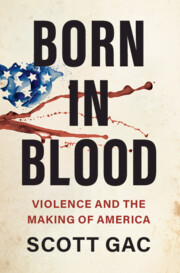
Born in Blood investigates one of history's most violent undertakings: The United States of America. People the world over consider violence in the United States as measurably different than that which troubles the rest of the globe, citing reasons including gun culture, the American West, Hollywood, the death penalty, economic inequality, rampant individualism, and more. This compelling examination of American violence explains a political culture of violence from the American Revolution to the Gilded Age, illustrating how physical force, often centered on racial hierarchy, sustained the central tenets of American liberal government. It offers an important story of nationhood, told through the experiences and choices of civilians, Indians, politicians, soldiers, and the enslaved, providing historical context for understanding how violence has shaped the United States from its inception.
Chapter 3 reveals how violent individuals and a violent state are structured in the Constitution. Here, violent, White self-determination (the right of White individuals to overthrow government) and liberalism (the systemic differences central to a liberal state) mix with republicanism (a decentralization of authority that privileges violent acts of citizens, a group most often defined as propertied, White men). In Article IV, Section 4, the Second Amendment, and the Fifth Amendment, this chapter reveals the key formulations and tensions of American violence.