To save content items to your account,
please confirm that you agree to abide by our usage policies.
If this is the first time you use this feature, you will be asked to authorise Cambridge Core to connect with your account.
Find out more about saving content to .
To save content items to your Kindle, first ensure no-reply@cambridge.org
is added to your Approved Personal Document E-mail List under your Personal Document Settings
on the Manage Your Content and Devices page of your Amazon account. Then enter the ‘name’ part
of your Kindle email address below.
Find out more about saving to your Kindle.
Note you can select to save to either the @free.kindle.com or @kindle.com variations.
‘@free.kindle.com’ emails are free but can only be saved to your device when it is connected to wi-fi.
‘@kindle.com’ emails can be delivered even when you are not connected to wi-fi, but note that service fees apply.
Seeds of Solidarity is a study of British Guiana amid a wave of Caribbean uprisings that brought modern politics to colonial spaces during the 1930s. It explores the historical power of a movement forged by people at the edges of empire during economic, political, and environmental crises. African- and Indian-Guianese youth, women, and men who worked on sugar plantations led a series of labor uprisings, despite attempts to turn these racialized communities against each other. Rather than erasing identities, their 'overlapping diasporas' signify how solidary can emerge without sameness, and how this process challenged the British Empire and reshaped Caribbean politics. This important work unites Caribbean history, African Diaspora and South Asian Diaspora studies, histories of racial capitalism and labor movements, gender studies, and the politics of colonialism and empire in the post-indenture period. It offers a model of resistance in today's era of deepening racial and economic inequality, fascism, and climate emergency.
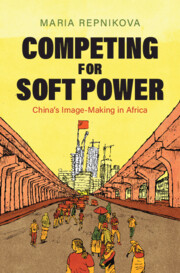
Through the critical case study of Ethiopia, Maria Repnikova examines the ambitious but disjointed display of Chinese diplomatic influence in Africa. In doing so, she develops a new theoretical approach to understanding China's practice of soft power, identifying the core mechanisms as tangible enticement with material and experiential offerings, ideational promotion of values, visions, and governance practices, and censorial power over the production and dissemination of China narratives. Through in-depth field work, including interviews and focus groups, Repnikova builds a clear picture of the uneven implementation and reception of this image-making, in which Chinese messengers can improvise official agendas, and Ethiopian recipients can strategically appropriate and negotiate Chinese power. Contrary to popular claims about China replacing the West in the Global South, this innovative research reveals the successes, but also the inconsistencies and limitations of Chinese influence, as well as the ever-present shadow of the West in mediating soft-power encounters.
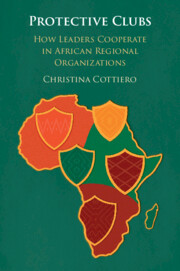
How do African leaders cooperate through regional intergovernmental organizations (RIOs) to manage political and security threats? Do the particular interests of heads of state really matter for explaining how these organizations address crises and intervene in their members' domestic affairs? Protective Clubs reveals how presidents across Africa cooperate in RIOs to protect themselves from threats, such as military coups. Cottiero argues that heads of state concerned with their personal survival often treat RIOs as bases for organizing, in essence, mutual protection clubs based on reciprocity. Leaders who cooperate and maintain 'good standing' with co-members are more likely to receive back-up during crises, while leaders who destabilized co-members are more likely to be abandoned or punished. Employing original datasets on security interventions and leader exile, interviews, and Nigerian presidential archive records, Protective Clubs shows how collusion among leaders matters not just for particular leaders, but for regional stability and democracy.
Ngugi wa Thiong'o in Context offers a compelling and comprehensive reading of the various contexts pivotal to Ngugi wa Thiong'o's practice as a writer. Ngugi drew a complex link between his role as a writer and the contexts within which his works are produced. The desire to come to terms with the past and the shifting historical process in his country is evident throughout his work. The volume shows that, for a writer whose work is steeped in biographical life experiences and historical events, context is even more special. It must be recovered through imagination and re-imagined as part of Ngugi's self-writing. One of the aims of this volume is to displace the notion of context as a reified site of retrieval and self-evident knowledge, and also to see how this sense of context offers readers of his vital writings new and disruptive ways of re-reading Ngugi's texts.
In what measure could education be an agent of African freedom? Combining histories of race, economics, and education, Elisa Prosperetti examines this question in two West African contexts, Ghana and Côte d'Ivoire, from the 1890s to the 1980s. She argues that a Black Atlantic perspective changes how we see decolonization and development in West Africa, by revealing schooling's essential role in aspirations of African emancipation. Rejecting colonial exploitation of the African body, proponents of anticolonial development instead claimed the mind as the site of economic productivity for African people. An Anticolonial Development shows how, in the middle of the twentieth century, Africans proposed an original understanding of development that fused antiracism to economic theory, and human dignity to material productivity.
Drawing on a decade of research and more than 580 interviews, this innovative political economy case study explores Rwanda's bold attempt to transform its economy after the 1994 genocide into one of the most rapidly growing countries in Africa. Pritish Behuria offers a multi-sector analysis of how globalisation and domestic politics shape contemporary development challenges. This study critically analyses the Rwandan Patriotic Front's ambitions to reshape Rwanda into a regional services hub while grappling with foreign dependency, elite vulnerability and limited financial resources. Through extensive analysis of the political economy of multiple sectors and the macro-economy, Behuria uses the Rwandan case as a window into answering why structural transformation remains so elusive on the continent. The Political Economy of Rwanda's Rise provides fresh insights into highlighting the contemporary challenges facing African countries as they integrate into the global economy. This title is also available as open access on Cambridge Core.
The story of American literature and empire goes beyond the broad historical periodization of empire to reimagine that history. The central terms American and literature have always been tied up in US empire as well as other empires in the Americas. The word 'America,' itself the product of inter-imperial intellectual rivalry, claims the name of an entire hemisphere for one country therein. To understand the full history of American literature and empire is to recognize its deep, strategically obscure, and often disavowed imperial contexts that in turn require differentially transatlantic, hemispheric, and global frameworks of analysis. This collection thus takes a sceptical stance toward its own geographical referent. Literature has a long and continuing imperial history as empire's proxy. These essays cover canonical authors such as Cooper, Melville, Whitman, and Baldwin as well as lesser-known writers, including emergent artists focused on world-making with a reparative, speculative attention to the future.
Through vibrant ethnographic storytelling, this study reveals how young women capitalise on uncertainty in Calabar, southeastern Nigeria, to realise respectable futures. Exploring young women's daily activities across different sites from the house to church, sewing shops and beauty salons, Fashioning Futures examines the complex ways in which various forms of uncertainty permeate life in a city shaped by Pentecostal fervour and patriarchal conservatism. Juliet Gilbert demonstrates how young women actively engage with forms of uncertainty such as illusion, dissimulation and fakery to present themselves as respectable urbanites and work towards marriage. Revealing young women's centrality in the construction of urban lifeworlds in contemporary Nigeria, Gilbert re-casts youthhood in Africa, both as an analytical category and as a time of experience.
This book examines a wide sweep of prominent Black and Asian British poets, from Linton Kwesi Johnson and Jean 'Binta' Breeze through David Dabydeen, Bernardine Evaristo, and Jason Allen-Paisant. Throughout, Omaar Hena demonstrates how these poets engage with urgent crises surrounding race and social inequality over the past fifty years, spanning policing and racial violence in the 1970s and 1980s, through poetry's cultural recognition in the 1990s and 2000s by museums, the 2012 London Olympics, the publishing scene, and awards and prizes, as well as continuing social realities of riots and uprisings. In dub poetry, dramatic monologues, ekphrasis, and lyric, Hena argues that British Black and Asian poets perform racial politics in conditions of spiraling crisis. Engaged and insightful, this book argues that poetry remains a vital art form in twenty-first-century global Britain. This title is also available as open access on Cambridge Core.
Alejo Carpentier in Context examines one of the greatest novelists of Latin American literature in the 20th century. The Cuban Carpentier was one of the regions firmest supporters of the Cuban Revolution yet was revealed later to have hidden important details of his biography. A polymath of encyclopedic knowledge, contributions to this book showcase his influence, not only as a novelist but also as a musicologist, writer of ballet scenarios, radio broadcaster, opera aficionado and expert in modernist architecture. This volume offers perspectives on Carpentier's concept of the marvelous real, which later morphed into magical realism, as well as on the baroque as a defining characteristic of Latin American culture. Debates focus on Carpentier's role as a public intellectual in Cuba and abroad, on new revelations about his biography and readings of his major novels, introducing ecocritical perspectives, theories of intermediality and recent philosophies of history.
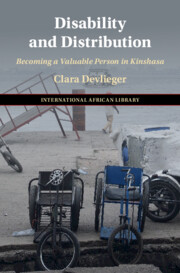
Set in the postcolonial city of Kinshasa (DR Congo), this ethnography explores how people with disabilities navigate debates about the just distribution of resources where there is little state organised welfare, and public perception of disability swings between the 'deserving' and 'undeserving'. Tracing a historic increase of disability due to polio and its long-term effects, this book examines two controversial livelihood activities that serve as informal alternatives to state support: a specialized form of international border brokerage across the Congo River, and a unique practice of bureaucratized begging that imitates state tax collection and humanitarian fundraising. Clara Devlieger examines how such activities shape ways that disabled people conceive the idea of becoming 'valuable people' in local terms: by supporting loved ones, many achieve high esteem against expectations, while adapting exclusionary models of urban personhood to include disability. Devlieger offers a new understanding of the complex dynamic between the imagined role of the state, international discourses of rights, and local experiences of disability.
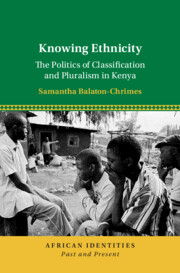
There is a widespread assumption that both ethnicity itself and ethnic conflict, are inevitable. Yet, we know very little about how ethnic identifications function in bureaucratic terms in Africa. The stakes of this problem are rapidly escalating in moves to digital identification and population knowledge systems. Focusing on Kenya, this study provides an urgently needed exploration of where ethnic classifications have come from, and where they might go. Through genealogies of tools of ethnic identification – maps, censuses, ID cards and legal categories for minorities and marginalised communities – Samantha Balaton-Chrimes challenges conventional understandings of classifications as legible. Instead, she shows them to be uncertain and vague in useful ways, opening up new modes of imagining how bureaucracy can be used to advance pluralism. Knowing Ethnicity holds important insights for policymakers and scholars of difference and governmentality in postcolonial societies, as well as African and ethnic politics.
The Messianic Jews of Ethiopia's Gambella region are Evangelical Christian Zionists who adhere to various Jewish practices and understand their faith as authentically emulating the faith of the first followers of Jesus Christ. Drawing on over a year of ethnographic research in this region, Yotam Gidron traces here the rise and evolution of Christian Zionist and Messianic Jewish faiths amongst Nuer communities in the Ethiopia-South Sudan borderlands. This study approaches processes of religious change from the perspective of believers, examining their pursuits of knowledge and transnational connectivity. In doing so, Gidron considers everyday dilemmas concerning spiritual mediation and truth, as they emerged in relation to church genealogies, Christian literacy, modes of prayer and praise, bloodlines, cattle, and the constitution of various human and divine relationships. As a result, he offers timely insights on spiritual and political life at the global margins, and on contemporary African attitudes towards Israel and the Middle East.
In the wake of the 2016 national elections in Ghana, the issue of cross-border voting triggered a nation-wide debate. But who exactly constitutes the electorate? Who is a national, who is a foreigner, and how are these distinctions identified in the Ghana-Togo borderlands? This study analyses how political belonging is constructed and how it interacts with the nation-state in the region, especially where communities lie across borders, or at another level than the nation-state. Based on archival research, interviews, oral tradition and newspaper analysis, Nathalie Raunet discusses a pattern based on legitimating narratives of indigeneity at local, regional and transnational scales. In doing so, this study offers a new interpretation of the relationship between the Ewe-speaking people (located across the south of the Ghana-Togo border), the Ghanaian and Togolese Republics, and their colonial predecessor states. Adopting an interdisciplinary approach, Nathalie Raunet connects the history of the region with contemporary power struggles and issues of belonging and citizenship since the turn of the twentieth century.
Why do some communities rise up in protest while others stay silent? In Making Protest Sarah J. Lockwood takes readers into the heart of urban South Africa – the world's so-called protest capital – to uncover the hidden figures behind modern mobilization: protest brokers. These intermediaries link political elites with ordinary citizens, enabling movements that might otherwise never ignite. Drawing on over two years of immersive fieldwork, unique life histories, surveys, and original datasets, Lockwood reveals how brokers shape where, how, and why protests happen – and why some efforts succeed while others fizzle. As a result, this study challenges how we think about activism, power, and the machinery behind social change. With important insights on democracy, protest, and the politics of everyday life, this book exposes the unseen networks driving collective actions – and why understanding them is vital in our era of rising global dissent.
The Conclusion recaps the conceptual themes of the book, emphasising the need for scholars to renew their focus upon the intertwined nature of kinship, class, and capital not only in the empirical study of capitalism on the African continent, but in anthropology where the study of kinship has veered away from questions of inheritance and property since the 1980s, a subject to which it is only now returning. It recaptures the book’s emphasis on the erosion of moral economies under conditions of land’s commodification, and the way this shapes the pauperisation of junior kin.