Refine search
Actions for selected content:
5162 results in Prehistory
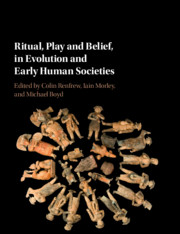
Ritual, Play and Belief, in Evolution and Early Human Societies
-
- Published online:
- 06 December 2017
- Print publication:
- 21 December 2017
Ideology, Ritual Performance and Its Manifestations in the Rock Art of Timor-Leste and Kisar Island, Island Southeast Asia
-
- Journal:
- Cambridge Archaeological Journal / Volume 28 / Issue 2 / May 2018
- Published online by Cambridge University Press:
- 04 December 2017, pp. 225-241
-
- Article
- Export citation
Glossary of Terms
-
- Book:
- Ancient China and its Eurasian Neighbors
- Published online:
- 13 November 2017
- Print publication:
- 23 November 2017, pp 229-236
-
- Chapter
- Export citation
Maps
-
- Book:
- Ancient China and its Eurasian Neighbors
- Published online:
- 13 November 2017
- Print publication:
- 23 November 2017, pp xiii-xiv
-
- Chapter
- Export citation
Charts
-
- Book:
- Ancient China and its Eurasian Neighbors
- Published online:
- 13 November 2017
- Print publication:
- 23 November 2017, pp xi-xii
-
- Chapter
- Export citation
Copyright page
-
- Book:
- Ancient China and its Eurasian Neighbors
- Published online:
- 13 November 2017
- Print publication:
- 23 November 2017, pp iv-iv
-
- Chapter
- Export citation
Figures
-
- Book:
- Ancient China and its Eurasian Neighbors
- Published online:
- 13 November 2017
- Print publication:
- 23 November 2017, pp ix-x
-
- Chapter
- Export citation
Bibliography 参考书目
-
- Book:
- Ancient China and its Eurasian Neighbors
- Published online:
- 13 November 2017
- Print publication:
- 23 November 2017, pp 237-266
-
- Chapter
- Export citation
Index
-
- Book:
- Ancient China and its Eurasian Neighbors
- Published online:
- 13 November 2017
- Print publication:
- 23 November 2017, pp 267-278
-
- Chapter
- Export citation
Chapter Two - Technoscapes and the Materialization of Ideas in Metal on the Inner Asian Frontier (c. 3000–1500 BCE)
-
-
- Book:
- Ancient China and its Eurasian Neighbors
- Published online:
- 13 November 2017
- Print publication:
- 23 November 2017, pp 35-71
-
- Chapter
- Export citation
Introduction - The Inner Asian Frontier Reconsidered
-
- Book:
- Ancient China and its Eurasian Neighbors
- Published online:
- 13 November 2017
- Print publication:
- 23 November 2017, pp 1-11
-
- Chapter
- Export citation
Contents
-
- Book:
- Ancient China and its Eurasian Neighbors
- Published online:
- 13 November 2017
- Print publication:
- 23 November 2017, pp vii-viii
-
- Chapter
- Export citation
Chapter Four - The Rise of States and the Formation of Group Identities in the Western Regions of the Inner Asian Frontier (c. 1500 to the Eighth Century BCE)
-
-
- Book:
- Ancient China and its Eurasian Neighbors
- Published online:
- 13 November 2017
- Print publication:
- 23 November 2017, pp 146-214
-
- Chapter
- Export citation
Chapter One - Shaping the Study of Inner Asian Artifacts and Mental Boundaries
-
-
- Book:
- Ancient China and its Eurasian Neighbors
- Published online:
- 13 November 2017
- Print publication:
- 23 November 2017, pp 12-34
-
- Chapter
-
- You have access
- HTML
- Export citation
Chapter Five - Final Statements/Conclusions and Future Challenges
-
-
- Book:
- Ancient China and its Eurasian Neighbors
- Published online:
- 13 November 2017
- Print publication:
- 23 November 2017, pp 215-228
-
- Chapter
- Export citation
Dedication
-
- Book:
- Ancient China and its Eurasian Neighbors
- Published online:
- 13 November 2017
- Print publication:
- 23 November 2017, pp v-vi
-
- Chapter
- Export citation
Chapter Three - Identity and Artifacts on the North Central and Northeastern Frontier during the Period of State Expansion in the Late Second and the Early First Millennium BCE
-
-
- Book:
- Ancient China and its Eurasian Neighbors
- Published online:
- 13 November 2017
- Print publication:
- 23 November 2017, pp 72-145
-
- Chapter
- Export citation
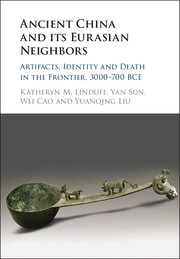
Ancient China and its Eurasian Neighbors
- Artifacts, Identity and Death in the Frontier, 3000–700 BCE
-
- Published online:
- 13 November 2017
- Print publication:
- 23 November 2017
Partnering with Pots: The Work of Objects in the Imperial Inca Project
-
- Journal:
- Cambridge Archaeological Journal / Volume 28 / Issue 2 / May 2018
- Published online by Cambridge University Press:
- 30 October 2017, pp. 243-257
-
- Article
- Export citation
Trypillia Mega-Sites and European Prehistory 4100–3400 BCE, edited by Johannes Müller , Knut Rassmann& Mykhailo Videiko , 2016. London/New York: Routledge; ISBN 978-1-910-52602-6 hardback; ISBN 978-1-315-63073-1 e-book; 19 b/w, 192 colour figs
-
- Journal:
- Cambridge Archaeological Journal / Volume 28 / Issue 2 / May 2018
- Published online by Cambridge University Press:
- 30 October 2017, pp. 358-360
-
- Article
- Export citation
