To save content items to your account,
please confirm that you agree to abide by our usage policies.
If this is the first time you use this feature, you will be asked to authorise Cambridge Core to connect with your account.
Find out more about saving content to .
To save content items to your Kindle, first ensure no-reply@cambridge.org
is added to your Approved Personal Document E-mail List under your Personal Document Settings
on the Manage Your Content and Devices page of your Amazon account. Then enter the ‘name’ part
of your Kindle email address below.
Find out more about saving to your Kindle.
Note you can select to save to either the @free.kindle.com or @kindle.com variations.
‘@free.kindle.com’ emails are free but can only be saved to your device when it is connected to wi-fi.
‘@kindle.com’ emails can be delivered even when you are not connected to wi-fi, but note that service fees apply.
Chapter 3 focuses on the emergence of the coastal paramount center at Liangzhu and its associated lowland network of mound centers during the early third millennium BCE. As the pinnacle of Neolithic political development, this coastal development ushered in some of the core symbols for political representation in early China, which eventually worked their way into the Sandai political tradition after its collapse in the late third millennium BCE. This presents a dramatically different pattern from the defining attributes of the classical tradition, thus serving as a baseline for investigating the political changes leading up to the rise of the Sandai Bronze Age civilization in the region later known as the Central Plains--the contrast offers critical insight on the nature and structure of change in the centuries to come.
Chapter 5 explores state formation in the Luoyang Basin during the early second millennium BCE, which presented evidence for the first production of bronze ritual vessels in the Central Plains and the first Luoyang-centered configuration of political landscape. The rise of Erlitou display traits of regeneration, reconfiguration, and transformation after the collapse of Longshan society, where both resilience of Longshan cultural traits and innovation of new traditions can be observed. Innovation in new forms, new décor, and new production technology at Erlitou attests to the creation of some of the primary symbols for political representation of the Sandai tradition, including the first bronze ding vessel. I argue that this critical change in political order defined the framework for Sandai political tradition, upon which later societies modeled themselves. The emphasis on the production of bronze vessels at Erlitou, and the expansion toward metal producing regions, attest to the rise of a metal-centric ideology of political landscape characteristic of the Sandai civilization.
Chapter 9 looks at the legacy of the wending story in the classical tradition of historical China and the methodological implications for archaeological research. Through a process of ritualization, the wending narrative became the most resilient political rhetoric in the Chinese language, whereas the recollection of the layered past was present in any discourse of power, past or present. By expanding the frame of archaeological inquiry in time and space, this book highlights the critical awareness of archaeological classification and the importance of a multi-scalar perspective in understanding state formation. The great antiquity for the landscape ideology of Yu’s tracks draws our attention to the emergence of knowledge and ideology of kingship before the actual rise of state apparatus. The perspective taken in this book raised an important question for the study of state formation—how notions of time and place, technologies, object forms, materiality, and techniques of religious communication were brought together in culturally meaningful ways for the creation and representation of a classical tradition.
Chapter 6 investigates the rise and expansion of the Shang state and the political circumstances under which pre-Shang social memories were transmitted through the second half of the second millennium BCE. The archaic lower Yellow River drainage system provided the armature for understanding the pattern of social interactions leading up to the rise and decline of Shang hegemony. Three legacies are particularly important for understanding the cultural assumptions in the wending narrative, namely the shifting configuration of political landscape, the ritualization of bronze ding vessels as the symbol of political authority, and the multiple sources of historical knowledge. The deliberate choice by Shang state builders to adhere to this distinctive Erlitou form and to make it as the primary symbol of Shang kingship sets the Shang apart from its peers in Bronze Age China. An archaeological investigation on the configuration of political landscape and social structure of the broadly defined Shang society provides critical insight on the sources of Zhou historical knowledge and the diverse ways that the pre-Shang legacy figured into the Zhou notion of the Sandai history.
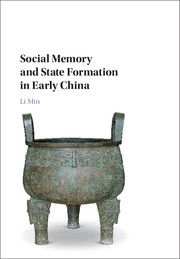
Chapter 1 introduces the research question: Why the classical tradition of early China represents history and ideology of kingship and statecraft in the culturally specific ways laid out in the famous story about the bronze ding tripod vessels? In this chapter, I lay out the various components goes into this symbolic representation of power, namely the ritualization of food and food vessels, of metallurgy, of time and space, which formed the defining attributes of the classical tradition. The aim of this book is to presents an archaeological narrative on the process that each of these components evolved in early China and their eventual convergence in the development of kingship and states.
Chapter 2 provides an overview of three landscape classification systems used in this book, i.e. cultural historical, topographic, and archaeologically-based classifications. To study the dynamic relationship between the physical and cultural landscape, I juxtapose these three landscape classifications integral to the wending narrative--each offers different sets of spatial representations that only partially overlap, and their constellations shift over time. Each scheme involves value-laden choices, embedded in political processes. The superimposition of these classification schemes helps to uncover the dynamic shifts in cultural concepts, categories, and techniques that crosscut seemingly natural boundaries.
This paper presents an experiment. Can a typologically inarticulate assemblage be accounted for by other means? What might such an articulation look like? What prospects would it offer? Focusing on three small late Pottery Neolithic assemblages from the southern Levant, the paper argues that they are typologically inarticulate, primarily because they possess considerable morphological fluidity that is at odds with the segmented structure demanded by this mode of classification. The paper presents an attempt to formulate an account of these assemblages that incorporates their morphological fluidity and ambiguity. Allowing for differential quantitative emphases across the assemblage, it is suggested that certain forms may be specified as types. In turn, the relations among these types are shown to constitute a structural order. Yet the assemblages are also fundamentally ambivalent, both constituting and de-constituting their order and logic. For the types are constituted in relative (rather than absolute) terms and the orderly structures are accompanied by elements that are incommensurable with it. Acknowledging these conflicting qualities, it is proposed that they are multiple, that the one assemblage is several. Finally, the paper explores some implications this understanding of the ceramic assemblages might have for the discussion of temporal development.
In this book, Li Min proposes a new paradigm for the foundation and emergence of the classical tradition in early China, from the late Neolithic through the Zhou period. Using a wide range of historical and archaeological data, he explains the development of ritual authority and particular concepts of kingship over time in relation to social memory. His volume weaves together the major benchmarks in the emergence of the classical tradition, particularly how legacies of prehistoric interregional interactions, state formation, urban florescence and collapse during the late third and the second millenniums BCE laid the critical foundation for the Sandai notion of history among Zhou elite. Moreover, the literary-historical accounts of the legendary Xia Dynasty in early China reveal a cultural construction involving social memories of the past and subsequent political elaborations in various phases of history. This volume enables a new understanding on the long-term processes that enabled a classical civilization in China to take shape.
Archaeologists have struggled for more than a century to explain why the first representational art of the Upper Palaeolithic arose and the reason for its precocious naturalism. Thanks to new data from various sites across Europe and further afield, as well as crucial insights from visual science, we may now be on the brink of bringing some clarity to this issue. In this paper, we assert that the main precursors of the first figurative art consisted of hand prints/stencils (among the Neanderthals and early Homo sapiens) and a corpus of geometric marks as well as a hunting lifestyle and highly charged visual system for detecting animals in evocative environments. Unlike many foregoing arguments, the present one is falsifiable in that five critical, but verifiable, points are delineated.