To save content items to your account,
please confirm that you agree to abide by our usage policies.
If this is the first time you use this feature, you will be asked to authorise Cambridge Core to connect with your account.
Find out more about saving content to .
To save content items to your Kindle, first ensure no-reply@cambridge.org
is added to your Approved Personal Document E-mail List under your Personal Document Settings
on the Manage Your Content and Devices page of your Amazon account. Then enter the ‘name’ part
of your Kindle email address below.
Find out more about saving to your Kindle.
Note you can select to save to either the @free.kindle.com or @kindle.com variations.
‘@free.kindle.com’ emails are free but can only be saved to your device when it is connected to wi-fi.
‘@kindle.com’ emails can be delivered even when you are not connected to wi-fi, but note that service fees apply.
The dominance of economics in shaping the modern world has encouraged scholars from diverse intellectual backgrounds to explore and interpret the evidence for exchange, merchants and markets in the distant past. Urban, state and pan-continental trade systems and networks were developed and in use for thousands of years before the emergence of coins in the early first millennium BC in Anatolia, India and China. In the absence of coins, there is at least some reassuring evidence—especially for historians and economists—when written records detailing goods and transactions are discovered and translated. However, while these sources are invaluable, the majority of the early trade and exchange between individuals and groups across the world is visible only in the archaeological record. The sheer scale, complexity and distances revealed, even for some small village-based agricultural groups, highlights that there was widespread co-operation, but also raises the question of how such exchanges could have occurred. It is in this space that the frequently neglected—and sometimes maligned—study of early metrological systems and weight use can be best appreciated.
This article explores the cremation burial practices of a pre-Tarascan community at Los Tamarindos, focusing on the perceptions of the bodies of those cremated. To reconstruct this element of mortuary practices in the Middle Balsas River basin during the Postclassic period, we analyzed the thermal alterations, anatomical arrangements, and spatial distribution of cremains within funerary urns. Our findings shed light on the low efficiency of cremation processes, which affect the resistance of cremains to mechanical damage and influences the spatial distribution of cremains in the burials. As a result, we were able to register only one case of an intentional distribution of human remains within a funerary urn: skull fragments were dominant in the upper part of the funerary vessel, with a gradual reduction in favor of the lower limb fragments toward the bottom. We also explored the potential presence of intentional manipulation of human remains in the majority of adult burials, offering new perspectives on cremation mortuary rites during the Middle and Late Postclassic period in the Middle Balsas region.
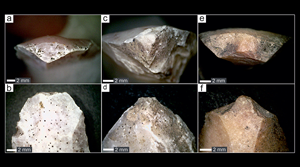
Presentamos avances en la exploración del abrigo rocoso Las Columnas situado en la Depresión Central de Chiapas, México. Un fechamiento obtenido por espectrometría de masas con aceleradores (AMS) muestra indicios de actividades humanas entre el 790 aC y 517 aC, período que corresponde con el desarrollo de sistemas políticos complejos mesoamericanos. Las excavaciones arrojaron también restos de talla, alisadores de piedra, caracoles, semillas y cerámica que indican actividades humanas recurrentes. Una muestra de artefactos líticos se analizó con microscopía para determinar su función. Los resultados preliminares indican que el abrigo Las Columnas fue utilizado para actividades domésticas y el procesamiento de huesos y pieles durante el Preclásico medio.
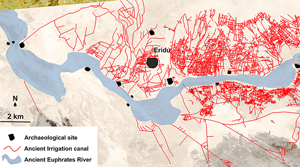
The Eridu region in southern Mesopotamia was occupied from the sixth until the early first millennium BC, and its archaeological landscape remains well preserved. The present study has identified and mapped a vast, intensive, well-developed network of artificial irrigation canals in this region.
Intermediate levels of social organization—above the household but below the entire settlement, city, or polity—are notoriously difficult to pinpoint in archaeological contexts, but they nevertheless represent a crucial frontier for building new archaeological theory to understand daily social life in the past. Ethnographic research demonstrates that informants recognize units such as the “neighborhood” and consider them important. In Mesoamerica, organizational units such as the Mixtec siqui, Aztec calpulli, and Maya cuchcabal were often formally recognized in social, military, and economic systems. Here, a neighborhood case study is presented from San Pedro Teozacoalco in Oaxaca, Mexico. The site known as Iglesia Gentil, which is located atop a mountain today called Cerro Amole, was the cabecera, or administrative center, of Chiyo Cahnu, an important Postclassic Mixtec polity. Using distributions of architecture and artifacts across the site based on data collected with GPS units from 2013 to 2017, three complementary GIS-based models are evaluated for their ability to define neighborhoods at Iglesia Gentil. The best is based on least cost paths modified by Tobler's hiking function.
Two new sites, identified during a survey of the Tajuña River Valley, central Iberia, show evidence of both flint extraction and working, specifically for the production of long blades. These are an important addition to the limited number of such sites known in Eurasia.
The Sidi Zin Archaeological Project aims to bridge understanding of the Acheulean–Middle Stone Age transition in northern Tunisia, a relatively understudied region in the context of hominin evolution. The Sidi Zin locality will provide chronological, palaeoenvironmental, geomorphological and cultural insights into Acheulean and Middle Stone Age occupations in Tunisia.
The European shores of the Mediterranean are characterised by well-known sociocultural and economic dynamics during the Bronze and Early Iron Ages (2200–550 BC), but our understanding of the African shores is comparatively vague. Here, the authors present results from excavations at Kach Kouch, Morocco, revealing an occupation phase from 2200–2000 cal BC, followed by a stable settlement from c. 1300–600 BC characterised by wattle and daub architecture, a farming economy, distinctive cultural practices and extensive connections. Kach Kouch underscores the agency of local communities, challenging the notion of north-western Africa as terra nullius prior to Phoenician arrival.
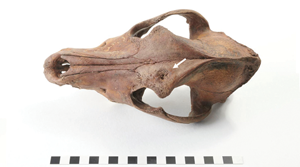
Bear baiting was a popular form of entertainment in Shakespearean England that was staged across the country but formalised in the Early Modern entertainment hub on Bankside, London. Here, the authors bring together zooarchaeological, stable isotope and archival evidence in the examination of faunal assemblages from nine archaeological sites on Bankside to elucidate characteristics indicative of bear baiting. In doing so, they present criteria for identifying bear-baiting assemblages in the archaeological record of England and beyond, even in the absence of associated documentary evidence.
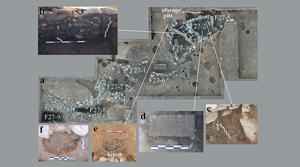
Xiangranggounan is an intensively occupied settlement associated with the Kayue culture on the north-eastern Qinghai-Tibet Plateau. Excavations in 2022 and 2023 revealed five house types with clear stratigraphic relationships that help to expand current understanding of the evolution of prehistoric settlement patterns in harsh plateau environments.
Abordamos aquí la problemática de la identificación de los referentes de los motivos rupestres de la localidad arqueológica de El Carrizal. Hasta el momento, la gran mayoría de las imágenes de cuadrúpedos ha sido reconocida como una representación de camélido, al tiempo que frecuentemente dichos atributos coexisten con otros propios de otras especies. Calculamos las proporciones anatómicas de las imágenes de cuadrúpedos plasmadas en los distintos paneles de los sitios, con el fin de compararlos con casos de referencia de otros ámbitos del Noroeste Argentino. Analizamos los rangos de variación de dichas proporciones en los sitios de referencia y los de El Carrizal, donde destacan, en primer lugar, una alta frecuencia de representación de terminaciones perpendiculares en las extremidades, asimilables a vasaduras; y, en segundo lugar, una longitud de cola mayor a aquellas propias del camélido, según se registra en las variedades vivientes actuales. Al comparar estas imágenes con las de cuadrúpedos del arte alfarero santamariano, interpretamos la presencia de este último rasgo (en figuras con el resto de los atributos asimilables a los de los camélidos), como expresión de un ser híbrido o quimérico, para el cual proponemos el nombre de “zoomorfo de naturaleza múltiple”.
En este trabajo presentamos el hallazgo, la identificación y el análisis de dos colecciones de artefactos etnográficos fueguinos recolectados por Martin Gusinde durante sus trabajos de campo con los pueblos originarios Selk'nam, Yagan y Kawésqar en Tierra del Fuego entre 1918 y 1924, y luego transportados a dos museos europeos. Se trata de 391 artefactos etnográficos fueguinos resguardados en el Missionshaus Sankt Gabriel y el Weltmuseum, ubicados en Viena (Austria). Identificamos los artefactos según la sociedad fueguina que los produjo: 118 selk'nam, 125 yagan y 83 kawésqar; y los analizamos de acuerdo a la clase de artefacto, morfología y materia prima. Caracterizamos así cada colección y la estudiamos de forma comparativa, evaluando su proveniencia e infiriendo que su “representatividad etnográfica” puede ser asignada a Gusinde. Sin embargo, las colecciones son internamente heterogéneas, y muestran recurrencias inter-colección que remiten a las distintas agencias de los pueblos originarios fueguinos, mostrando cómo la ontología de la colección subsume no sólo la agencia del coleccionista, sino también la agencia de los productores/usuarios originarios de los artefactos.
The examination of funerary landscapes in ancient Egypt has traditionally encountered challenges in establishing comprehensive perspectives that could facilitate the formulation of theories explaining the paradigms governing the creation and evolution of these spaces. Indeed, in recent decades, with the advent of new methodological and epistemological approaches, certain foundational principles explaining the placement of necropolises, the organization of tombs and the symbolism inherent to these environments have been called into question. This article seeks to introduce a fresh perspective on the Egyptian funerary landscape and its role in shaping cosmogonic narratives, establishing sacred spaces and contributing to the cultural transmission of these elements. Employing a methodological framework rooted in emerging fields of study like cognitive archaeology, fractal geometry and a reexamination of Egyptian protoculture, we aim to provide a novel understanding of this landscape. Given the evidence we have presented, it has become necessary to articulate a new concept that crystallizes these innovative viewpoints and offers a fresh interpretive framework for the study of landscape archaeology, not only within Egyptology but also in the broader realm of archaeology as a whole.
Grand solar minima are periods spanning from decades to more than a century during which solar activity is unusually low. A cluster of such minima occurred during the last millennium, as evidenced by reductions in the numbers of sunspots observed and coeval increases in cosmogenic isotope production. Prior to the period of instrumental records, natural archives of such isotopes are the only resources available for detecting grand solar minima. Here, we examine the period 433–315 BCE, which saw a sustained increase in the production of the cosmogenic isotope, radiocarbon. Our new time series of radiocarbon data (Δ14C), obtained on cellulose extracted from known-age oak tree rings from Germany, reveal that the rise in production that occurred at this time was commensurate with patterns observed over recent grand solar minima. Our data also enhance, and to a degree challenge, the accuracy of the international atmospheric radiocarbon record over this period.