To save content items to your account,
please confirm that you agree to abide by our usage policies.
If this is the first time you use this feature, you will be asked to authorise Cambridge Core to connect with your account.
Find out more about saving content to .
To save content items to your Kindle, first ensure no-reply@cambridge.org
is added to your Approved Personal Document E-mail List under your Personal Document Settings
on the Manage Your Content and Devices page of your Amazon account. Then enter the ‘name’ part
of your Kindle email address below.
Find out more about saving to your Kindle.
Note you can select to save to either the @free.kindle.com or @kindle.com variations.
‘@free.kindle.com’ emails are free but can only be saved to your device when it is connected to wi-fi.
‘@kindle.com’ emails can be delivered even when you are not connected to wi-fi, but note that service fees apply.
This paper uses material efficacy as an analytical position to consider how silver helped to shape large-scale historical trajectories in Iron Age Scotland. Roman silver entered Scotland as imperial matter beginning in the first century ad and later inspired an assemblage of indigenous wearable silver in the fourth–fifth centuries. I investigate the human–silver collaborations involved in the transition from hoarding Roman silver coins to recycling Roman Hacksilber. By tracing the object trajectory of spiral rings, I show how silver's material properties and entanglements played a role in developing Scotland's earliest silver products. Around the fourth century, a diversity of spiral rings was replaced by a specific style of silver spiral finger ring. Silver brought to Iron Age Scotland by the Romans inspired and afforded individuals in northern Britain a new and empowering regional socio-political identity. Material efficacy, as explored in this case study, has relevance beyond Iron Age/Roman studies to any anthropological investigation of underrepresented human agency.
This article identifies large-scale chiastic and bracketing structures in contemporary, colonial and Classic Maya verbal art and literature. These structures are composed of the repetition of lines, verses and stanzas that frame sections of texts and sometimes images. Initially, the argument focuses on an ethnopoetic analysis that directs attention to such forms in modern and colonial narrative and presents an extended contemporary Yucatecan story to illustrate key forms. Second, it turns to similar structures in Classic Mayan narrative written in Maya hieroglyphs to examine the way rhetorical and linguistic tropes intertwined with corresponding features in visual compositions to craft highly sophisticated artistic programmes. By tracking how specific structures are deployed and in what contexts, this article defines an aesthetic that not only sheds light on verbal narratives, but also elucidates visual programmes and their interrelationship with text to reveal a fundamental principle in Maya world conceptualization. This literary and visual analysis develops a cross-medial Maya aesthetics comparable to other global poetic traditions.
The question addressed in this Element is: What happens to a society when, in the absence of influence from foreign populations, constraints are released by a new crop making possible significant surplus production? We will draw on the historical traditions of 110 tribes of the Enga of Papua New Guinea recorded over a decade to document the changes that occurred in response to the potential for surplus production after the arrival of the sweet potato some 350 years prior to contact with Europeans. Economic change alone does not restructure a society nor build the social and political scaffolding for new institutions. In response to rapid change, the Enga drew on rituals that altered norms and values and resolved cultural contradictions that inhibited cooperation to bring about complexity rather than chaos. The end result was the development of one of the largest known ceremonial exchange systems prior to state formation.
Anthropological archaeology underwater is a new field. What type of research is this and how do anthropologists go about it? When most people hear the phrase 'underwater archaeology', they think of shipwrecks and dramatic images of lost ships at sea, but the underwater archaeological record is vast. In addition to historic vessels, water preserves some of the oldest landscapes on the planet. While archaeologists are interested in the past, those working underwater apply the latest technologies to provide fresh understandings about ancient human behaviour. Underwater environments provide preservation that is unmatched on land and therefore the data collected is novel – providing information about human lifeways and creating a picture of the past we would otherwise never see. This Element will explore the world of anthropological archaeology underwater, focusing on submerged sites, and review the techniques, data, and theoretical perspectives which are offering new insights into the human story.
Research on rock art around the world takes for granted the premise that rock art, as a product of the Upper Palaeolithic symbolic revolution, is a natural behavioral expression of Homo sapiens, essentially reflecting new cognitive abilities and intellectual capacity of modern humans. New discoveries of Late Pleistocene rock art in Southeast Asia as well as recent dates of Neandertal rock art are also framed in this light. We contend in this paper that, contrary to this essentialist non-interpretation, rock art is a historical product. Most human groups have not made rock art. Rock art's main characteristic is its inherent territorial/spatial dimension. Moreover, or probably because of it, rock art is fundamentally associated with food-producing economies. The debate between the cognitive versus social and historical character of rock art is rarely explicitly addressed. In this paper we explore this historical dimension through examples from rock-art corpora worldwide: they provide key case studies to highlight the relevance of addressing the different temporalities of rock-art traditions, their interruptions and, therefore, their historical qualities.
Studies of balances (scales) in Europe, Asia and northern Africa have found that their use is not exclusively tied to state control or market exchange, but rather grew and evolved through interactions among bureaucrats in centralized states, merchants, artisans and local leaders. Research on balances from Andean South America can contribute to an understanding of the diverse roles and functions of balances, as they developed independently in a region where there were both exchange-based and non-market economies. This article includes data on Andean balances that reveal that they were used as early as the Late Intermediate Period (ad 1100–1400), and that there is variation in the characteristics and dimensions of the balances. Similar to other regions, balances in the Andes were likely used by different groups of specialists including merchants, bureaucrats and artisans. To understand how balances were used, they need to be understood alongside long-distance exchange practices, socio-political strategies, the organization of craft production and the possible use of currency.
This Element addresses a burning question – how can archaeologists best identify and interpret cultural burning, the controlled use of fire by people to shape and curate their physical and social landscapes? This Element describes what cultural burning is and presents current methods by which it can be identified in historical and archaeological records, applying internationally relevant methods to Australian landscapes. It clarifies how the transdisciplinary study of cultural burning by Quaternary scientists, historians, archaeologists and Indigenous community members is informing interpretations of cultural practices, ecological change, land use and the making of place. This title is also available as Open Access on Cambridge Core.
This paper argues for a new way of thinking about Early Celtic art in the context of changes taking place throughout Eurasia during the fifth and fourth centuries bce. It applies ideas of anthropologist Alfred Gell, among others, regarding art as a stimulus to action. It asks, in the spirit of papers by Chris Gosden and W.J.T. Mitchell, ‘what did the art do’? The paper argues that this complex new art can be understood in terms of agency contributing to and even stimulating aggressive attitudes and practices on the part of elites during the late fifth and early fourth centuries bce. The new worldviews that are apparent in the new style, and actions driven by them, played major roles in Iron Age Europeans’ participation in the so-called Axial Age of dynamic change throughout Eurasia.
The study explores the meaning-making of cultural heritage in school field trips to five sites in the region Östergötland in Sweden. It treats the materiality of the place and experiences of the guides and the pupils, obtained in school as well as in other contexts, as meaning-making resources during the site visits. It emphasises that sites should be seen as processes, open to interpretations and reinterpretations. The visitor is steered by expectations and common values as well as by the ways in which the heritage site is displayed and presented. In the present study, both adults (guides) and children (pupils) are defined as visitors. The authors draw on theories from history education research and from heritage studies when interpreting how pupils encounter heritage sites, they underline the centrality of 'the flesh and embodied agency' in the experience of sites. This title is also available as Open Access on Cambridge Core.
Hoards have played a significant role in our narratives of the European Bronze Age, but their purpose and meaning have been the source of much debate. These debates have been positively impacted by studies that investigate the ways in which hoards are connected to specific landscape contexts. In this paper, we discuss the outcome of one such in-depth field study of 62 Bronze Age metalwork deposition locations from the Swedish province of Halland. By systematically analysing digital sources such as museum archives, church records and historical maps, we were able to establish the locations of a number of previously unlocated finds, which were then visited in the field. Through this combined archival work and fieldwork, we distinguished several patterns that allude to a connection between metalwork deposits, object types and specific places in the landscape. These patterns shed light on the landscape context of hoards in this region and illuminate how deposition patterns changed over time; we consider some factors that may help to explain these changes. The results emphasize the importance of landscape studies for understanding the role of selective deposition in European Bronze Age societies, and more broadly, the social implications of hoards in their context.
In this paper, we examine the lunar calendar interpretation to evaluate whether it is a viable explanation for the production of Upper Palaeolithic parietal art. We consider in detail the history of this approach, focusing on recently published variations on this interpretation. We then discuss the scientific method and whether these recent studies are designed to address the research questions necessary to test a lunar calendar hypothesis. More broadly, we explore challenges related to inferring meaning in art of the deep past, the use of secondary sources and selecting appropriate ethnographic analogies. Finally, we assess claims that the lunar calendar interpretation documents the world's oldest (proto)writing system. We conclude that the lunar calendar interpretation as currently construed suffers from multiple theoretical and methodological weaknesses preventing it from being a viable explanation for the production of Upper Palaeolithic art. We further find that claims following from this interpretation to have discovered the oldest known (proto)writing system are unsubstantiated.
Various authors have claimed over the years that Homo erectus had language. Since there is no direct evidence about the matter, this claim represents the conclusion of a multi-step composite inference drawn from putative non-linguistic attributes of the species. Three maritime behaviours are central among these attributes: crossing open seas to get to insular islands such as Flores in the Indian ocean and Crete in the Mediterranean; building complex watercraft for the crossings; and undertaking navigation in making the crossings. Dubbing it the ‘Seafaring Inference’, the present article reconstructs and appraises the way in which Barham and Everett use the Seafaring Inference to build a case for the claim that Homo erectus had language. This composite inference starts from certain lithic objects found on Flores and ends, via six simple inferences, with the conclusion that Homo erectus had a form of language. The main finding of the article is that this composite inference is flawed in including a simple inference which is unsound and, accordingly, cannot be used to make a strong case for the claim that Homo erectus had language. There is a less well-developed variant of the Seafaring Inference which proceeds from the recovery of lithic objects on Crete. This variant is found to be multiply flawed, there being several simple unsound simple inferences among its components.
This study investigates the effects that an encounter with a foreign object can have on local traditions. Notions of object agency and object biographies will be utilized to address what happens when people become entangled with new things: the new context can have an impact on the newly introduced object, and those newly introduced objects can similarly impact locals and their traditions. The Late Bronze Age southern Levantine site of Tel Burna will serve as a case study, where a number of imported Cypriot pithoi were found alongside locally produced pithoi. It will be demonstrated that in their new context, the Cypriot pithoi were given new meaning and function. At the same time, the imported pithoi played active roles in the local potters of Tel Burna making pithoi. However, the local pithoi resemble local storage jars, so while the potters mimicked the concept of the Cypriot pithoi, they did so according to local normative forms.
Large walling projects are among the most visible features in the archaeological record. However, enclosure walls remain relatively under-theorized relative to other monumental buildings. In an attempt to move beyond simple explanations that analyse walls solely as defensive features or symbols, I link monumental walls to notions of sovereign power and action-oriented theories of value(s). Using examples from Pharaonic Egypt, I argue that monumental enclosure walls were attempts to define and realize particular social totalities, whether these were a temple complex, a royal tomb or an urban centre. If all efforts at border-making are also an exercise in power, walls have the potential to illuminate some of the goals and values of those ordering their construction. By analysing changes and continuities related to which structures required the protection of a monumental enclosure wall over time, it is possible to shed light on the fluid priorities of the most important political actors in Pharaonic society. Yet the very presence of a wall implies potential dissent and alternative practices—otherwise a wall's construction would not have been necessary.
Southern Peru is home to one of the richest sites with rock art in South America—Toro Muerto. A unique aspect of the iconography of the petroglyphs of the site is the figures of dancing humans, the so-called danzantes, which are additionally frequently associated with geometric motifs, mostly variants of zigzag lines. Drawing upon intriguing data recorded during Reichel-Dolmatoff's research in Colombia related to the meaning of analogous motifs in Tukano art, as well as broader exploration of the sonic sphere in South American cultures and the thesis that Amazonian animism was a more archaic ontology over a broader area of South America, this paper suggests that the geometric patterns at Toro Muerto, with which the figures of danzantes are juxtaposed, may have been representations of songs. An extension of this hypothesis is the suggestion that some of the more complex compositions consisting of danzantes and linear geometric motifs were graphic metaphors of transfer to the other world.
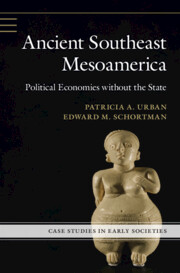
Ancient Southeast Mesoamerica explores the distinctive development and political history of the region from its earliest inhabitants up to the Spanish conquest. It was composed of a matrix of social networks rather than divided by distinct cultures and domains. Making use of the area's rich archaeological data, Edward Schortman and Patricia Urban provide a social network analysis of southeast Mesoamerica. They demonstrate how inhabitants from different locales were organized within such networks, and how they mobilized the assets that they needed to define and achieve their own goals. The also provide evidence for the actions of other groups, who sought to promote their importance at local and regional scales, and often opposed those efforts. Schortman and Urban's study demonstrates the fresh insights gained from study of socio-political structures via a social network perspective. It also challenges models that privilege the influence of powerful leaders in shaping those structures.
This Element describes and synthesizes archaeological knowledge of humankind's first cities for the purpose of strengthening a comparative understanding of urbanism across space and time. Case studies are drawn from ancient Mesopotamia, Europe, Asia, Africa, and the Americas. They cover over 9000 years of city building. Cases exemplify the 'deep history' of urbanism in the classic heartlands of civilization, as well as lesser-known urban phenomena in other areas and time periods. The Element discusses the relevance of this knowledge to a number of contemporary urban challenges around food security, service provision, housing, ethnic co-existence, governance, and sustainability. This study seeks to enrich scholarly debates about the urban condition, and inspire new ideas for urban policy, planning, and placemaking in the twenty first century.
The aim of the article is to reframe speculation from being seen as synonymous with unacademic conjecture, or as a means for questioning consensus and established narratives, to becoming a productive practical engagement with the archaeological and responding to its intrinsic uncertainties. In the first part of the article, we offer a review of speculation in the history of archaeological reasoning. In the second part, we proceed to discussing ways of embracing the speculative mandate, referring back to our engagements with the art/archaeology project Ineligible and reflections on how to work with the unknowns and uncertainties of archaeology. In the third and last part, we conclude by making the case for fertilizing the archaeological potential nested in the empirical encounter, creating more inceptions than conclusions, fostering ambiguities, contradictions and new spaces of experiential inquiry. This leads us to suggest that—when working with the archaeological—speculation should be seen not only as a privilege, but also as an obligation, due to the inherent and inescapable uncertainties of the discipline. In other words, archaeology has been given a mandate for speculation through its material engagements.