Refine search
Actions for selected content:
708 results in Archaeological Science
1 - Monkeys in the City of Gods
- from Part I - The Americas
-
-
- Book:
- World Archaeoprimatology
- Published online:
- 03 August 2022
- Print publication:
- 18 August 2022, pp 13-47
-
- Chapter
- Export citation
-
Summary
Primates are mammals with high cultural significance in ancient societies. The objective of this research is to explore the material culture and biological remains of primates found in Teotihuacan, one of the largest pre-Hispanic urban areas of Mexico. Remains of Mesoamerican spider monkeys (Ateles cf. A. geoffroyi) were found in the Pyramid of the Moon, Xalla, and the Plaza of the Columns. Portable material culture that resembles primates was recovered elsewhere within Teotihuacan, but mostly in Tetitla and La Ventilla. Murals with representations of monkeys were found at these last two Teotihuacan sites. Possibly, primates reached Teotihuacan because of relationships with peoples from more distant lands such as the Mayan region as well as the Oaxacan province ruled by Monte Albán. The rise of the presence of primates in Teotihuacan occurred during the Classic period (~200–550 CE); however, it is relatively scarce considering the large size of the city and the long period of time in which Teotihuacan had been researched. Nevertheless, the existence of monkeys in Teotihuacan, either as exotic animals or as portable objects, does also seem to indicate that they were disseminated within different parts of the city. Thus, living primates and their representations circulated with their symbolic value in Teotihuacan, particularly among members of the ruling elite, and likely among members of other neighboring Mesoamerican societies.
Keywords:Archaeoprimatology, Classic period, Maya, Oaxaca, Osteoarchaeology, Pottery, Primatology, Puebla.
12 - The Nonhuman Primate Remains from the Baboon Catacomb at Saqqara in Egypt
- from Part III - Africa
-
-
- Book:
- World Archaeoprimatology
- Published online:
- 03 August 2022
- Print publication:
- 18 August 2022, pp 310-353
-
- Chapter
- Export citation
-
Summary
After a rapid survey of the contents of the Baboon Catacomb at Saqqara in Egypt, most of the remains of an estimated 180 monkey individuals (the surviving 40%) were temporarily removed for further study. The predominant species is Papio anubis, but 21 Macaca sylvanus and 2 Chlorocebus aethiops were present. Late Dynastic Egyptians employed a unique method of encasing linen-wrapped baboon mummies in plaster at the catacomb, but most of the monkey corpses were probably macerated before interment. Most of the skulls show symptoms of dietary deficiency or sunlight deprivation; some show signs of violence. The disproportionate male representation indicates that little breeding occurred. Males were probably preferred because of human reverence for the characteristic sitting posture, often with penis erect, that monkeys adopt when advertising land occupancy. Humans once displayed in a similar manner, later using effigies as stand-ins, but as civilization developed, this territorial behavior was suppressed.
Keywords:Cage paralysis, Herodotus, Imhotep, Osteomalacia, Sun worship, Thoth
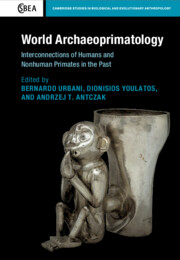
World Archaeoprimatology
- Interconnections of Humans and Nonhuman Primates in the Past
-
- Published online:
- 03 August 2022
- Print publication:
- 18 August 2022
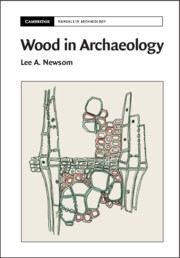
Wood in Archaeology
-
- Published online:
- 02 April 2022
- Print publication:
- 20 January 2022
Copyright page
-
- Book:
- Wood in Archaeology
- Published online:
- 02 April 2022
- Print publication:
- 20 January 2022, pp iv-iv
-
- Chapter
- Export citation
3 - Woody Plants
-
- Book:
- Wood in Archaeology
- Published online:
- 02 April 2022
- Print publication:
- 20 January 2022, pp 73-92
-
- Chapter
- Export citation
Contents
-
- Book:
- Wood in Archaeology
- Published online:
- 02 April 2022
- Print publication:
- 20 January 2022, pp vii-viii
-
- Chapter
- Export citation
Dedication
-
- Book:
- Wood in Archaeology
- Published online:
- 02 April 2022
- Print publication:
- 20 January 2022, pp v-vi
-
- Chapter
- Export citation
Appendix B - Modern Wood IAWA Data Sheet. Reproduced from InsideWood (2004 onwards; Wheeler 2011). Used with the kind permission of Elisabeth A. Wheeler.
-
- Book:
- Wood in Archaeology
- Published online:
- 02 April 2022
- Print publication:
- 20 January 2022, pp 262-271
-
- Chapter
- Export citation
Appendix C - Fiber Datasheet. Reproduced from Wheeler et al. (1986). Used with the kind permission of Elisabeth A. Wheeler.
-
- Book:
- Wood in Archaeology
- Published online:
- 02 April 2022
- Print publication:
- 20 January 2022, pp 272-273
-
- Chapter
- Export citation
Figures
-
- Book:
- Wood in Archaeology
- Published online:
- 02 April 2022
- Print publication:
- 20 January 2022, pp x-xii
-
- Chapter
- Export citation
Acknowledgments
-
- Book:
- Wood in Archaeology
- Published online:
- 02 April 2022
- Print publication:
- 20 January 2022, pp xix-xx
-
- Chapter
- Export citation
Bibliography
-
- Book:
- Wood in Archaeology
- Published online:
- 02 April 2022
- Print publication:
- 20 January 2022, pp 276-317
-
- Chapter
- Export citation
Index
-
- Book:
- Wood in Archaeology
- Published online:
- 02 April 2022
- Print publication:
- 20 January 2022, pp 318-332
-
- Chapter
- Export citation
Plates
-
- Book:
- Wood in Archaeology
- Published online:
- 02 April 2022
- Print publication:
- 20 January 2022, pp ix-ix
-
- Chapter
- Export citation
5 - Working with Archaeological Wood
-
- Book:
- Wood in Archaeology
- Published online:
- 02 April 2022
- Print publication:
- 20 January 2022, pp 153-215
-
- Chapter
- Export citation
Appendices
-
- Book:
- Wood in Archaeology
- Published online:
- 02 April 2022
- Print publication:
- 20 January 2022, pp 261-275
-
- Chapter
- Export citation
2 - Archaeological Wood
-
- Book:
- Wood in Archaeology
- Published online:
- 02 April 2022
- Print publication:
- 20 January 2022, pp 23-72
-
- Chapter
- Export citation
4 - Wood Anatomy Basics
-
- Book:
- Wood in Archaeology
- Published online:
- 02 April 2022
- Print publication:
- 20 January 2022, pp 93-152
-
- Chapter
- Export citation
Tables
-
- Book:
- Wood in Archaeology
- Published online:
- 02 April 2022
- Print publication:
- 20 January 2022, pp xiii-xiv
-
- Chapter
- Export citation
