Refine search
Actions for selected content:
708 results in Archaeological Science
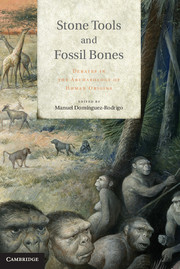
Stone Tools and Fossil Bones
- Debates in the Archaeology of Human Origins
-
- Published online:
- 05 April 2012
- Print publication:
- 26 March 2012
Part i - Onthe Use of Analogy I: The Earliest Meat Eaters
-
- Book:
- Stone Tools and Fossil Bones
- Published online:
- 05 April 2012
- Print publication:
- 26 March 2012, pp 45-198
-
- Chapter
- Export citation
Chapter 7 - The origins of the Oldowan: Why chimpanzees (Pan troglodytes) still are good models for technological evolution in Africa
- from Part II - Onthe use of analogy II: The earliest stone toolmakers
-
-
- Book:
- Stone Tools and Fossil Bones
- Published online:
- 05 April 2012
- Print publication:
- 26 March 2012, pp 201-221
-
- Chapter
- Export citation
Chapter5 - Meat foraging by Pleistocene African hominins: Tracking behavioral evolution beyond baseline inferences ofearly access to carcasses
- from Part i - Onthe Use of Analogy I: The Earliest Meat Eaters
-
-
- Book:
- Stone Tools and Fossil Bones
- Published online:
- 05 April 2012
- Print publication:
- 26 March 2012, pp 152-173
-
- Chapter
- Export citation
Chapter 4 - On earlyhominin meat eating and carcass acquisition strategies: Still relevant after all these years?
- from Part i - Onthe Use of Analogy I: The Earliest Meat Eaters
-
-
- Book:
- Stone Tools and Fossil Bones
- Published online:
- 05 April 2012
- Print publication:
- 26 March 2012, pp 115-151
-
- Chapter
- Export citation
Tables
-
- Book:
- Stone Tools and Fossil Bones
- Published online:
- 05 April 2012
- Print publication:
- 26 March 2012, pp ix-x
-
- Chapter
- Export citation
Introduction
-
- Book:
- Stone Tools and Fossil Bones
- Published online:
- 05 April 2012
- Print publication:
- 26 March 2012, pp 1-10
-
- Chapter
- Export citation
Chapter 2 - Conceptualpremises in experimental design and their bearing on the use of analogy: A critical example from experiments on cut marks
- from Part i - Onthe Use of Analogy I: The Earliest Meat Eaters
-
-
- Book:
- Stone Tools and Fossil Bones
- Published online:
- 05 April 2012
- Print publication:
- 26 March 2012, pp 47-79
-
- Chapter
-
- You have access
- HTML
- Export citation
Contributors
-
-
- Book:
- Stone Tools and Fossil Bones
- Published online:
- 05 April 2012
- Print publication:
- 26 March 2012, pp xiii-xiv
-
- Chapter
- Export citation
Chapter 1 - Toward a scientific-realistic theory on the origin of human behavior
-
-
- Book:
- Stone Tools and Fossil Bones
- Published online:
- 05 April 2012
- Print publication:
- 26 March 2012, pp 11-44
-
- Chapter
-
- You have access
- HTML
- Export citation
Copyright page
-
- Book:
- Stone Tools and Fossil Bones
- Published online:
- 05 April 2012
- Print publication:
- 26 March 2012, pp iv-iv
-
- Chapter
- Export citation
Figures
-
- Book:
- Stone Tools and Fossil Bones
- Published online:
- 05 April 2012
- Print publication:
- 26 March 2012, pp xi-xii
-
- Chapter
- Export citation
Contents
-
- Book:
- Stone Tools and Fossil Bones
- Published online:
- 05 April 2012
- Print publication:
- 26 March 2012, pp vii-viii
-
- Chapter
- Export citation
Chapter 6 - Can weuse chimpanzeebehavior to model early hominin hunting?
- from Part i - Onthe Use of Analogy I: The Earliest Meat Eaters
-
-
- Book:
- Stone Tools and Fossil Bones
- Published online:
- 05 April 2012
- Print publication:
- 26 March 2012, pp 174-198
-
- Chapter
- Export citation
Part II - Onthe use of analogy II: The earliest stone toolmakers
-
- Book:
- Stone Tools and Fossil Bones
- Published online:
- 05 April 2012
- Print publication:
- 26 March 2012, pp 199-358
-
- Chapter
- Export citation
Chapter 3 - The use of bone surface modificationsto model hominid lifeways during the Oldowan
- from Part i - Onthe Use of Analogy I: The Earliest Meat Eaters
-
-
- Book:
- Stone Tools and Fossil Bones
- Published online:
- 05 April 2012
- Print publication:
- 26 March 2012, pp 80-114
-
- Chapter
- Export citation
Dedication
-
- Book:
- Stone Tools and Fossil Bones
- Published online:
- 05 April 2012
- Print publication:
- 26 March 2012, pp v-vi
-
- Chapter
- Export citation
Chapter 8 - Whatdoes Oldowan technology represent in terms of hominin behavior?
- from Part II - Onthe use of analogy II: The earliest stone toolmakers
-
-
- Book:
- Stone Tools and Fossil Bones
- Published online:
- 05 April 2012
- Print publication:
- 26 March 2012, pp 222-244
-
- Chapter
- Export citation
Stone Tools and Fossil Bones - Title page
-
-
- Book:
- Stone Tools and Fossil Bones
- Published online:
- 05 April 2012
- Print publication:
- 26 March 2012, pp iii-iii
-
- Chapter
- Export citation
Stone Tools and Fossil Bones - Half title page
-
- Book:
- Stone Tools and Fossil Bones
- Published online:
- 05 April 2012
- Print publication:
- 26 March 2012, pp i-ii
-
- Chapter
- Export citation
