To save content items to your account,
please confirm that you agree to abide by our usage policies.
If this is the first time you use this feature, you will be asked to authorise Cambridge Core to connect with your account.
Find out more about saving content to .
To save content items to your Kindle, first ensure no-reply@cambridge.org
is added to your Approved Personal Document E-mail List under your Personal Document Settings
on the Manage Your Content and Devices page of your Amazon account. Then enter the ‘name’ part
of your Kindle email address below.
Find out more about saving to your Kindle.
Note you can select to save to either the @free.kindle.com or @kindle.com variations.
‘@free.kindle.com’ emails are free but can only be saved to your device when it is connected to wi-fi.
‘@kindle.com’ emails can be delivered even when you are not connected to wi-fi, but note that service fees apply.
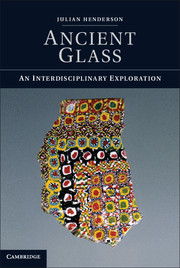
This book is an interdisciplinary exploration of archaeological glass in which technological, historical, geological, chemical, and cultural aspects of the study of ancient glass are combined. The book examines why and how this unique material was invented some 4,500 years ago and considers the ritual, social, economic, and political contexts of its development. The book also provides an in-depth consideration of glass as a material, the raw materials used to make it, and its wide range of chemical compositions in both the East and the West from its invention to the seventeenth century AD. Julian Henderson focuses on three contrasting archaeological and scientific case studies: Late Bronze Age glass, late Hellenistic-early Roman glass, and Islamic glass in the Middle East. He considers in detail the provenances of ancient glass using scientific techniques and discusses a range of vessels and their uses in ancient societies.
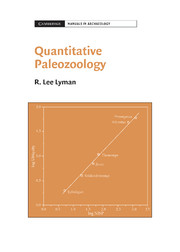
Quantitative Paleozoology describes and illustrates how the remains of long-dead animals recovered from archaeological and paleontological excavations can be studied and analyzed. The methods range from determining how many animals of each species are represented to determining whether one collection consists of more broken and more burned bones than another. All methods are described and illustrated with data from real collections, while numerous graphs illustrate various quantitative properties.
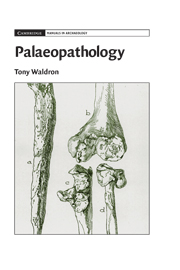
Palaeopathology is designed to help bone specialists with diagnosis of diseases in skeletal assemblages. It suggests an innovative method of arriving at a diagnosis in the skeleton by applying what are referred to as 'operational definitions'. The aim is to ensure that all those who study bones will use the same criteria for diagnosing disease, which will enable valid comparisons to be made between studies. This book is based on modern clinical knowledge and provides background information so that those who read it will understand the natural history of bone diseases, and this will enable them to draw reliable conclusions from their observations. Details of bone metabolism and the fundamentals of basic pathology are also provided, as well as a comprehensive and up-to-date bibliography. A short chapter on epidemiology provides information on how best to analyze and present the results of a study of human remains.
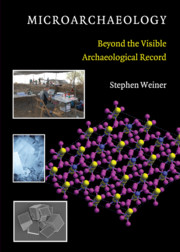
The archaeological record is a combination of what is seen by eye, as well as the microscopic record revealed with the help of instrumentation. The information embedded in the microscopic record can significantly add to our understanding of past human behaviour, provided this information has not been altered by the passage of time. Microarchaeology seeks to understand the microscopic record in terms of the type of information embedded in this record, the materials in which this information resides, and the conditions under which a reliable signal can be extracted. This book highlights the concepts needed to extract information from the microscopic record. Intended for all archaeologists and archaeological scientists, it will be of particular interest to students who have some background in the natural sciences as well as archaeology.
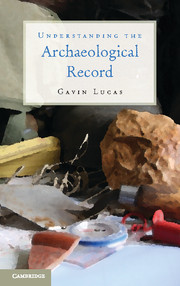
This book explores the diverse understandings of the archaeological record in both historical and contemporary perspective, while also serving as a guide to reassessing current views. Gavin Lucas argues that archaeological theory has become both too fragmented and disconnected from the particular nature of archaeological evidence. The book examines three ways of understanding the archaeological record - as historical sources, through formation theory and as material culture - then reveals ways to connect these three domains through a reconsideration of archaeological entities and archaeological practice. Ultimately, Lucas calls for a rethinking of the nature of the archaeological record and the kind of history and narratives written from it.
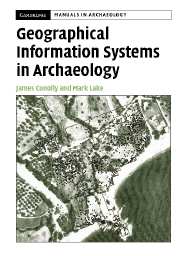
Geographical Information Systems has moved from the domain of the computer specialist into the wider archaeological community, providing it with an exciting new research method. This clearly written but rigorous book provides a comprehensive guide to that use. Topics covered include: the theoretical context and the basics of GIS; data acquisition including database design; interpolation of elevation models; exploratory data analysis including spatial queries; statistical spatial analysis; map algebra; spatial operations including the calculation of slope and aspect, filtering and erosion modeling; methods for analysing regions; visibility analysis; network analysis including hydrological modeling; the production of high quality output for paper and electronic publication; and the use and production of metadata. Offering an extensive range of archaeological examples, it is an invaluable source of practical information for all archaeologists, whether engaged in cultural resource management or academic research. This is essential reading for both the novice and the advanced user.
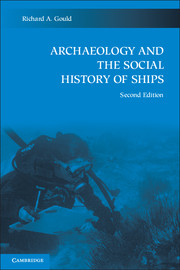
Maritime archaeology deals with shipwrecks and is carried out by divers rather than diggers. It embraces maritime history and analyses changes in shipbuilding, navigation and seamanship and offers fresh perspectives on the cultures and societies that produced the ships and sailors. Drawing on detailed past and recent case studies, Richard A. Gould provides an up-to-date review of the field that includes dramatic new findings arising from improved undersea technologies. This second edition of Archaeology and the Social History of Ships has been updated throughout to reflect new findings and new interpretations of old sites. The new edition explores advances in undersea technology in archaeology, especially remotely operated vehicles. The book reviews many of the major recent shipwreck findings, including the Vasa in Stockholm, the Viking wrecks at Roskilde Fjord and the Titanic.
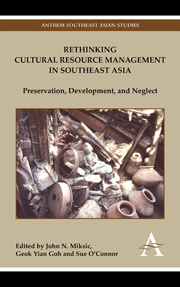
Rethinking Cultural Resource Management in Southeast Asia explores the challenges facing efforts to protect the cultural assets of Southeast Asia from the ravages of tourism and economic development.