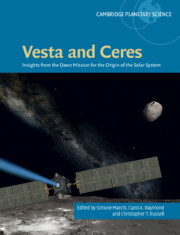

The NASA Dawn mission, launched in 2007, aimed to visit two of the most massive protoplanets of the main asteroid belt: Vesta and Ceres. The aim was to further our understanding of the earliest days of the Solar System, and compare the two bodies to better understand their formation and evolution. This book summarises state-of-the-art results from the mission, and discusses the implications for our understanding not only of the asteroid belt but the entire Solar System. It comprises of three parts: Part 1 provides an overview of the main belt asteroids and provides an introduction to the Dawn mission; Part 2 presents key findings from the mission; and Part 3 discusses how these findings provide insights into the formation and evolution of the Solar System. This is a definitive reference for academic researchers and professionals of planetary science, asteroid science and space exploration.
‘As Vesta and Ceres are two of the most massive asteroids in the main belt, they are of significant interest for researchers who study theories of the formation of Earth and the other terrestrial planets. This work facilitates interdisciplinary study by astronomers, planetary scientists, astrobiologists, and others interested in the formation and evolution of the main belt asteroids … Highly recommended.’
C. Palma Source: Choice
Loading metrics...
* Views captured on Cambridge Core between #date#. This data will be updated every 24 hours.
Usage data cannot currently be displayed.
This section outlines the accessibility features of this content - including support for screen readers, full keyboard navigation and high-contrast display options. This may not be relevant for you.
Accessibility compliance for the PDF of this book is currently unknown and may be updated in the future.
