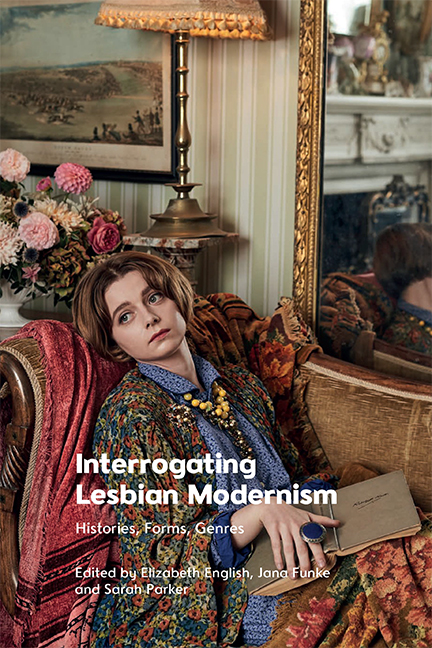
9 - Lesbian Joyce
Published online by Cambridge University Press: 06 March 2025

Summary
James Joyce was enabled by lesbians. In 1914, A Portrait of the Artist as a Young Man was initially serialised in The Egoist, a radical little magazine first founded as The Freewoman by Dora Marsden, then sustained as The New Freewoman by her intimate friend Harriet Shaw Weaver. Joyce acknowledged his debut and debt by reviving the former feminist title in Finnegans Wake: ‘I’m so keen on that New Free Woman with novel inside.’ ‘Dear Miss Weaver’ was Joyce's champion and financier for the rest of his life, although censorship constraints meant that Ulysses was first issued by two other lesbian couples. In New York, Jane Heap and Margaret Anderson serialised two-thirds in their avant-garde The Little Review, until the New York Society for the Suppression of Vice suppressed it. In Paris, Sylvia Beach and Adrienne Monnier ushered Ulysses through their new Shakespeare and Company publishing house, before passing the plates to Weaver for her own Egoist Press imprint. Joyce's indebtedness to these Sapphic midwives of modernism was anticipated and obliquely repaid through sympathetic interest. His sense of the possibilities of queer attractions eddies through and disturbs the ostensibly heterosexual dynamics of Dubliners and Ulysses. Although his treatment of the women who facilitated his writing was not always gracious, Joyce's sensitivity to tenderness, intimacy and love between women nonetheless stands as tribute to lesbian comrades and friends.
On 15 February 1912, Kathlyn Oliver disrupted the letters column of The Freewoman by contending that ‘the abstinence of many single women’ was ‘not injurious,’ since they were ‘sexually anaesthetic.’ Her disclosure was characteristic of The Freewoman's boldly confessional mode. Launched in November 1911 by renegade suffragists Dora Marsden and Mary Gawthorpe, it debated ‘free love,’ birth control, sex work, and ‘Uranianism,’ by which it meant sex between men. It prided itself, as contributor Rebecca West later put it, on ‘its unblushingness—The Freewoman mentioned sex loudly and clearly and repeatedly and in the worst possible taste.’ The journal was committed to promoting possibilities for women beyond heterosexual reproductive marriage, most strenuously through the contributions of the socialist feminist Stella Browne.
Information
- Type
- Chapter
- Information
- Interrogating Lesbian ModernismHistories, Forms, Genres, pp. 204 - 222Publisher: Edinburgh University PressPrint publication year: 2023
Accessibility standard: Unknown
Why this information is here
This section outlines the accessibility features of this content - including support for screen readers, full keyboard navigation and high-contrast display options. This may not be relevant for you.Accessibility Information
Accessibility compliance for the PDF of this book is currently unknown
and may be updated in the future.