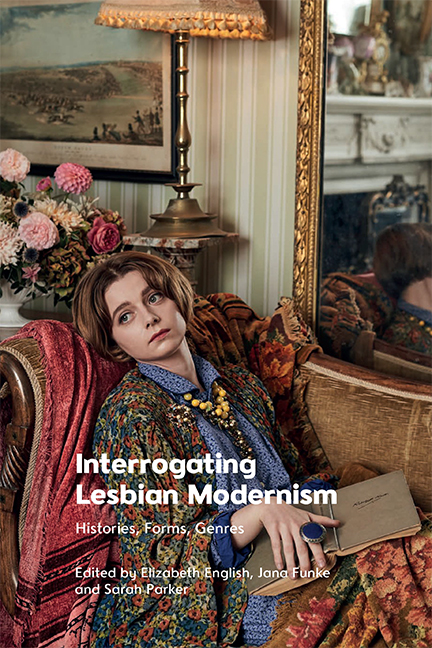
Interrogating Lesbian Modernism

-
Select format
-
- Publisher:
- Edinburgh University Press
- Publication date:
- 06 March 2025
- 01 June 2023
- ISBN:
- 9781474486071
- 9781474486057
- 9781474486064
- Dimensions:
- Weight & Pages:
- Dimensions:
- Weight & Pages:
You may already have access via personal or institutional login
Show more authors 
You may already have access via personal or institutional login
Book description
Makiko Minow coined the phrase 'lesbian modernism' in 1989. Since then, scholars of lesbian modernism have produced crucial work to critique and expand the modernist canon. At the same time, there has been ongoing critical debate about what constitutes a lesbian modernist text, who counts as a lesbian modernist author, and how lesbian modernism relates to queer and trans modernism. This edited volume presents twelve newly commissioned chapters that reassess and interrogate the meanings, uses and limitations of lesbian modernism by exploring a broad range of authors, genres and histories. Individual chapters investigate what work the concept of 'lesbian modernism' has done in the past, how its boundaries have been defined and contested, and what voices have been included and excluded. As a whole, the book demonstrates how the concept of lesbian modernism can be mobilised in new and meaningful ways to continue to inform and enrich modernist studies.
Contents
Contents
Metrics
Full text views
Full text views helpTotal number of HTML views: 0
Total number of PDF views: 0 *
 Loading metrics...
* Views captured on Cambridge Core between #date#. This data will be updated every 24 hours.
Usage data cannot currently be displayed.
Accessibility standard: Unknown
Why this information is here
This section outlines the accessibility features of this content - including support for screen readers, full keyboard navigation and high-contrast display options. This may not be relevant for you.
Accessibility Information
Accessibility compliance for the PDF of this book is currently unknown and may be updated in the future.