To save content items to your account,
please confirm that you agree to abide by our usage policies.
If this is the first time you use this feature, you will be asked to authorise Cambridge Core to connect with your account.
Find out more about saving content to .
To save content items to your Kindle, first ensure no-reply@cambridge.org
is added to your Approved Personal Document E-mail List under your Personal Document Settings
on the Manage Your Content and Devices page of your Amazon account. Then enter the ‘name’ part
of your Kindle email address below.
Find out more about saving to your Kindle.
Note you can select to save to either the @free.kindle.com or @kindle.com variations.
‘@free.kindle.com’ emails are free but can only be saved to your device when it is connected to wi-fi.
‘@kindle.com’ emails can be delivered even when you are not connected to wi-fi, but note that service fees apply.
The chapter discusses the development of sacramental doctrine during a period of lively debate on the subject around the year 1200, with a focus on the relevance of the Fourth Lateran Council as a continuation of the eleventh-century ecclesiastical reform movement, and with stress on the unique relevance of Paris as the key centre of intellectual production.
Herodotus’ Historiesare filled with instances of personal engagement with the supernatural. If we consider that phenomenon in the specific terms of ‘personal religion’, new patterns and questions emerge. This chapter demonstrates not only that personal religion in Herodotus tends to resolve itself in the political, but that this reinforces the point that there was no strict boundary between personal and polis religion. Most of the people whose experiences Herodotus relates remain ‘public figures’, and Herodotus’ historical narrative, by its nature, devotes significant attention to political affairs. Many episodes from the Histories involve atypical individuals. But their experiences with the divine nevertheless fit into common categories, and the concerns which lead these individuals to approach the divine are mostly nothing out of the ordinary. Herodotus’ stories reveal elements of personal religious practice which might otherwise be difficult to find in surviving sources. By considering both personal and civic aspects of Greek religious thought and practice in Herodotus’ work, we see the continuous presence of the gods in the lived experience of individuals.
The notion that curse tablets were used to cause harm whereas amulets were used to provide protection is a misleading oversimplification. Curse tablets have often been removed from the category of religion and consigned to the illusive one of magic. However, the existence of those tablets designated as prayers for justice illustrates that the desires which drove curse tablet creation were varied. To ascertain to what extent the use of curse tablets and amulets fitted in with polis religion, different aspects of them are examined, such as the ritualistic nature of their creation, their use of formulaic inscriptions and evidence for their use, or lack of use, of reciprocity. Examples of amulets and curse tablets are presented from the fourth century BCE through to the second century CE and from a large geographical scope. Examples from across the Greek world illustrate a paradoxical unity and sense of religious community amongst those who engaged in these practices. The incredibly personal nature of the inscriptions on curse tablets and the wearing of amulets provides an insight into Greek religious practice at an individual level.
This chapter draws on conceptualizations of the romance form by Northrop Frye and Fredric Jameson to provincialize them and delineate the imperial romance and its formal and functional specificities. It argues that the imperial romance is a colonial scripture, that is, a ritualized site for the articulation and performance of colonial ideology. It reads Philip Meadows Taylor’s “mutiny novel” Seeta (1872), set in India, and Henry Rider Haggard’s King Solomon’s Mines (1885), set in Africa, to illustrate how these texts rearticulate categories of “good” and “evil.” It also underlines how these texts articulate and resolve colonial anxieties, especially around racial miscegenation. In underlining the imperial romance as a key site for the symbolic resolution of real contradictions of colonial life, the essay illuminates its ritual (and utopian) function that reaffirms and perpetuates colonial ideology.
The final chapter examines how a new kind of shamanism developed in the riverbank settlements and attracted peoples across the colonial and Indigenous spaces. Although shamanism was a feature of Amerindian societies, the Portuguese also had a tradition of healing and folk curing. Riverine shamans from Indigenous communities were highly active in the eighteenth century, and modified Indigenous practices and Catholic symbols to meet the needs of their clients from all backgrounds seeking their ‘merciful’ work. Shamanic curing and healing connected the three spaces as shamans moved between each one and provided clients with relief from their suffering.
The excavations at Wroxeter conducted by J.P. Bushe-Fox examined a zone of the Roman city very different to the public baths and macellum complex extensively investigated in the later twentieth century. Bushe-Fox’s work in Insula 8 is the best and largest sample of Wroxeter’s residential buildings investigated to date; the focus of this paper is the large number of complete ceramic vessels included in the pits and wells he excavated. Recognition of the act of burying complete vessels, and of that practice as a meaningful tradition in antiquity, has developed over the last 25 years. Revisiting the Bushe-Fox excavations has provided a large body of new evidence for the practising of domestic rituals at Wroxeter.
This second chapter on Julian’s Against the Galileans traces the second movement of Julian’s strategy of narrative subsumption: charting the apostasies that cascaded from, first, the Hellenic and, then, the Hebrew traditions, culminating in the Christian sect. Having pointed out the basic compatibility between Hebrew and Hellenic doctrine, Julian emphasizes next the most significant difference between the two: the glaring inferiority of the Hebrew to the Hellenic tradition. This basic framework makes sense of Julian’s claim that Christians are double apostates: Christians started out as Hellenes, and their first mistake was of degree rather than kind: they opted for the lesser Hebrew tradition, rather than the Hellenic one. They latched onto a deviation within the Hebrew tradition, however, which became the grounds for their second apostasy, now away from the Hebrews, to create a new sect.
Kimberly Hope Belcher surveys an impressive number of authors and theories who have engaged with the broad human phenomenon of ritual. For it is evident that both classical ritual studies and more recent approaches have enormous potential for engaging in a dialogue with scholars of Christian liturgy and liturgies.
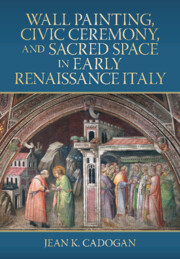
Wall Painting, Civic Ceremony and Sacred Space in Early Renaissance Italy investigates how mural paintings affirmed civic identities by visualizing ideas, experiences, memory, and history. Jean Cadogan focuses on four large mural decorations created by celebrated Florentine artists between 1377 and 1484. The paintings adorn important sacred spaces- the chapel of the Holy Belt in the cathedral of Prato, the monumental cemetery in Pisa's cathedral square, and the cathedral of Spoleto -- yet extoll civic virtues. Building on previously unpublished archival documents, primary sources, and recent scholarship, Cadogan relates the architectural and institutional histories of these sites, reconstructs the ceremonies that unfolded within them, and demonstrates how these sacred spaces were central to the historical, institutional, and religious identities of the host cities. She also offers new insights into the motives and mechanics of patronage and artistic production. Cadogan's study shows how images reflected and shaped civic identity, even as they impressed through their scale and artistry.
In the study of the early medieval Rūs and the Viking diaspora, Arabic geographical writings on the practice of funerary sacrifice loom large. Against growing uses of this body of source material as evidence on ritual, the treatment of women, and the global connections of the Rūs, critical issues in the use of and access to this source material necessitate a fresh analysis. This Element reevaluates geographical writings on Rūs death and sacrificial rituals, redirecting focus towards the textual transmission of ideas in both Arabic and Persian to offer a critical guide to geographical knowledge dissemination on Rūs funerary practices.
Chapter 2 examines the circulation and application of medical and ritual knowledge in Caribbean and Pacific New Granada, including Venezuela and Panama, and is based upon Inquisition trial records and secular court cases. The chapter approaches healing and ritual as intimately connected and often inseparable activities for African-descended practitioners who were solicited by clients of all ethnicities. Where clients were also people of colour, they were often hired to perform work of community healing. The chapter outlines the gendered and racialised patterns of prosecution and punishment of defendants of African descent tried by the Inquisition of Cartagena de Indias. This is followed by an analysis of the mobility and exchange of healing knowledge in Caribbean and Pacific New Granada, an examination of the marketplace of ideas, and an exploration of the social worlds in which black specialists practiced. Case studies include that of three Kongolese bondsmen, who had hired Joseph and Thomas to poison his owner in 1740s Cartagena, and that of enslaved man Aja, who was accused by fellow bondspersons, other members of the cuadrilla on the gold mines of San Antonio in the Cauca valley mines (owned by the Convent of the Encarnación in the city of Popayán) in the 1770s.
This chapter surveys a range of engagements with religion in the modernist theatre, from T. S. Eliot’s vision for a new Christian drama to Bertolt Brecht’s fascination with the Bible, and from Sylvia Wynter’s staging of Afro-diasporic ritual practices to Rabindranath Tagore’s dramatisation of Buddhist legend. Such works, this chapter shows, tend to favour syncretic and heterodox expressions of religious subjects, frequently drawing together multiple doctrinal or ritual traditions within a single performance. These modern dramas of religion are examined across four sections: ‘Modernist Iconoclasms’, on dramatists who sought to dismantle religion’s influence; ‘Temples of a Living Art’, on artists who sought to remake theatre in the image of religion; ‘Ritual and Sacrifice’, on theatre and metaphysics; and ‘Allegories and Parables of Renewal’, on the intersection of religious allegory with social change. Throughout these sections, the chapter illustrates the plural and paradoxical roles for religion assigned on the modernist stage.
Humans often participate in physically harmful and demanding rituals with no apparent material benefits. Although such behaviours have traditionally been explained using the lens of costly signalling theory, we question whether the canonical theory can be applied to the case of human cooperative signals and introduce a modification of this theory based on differential benefit estimation. We propose that along with cooperative benefits, committed members also believe in supernaturally induced benefits, which motivate participation in extreme rituals and stabilize their effects on cooperative assortment. Using Thaipusam Kavadi as a prototypical costly ritual, Tamil (ingroup) and Christian (outgroup) participants in Mauritius (N = 369) assessed the cost and benefits of Kavadi participation or hiking. We found that ingroup participants estimated material costs as larger than outgroups, physical costs as lower, and benefits as larger. These findings suggest that estimated costs may vary by modality and cultural expectations (e.g. Kavadi participants are not supposed to display pain), while supernaturally induced benefits were consistently reported as larger by ingroups compared to outgroups. We conclude that differential estimation of ritual benefits, not costs, are key to the persistence of extreme rituals and their function in the assortment of committed members, underscoring the role of differential estimation in the cognitive computation of signal utility.
Atonement is a critical component of the cultic system described in Leviticus 1–7 and 16. Purification of sin and thanksgiving offerings shape the worship of Israel. This chapter describes the theology of sacrifice and atonement in Leviticus, the specific offerings, and how atonement has been interpreted by later commentators.
Chapter 4 is in part an examination of a Mycenaean divine Potnia, one affiliated with the “labyrinth,” the Potnia of the dabúrinthos (δαβύρινθος). The labyrinthine space with which she is associated is an Asian cult notion introduced from Anatolia to Balkan Hellas. This chapter also examines the Rājasūya, a Vedic rite of consecration by which a warrior is made a king and a likely cult counterpart to the Mycenaean initiation of the wanaks.
Chapter 2 examines the Vedic sacrificial post called the yūpa and its role in ritual performances. A Mycenaean Greek cognate term and comparable ritual implement lies behind the Linear B form spelled u-po – that is, hûpos (ὗπος). Among other topics treated in this chapter are the Mycenaean deity called the po-ti-ni-ja, a-si-wi-ja, the Asian Potnia, and the u-po-jo po-ti-ni-ja, the Potnia of the u-po (that is, húpoio Pótnia [ὕποιο Πότνια]), a term matched exactly by Sanskrit patnī-yūpá-.
Chapter 6 examines Iranian cult and myth as evidenced in the Nart sagas of Transcaucasia, but also among Scythians as well as in Zoroastrian tradition, including the psychotropic cult substances Haoma (Iranian) and Soma (Indic). The Greek polis of Dioscurias in the Caucasus is explored as a place where Hellenic and Indo-Iranian divine-twin myth and cult affiliation meet, as indeed they do in the Pontic polis of Sinope. Aeolian connections are conspicuous at both locales.
Chapter 7 examines the sheep’s fleece filter used in the preparation of Soma. A cult ideology in which such an implement played an important role was preserved for some time in Iranian tradition in the Caucuses, ultimately giving expression to Greek ideas about the presence of fleecy filters impinged with gold in the vicinity of Dioscurias – rationalizing accounts of the Golden Fleece of Aeolian Argonautic tradition. Particular elements of the Golden Fleece myth find parallels in Indic poetic accounts of the performance of Soma cult. The common Hellenic and Indic elements constitute a shared nexus of ideas that earliest took shape in Bronze-Age communities of admixed Mycenaean and Luvian populations into which Mitanni Soma ideas had spread via Kizzuwatna. The Golden Fleece mythic tradition, with its geographic localization in Transcaucasia, is a Mycenaean Asianism that took shape in Asia Minor under Indic and Iranian influences and that continued to evolve among the Iron-Age Asian Greeks.
Chapter 5 considers the Indic divine twins, the Aśvins (Aśvínā), or Nāsatyas (Nā́satyā), their association with the Indic Dawn goddess Uṣas, and their place in the Indic Soma cult. Discussion then shifts to the kingdom of Mitanni in Syro-Mesopotamia, a place into which Indic culture was introduced as Indo-Iranian peoples migrated southward through Asia, as also at Nuzi. There is good lexical evidence for the presence of a Soma cult in Mitanni, and Soma-cult ideas appear to have spread out of Mitanni, through Kizzuwatna, into the Luvian milieu of western Asia Minor, where such ideas would almost certainly have been encountered by resident Mycenaean Greeks, intermingled biologically, socially, culturally, and linguistically with Luvian populations. With that spread certain elements of Soma-cult ideology were mapped onto Anatolian cult structures.