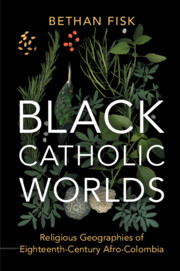
Black Catholic Worlds

-
Select format
-
- Publisher:
- Cambridge University Press
- Publication date:
- 28 August 2025
- 11 September 2025
- ISBN:
- 9781009543576
- 9781009543538
- Dimensions:
- (229 x 152 mm)
- Weight & Pages:
- 0.62kg, 308 Pages
- Dimensions:
- Weight & Pages:
- Subjects:
- Sociology of Race and Ethnicity, Area Studies, Latin American Studies, History, Latin American History
- Series:
- Afro-Latin America
You may already have access via personal or institutional login- Subjects:
- Sociology of Race and Ethnicity, Area Studies, Latin American Studies, History, Latin American History
- Series:
- Afro-Latin America
Show more authors 
You may already have access via personal or institutional login
Book description
Centring the lived experiences of enslaved and free people of colour, Black Catholic Worlds illustrates how geographies and mobilities – between continents, oceans, and region – were at the heart of the formation and circulation of religious cultures by people of African descent in the face of racialisation and slavery. This book examines black Catholicism in different sites – towns, mines, haciendas, rochelas, and maroon communities – across New Granada, and frames African-descended religions in the region as “interstitial religions.” People of African descent engaged in religious practice and knowledge production in the interstices, in liminal places and spaces that were physical sites but also figurative openings, in a society shaped by slavery. Bringing together fleeting moments from colonial archives, Fisk traces black religious knowledge production and sacramental practice just as gold, mined by enslaved people, again began to flow from the Pacific coast to the Atlantic world.
Reviews
‘Black Catholic Worlds is a moving and groundbreaking examination of African-descended people’s Catholic popular religiosities and practices in one of the most important sites of the early modern African diaspora: eighteenth-century Colombia. Impressively stitching together archival fragments across eighteenth-century Afro-Colombia, Fisk manages the seemingly impossible task of centering the interior lives of people of African descent as they created religious and sacramental Catholic knowledge ‘on the move.’ An instant classic.’
Yesenia Barragan - Rutgers University
‘Fisk's geopolitical approach to slavery, colonial rule, and Black religious practice in New Granada reveals the ways that Afro-descendants of various lineages constituted belonging through mobility and dispersal. By examining the ways Afro-descendants developed social and spiritual communities in motion, Black Catholic Worlds reveals the making of the Afro-Caribbean and Afro-Pacific lowland territories across New Granada.’
Sherwin K. Bryant - author of Rivers of Gold, Lives of Bondage: Governing through Slavery in Colonial Quito
‘In this wonderful book, Fisk explodes numerous binaries - Atlantic/Pacific, land/water, place/movement, sacred/secular, centre/margin, African/creole - in a meticulously documented endeavour to establish African-descent people in colonial Colombia as active creators and circulators of religious knowledge. Essential reading for anyone interested in the history of African diasporas in the Americas.’
Peter Wade - University of Manchester
‘Extensively researched and compellingly argued, Black Catholic Worlds is a groundbreaking contribution to Afro-Latin American studies. Fisk significantly expands our knowledge of the uses people of African descent made of Catholicism. A must-read for any student of the African diaspora.’
Miguel Valerio - author of Sovereign Joy: Afro-Mexican Kings and Queens, 1539–1640
‘Fisk vividly underscores how free and enslaved Black people mobilized the brutality and bounty of New Granada to make of early modern Catholicism what they willed.’
Danielle Terrazas Williams - author of The Capital of Free Women: Race, Legitimacy, and Liberty in Colonial Mexico
Contents
Contents
References
Metrics
Full text views
Full text views helpTotal number of HTML views: 0
Total number of PDF views: 0 *
 Loading metrics...
* Views captured on Cambridge Core between #date#. This data will be updated every 24 hours.
Usage data cannot currently be displayed.
Accessibility standard: Missing or limited accessibility features
Why this information is here
This section outlines the accessibility features of this content - including support for screen readers, full keyboard navigation and high-contrast display options. This may not be relevant for you.
Accessibility Information
The PDF of this book is known to have missing or limited accessibility features. We may be reviewing its accessibility for future improvement, but final compliance is not yet assured and may be subject to legal exceptions. If you have any questions, please contact accessibility@cambridge.org.
Content Navigation
Table of contents navigation
Allows you to navigate directly to chapters, sections, or non‐text items through a linked table of contents, reducing the need for extensive scrolling.
Index navigation
Provides an interactive index, letting you go straight to where a term or subject appears in the text without manual searching.
Reading Order and Textual Equivalents
Single logical reading order
You will encounter all content (including footnotes, captions, etc.) in a clear, sequential flow, making it easier to follow with assistive tools like screen readers.
Structural and Technical Features
ARIA roles provided
You gain clarity from ARIA (Accessible Rich Internet Applications) roles and attributes, as they help assistive technologies interpret how each part of the content functions.