To save content items to your account,
please confirm that you agree to abide by our usage policies.
If this is the first time you use this feature, you will be asked to authorise Cambridge Core to connect with your account.
Find out more about saving content to .
To save content items to your Kindle, first ensure no-reply@cambridge.org
is added to your Approved Personal Document E-mail List under your Personal Document Settings
on the Manage Your Content and Devices page of your Amazon account. Then enter the ‘name’ part
of your Kindle email address below.
Find out more about saving to your Kindle.
Note you can select to save to either the @free.kindle.com or @kindle.com variations.
‘@free.kindle.com’ emails are free but can only be saved to your device when it is connected to wi-fi.
‘@kindle.com’ emails can be delivered even when you are not connected to wi-fi, but note that service fees apply.
Chapter 7 elaborates on the extensive empirical corpus analysed in the preceding chapters. It reinforces the comparative points and clarifies the general patterns emerging in the book. It also expands our reflections on the meanings of modern transnational war volunteering, especially as seen through the conceptual lens of internationalism. The chapter presents conclusions regarding the ideological and organisational dynamics of transnational war volunteering as a left-wing political practice in the twentieth century. These findings open up new perspectives on mobilisation patterns pertaining to transnational volunteering, potentially moving the discussion away from top-down directives or impersonal indoctrination tools to a greater appreciation of the significance of contingency and horizontal influences shaping volunteer behaviour. Elaborating on these findings, the concluding chapter thus offers new conceptual registers to comprehend the phenomenon of left-wing war volunteering in the twentieth century.
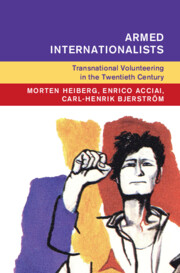
This unique transnational history explores the extraordinary lives of left-wing volunteers who fought in not just one, but multiple conflicts across the globe during the mid-twentieth century. Utilising previously unpublished archival material, Heiberg, Acciai and Bjerström follow these individual soldiers through military conflicts that were, in most cases, geographically centred on individual countries but nonetheless evinced a crucial transnational dimension. From the Spanish Civil war of 1936 to the Nicaraguan Revolution of 1979, the authors marshall these diverse case studies to create a conceptual framework through which to better understand the networks and recruitment patterns of transnational volunteering. They argue that the Spanish Civil War created a model for this transnational left-wing military volunteering and that this experience shaped the global left responses to a range of conflicts throughout the twentieth century.
Recommend this
Email your librarian or administrator to recommend adding this to your organisation's collection.