To save content items to your account,
please confirm that you agree to abide by our usage policies.
If this is the first time you use this feature, you will be asked to authorise Cambridge Core to connect with your account.
Find out more about saving content to .
To save content items to your Kindle, first ensure no-reply@cambridge.org
is added to your Approved Personal Document E-mail List under your Personal Document Settings
on the Manage Your Content and Devices page of your Amazon account. Then enter the ‘name’ part
of your Kindle email address below.
Find out more about saving to your Kindle.
Note you can select to save to either the @free.kindle.com or @kindle.com variations.
‘@free.kindle.com’ emails are free but can only be saved to your device when it is connected to wi-fi.
‘@kindle.com’ emails can be delivered even when you are not connected to wi-fi, but note that service fees apply.
What role did nomadic and non-settled societies play in the early twentieth-century world economy? Exploring a remote mountain valley close to the border between the Russian and Qing empires, this article investigates the multiscalar history of the Karkara trade fair and its Kazakh and Kyrgyz pastoralist communities. Although at first sight incongruous given its remote location, this market was in fact one of the most significant fairs in the entire Russian empire. Tracing dynamic circuits of exchange on local, regional, and trans-imperial scales across northern Eurasia and beyond from the 1890s to 1916, the article argues that ecological perspectives are essential if we are to understand the anatomy of global capitalism in the valley, and that the shifting relationship between environment, economy, and political power as the Russian imperial state sought to use the fair as a site of control and regulation created frictions that proved deeply corrosive. Throughout, the article underscores the need to re-evaluate the often overlooked importance of pastoralist societies and seemingly remote rural places in the early twentieth-century global economy and in modern Eurasian history.
This article addresses the transformative role of ethnoarchaeology in reshaping the study of pastoralism. Long marginalized by dominant scientific and political discourses, pastoralism is now increasingly seen as a sophisticated, adaptive livelihood strategy – especially in contexts of high environmental variability. Since pastoralism is predominantly practiced in drylands – arid and semiarid regions historically viewed as peripheral – its study has helped reframe these environments as dynamic landscapes of innovation and resilience. This reevaluation has been pushed, this article argues, also by the contributions of ethnoarchaeology. As a field that bridges past and present, it has enabled the generation of new concepts, the challenge of traditional archaeological frameworks and the integration of Indigenous knowledge systems.
The silent film Grass (1925), which follows the seasonal migration of members of the Bakhtiari tribal confederation and their herds, shows mobile pastoralism as a changeless, remote, environmentally driven, and primitive way of life. An anthropological and historical analysis of the film explores problematic conceptions that still underlie the contemporary study of historical and ancient pastoralism.
This chapter extends the conceptual framework laid out in Chapter 2 to a series of basic questions about various dimensions of ancient and historical pastoralism, using constellations of methods reviewed in Chapters 4 and 5. Answering these questions on the basis of empirical archaeological data also builds a broader basis for comparing ancient pastoralism to historically and ethnographically documented practices, providing the means to generate stronger ethnographic analogies for archaeological interpretation, as discussed in Chapter 3.
This introductory chapter discusses how archaeologists have studied and represented pastoralism, often in ways that parallel the tropes that the film Grass introduced. Despite decades of work and varied approaches associated with different theoretical traditions, archaeologists largely have not written histories of pastoralism that address continuity and change. The archaeology of pastoralism faces four longstanding problems that contribute to an ongoing tendency to see pastoralists as changeless: (1) conceptual conflation, (2) misuse of ethnographic analogy, (3) a paucity of direct data, and (4) separate regional traditions of research.
A critical and empirical archaeology of pastoralism has already begun to rewrite some of the long-standing “grand narratives” of pastoralism’s role in shaping ancient urbanism, trade, polities, and landscapes.
New research agendas tackle questions about the social and political dimension of ancient and historical pastoralism and the impact that herd animals and herding had on societies through time. These research agendas include social zooarchaeology and the archaeology of social spaces in pastoral landscapes, such as monuments, gathering spaces, and corrals or other herding infrastructure. In the future, household archaeological approaches to settlements and campsites should play a more important role.
Archaeological research on pastoralism has mostly occurred within the silos of separate regionally specific traditions in the Middle East, Central Eurasia, North Africa, and East Africa. The common questions concerning pastoral ecologies and economies outlined in Chapter 6 and the social research agendas discussed in Chapter 7 open space for a more robust comparative archaeology of pastoralism across disparate regions and longer time spans.
Various biomolecular methods increasingly augment foundational methodologies for the study of pastoralism, including isotopic analyses, analyses of ancient human and animal DNA, identification of milk proteins, and residue analyses that identify animal carcass fat and milk fat. Although the results of biomolecular analyses can significantly expand the evidentiary basis for the archaeology of pastoralism and have in many ways revolutionized the field, they are not some sort of panacea that can easily solve all of the conceptual, interpretive, empirical, and disciplinary problems laid out in Chapter 1.
In China’s pastoral regions, both formal and informal rules are embedded in society and are continually negotiated and reassembled according to social, cultural and political contexts. In particular, the de facto rules governing rangeland use and access are much more intricate and dynamic than de jure property rights as set forth by statutory law. Through the lens of legal pluralism, this article examines the multiplicity of customary practices in Saga, a pastoral village in Amdo Tibet, where pastoralists develop rangeland practices in multiple contexts to manoeuvre in their struggle for inclusion in wealth building and the right to access rangeland and natural resources. Through three cases of customary practices – grazing bans, pasture patrols and communal summer grazing – this research demonstrates how pastoralists interpret and tailor rangeland governance to meet their expectations. A plural context-based hybrid rangeland governance is visible in Saga, where in response to changing de jure rules, de facto rules are deeply rooted in social, cultural and emotional dimensions. Rather than becoming fixed, de facto rules and practices are always evolving in response to the local context where multiple types of de jure rules apply.
Ancient stone monuments may have marked the locations of key ritual activities for pastoralist communities. This project is the first to employ multi-method geophysical survey to identify additional features of construction and use at the Chalcolithic-period Rajajil Columns site in northern Saudi Arabia.
Multidisciplinary research is deepening our understanding of high-altitude pastoralism on the Tibetan Plateau, but such studies also highlight a strong riverine bias in the location of excavated sites. In a move to address this skewing of the dataset, the authors propose the exploration of modern highland corrals with shovel testing and test excavations as a labour-efficient survey method, streamlined through the identification of potential sites from satellite imagery. Three prehistoric sites were successfully located using this method, the earliest dating to the first millennium BC, encouraging the reconsideration of current survey strategies in Tibet and other mountainous regions.
With a legacy of sociopolitical and economic exclusion, ethnic conflicts, and an extremely arid climate, the Turkana people struggle to meet the two most basic necessities of life – food and water. One perennial river flowing from Uganda replenishes the groundwater on which the survival and growth of Lodwar depends. Lodwar’s water utility ranks poorly across national regulation metrics delivering an average of 24 litres per person per day to half of the town’s residents. Violent flash floods are known to wash away homes, people and animals almost every year. Relocating to safer grounds in peri-urban areas means losing income opportunities, education and healthcare services, and most importantly, water. A vibrant informal market has emerged, with tanker trucks and motorbikes selling water from the utility’s boreholes at high costs. For those who cannot afford vended water, scooping out dry riverbeds is the only option. With the discovery of crude oil and untapped groundwater reserves, coupled with construction of regional transport links, there is optimism for economic development in this marginalised county. Yet unless there is action to address the fundamental lack of capacity or coordination among multiple stakeholders, Lodwar’s water woes are likely to limit human and economic development.
This chapter argues that what Gerard Manley Hopkins termed the “rural scene” provided a focal point in the 1870s for profound changes in the Victorian understanding, valuation, and transformation of the natural world. British writing at this time demonstrates a shift from viewing the rural scene as picturesque landscape, as evidenced in provincial novels such as George Eliot’s Middlemarch, to conceiving of it as an environment encompassing human and nonhuman nature, notably in Richard Jefferies’ nature writings and Thomas Hardy’s first Wessex novels. Grasping the full scope of Victorian responses to the rural scene in the 1870s also requires looking to the expanding pastoral industries of the settler empire. Writing in and about the settler colonies of Australia and New Zealand, by Lady Barker, Rolf Boldrewood, and Anthony Trollope, highlights how a perceived absence of rural aesthetic values helped render colonial nature available for transformation and subsequent economic exploitation.
Recent research on the organisation and growth of large settlements (both urban and non-urban) has prompted a reassessment of factors driving population aggregation. Systematic aerial and ground survey of the South Caucasus mega-fortress Dmanisis Gora, described here, contributes to the understanding of large fortress settlements in the South Caucasus (c. 1500–500 BC) as part of this wider debate. Substantial defensive walls and stone architecture in the outer settlement contrast with low-intensity occupation, possibly by a seasonally mobile segment of the population. The exceptional size of Dmanisis Gora helps add new dimensions to population aggregation models in Eurasia and beyond.
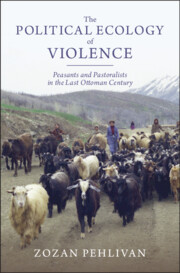
In this innovative, interdisciplinary work, Zozan Pehlivan presents a new environmental perspective on intercommunal conflict, rooting slow violence in socioeconomic shifts and climatic fluctuations. From the nineteenth to the early twentieth centuries, recurrent and extreme climate disruptions became an underlying yet unacknowledged component of escalating conflict between Christian Armenian peasants and Muslim Kurdish pastoralists in Ottoman Kurdistan. By the eve of the First World War, the Ottoman state's shifting responses to these mounting tensions transformed the conflict into organized and state-sponsored violence. Pehlivan upends the 'desert-sown' thesis and establishes a new theoretical and conceptual framework drawing on climate science, agronomy, and zoology. From this alternative vantage point, Pehlivan examines the impact of climate on local communities, their responses and resilience strategies, arguing that nineteenth-century ecological change had a transformative and antagonistic impact on economy, state, and society.
In the social, historical, and political context of Xi Jinping’s China, particular forms of racialization and racial capitalism have emerged in Altay Prefecture, the homeland of ethnic Kazakhs on China’s northwest border. This study examines the husbandry industry in Altay Prefecture to elucidate how Xi’s China has built a mode of racial capitalism through the management of Kazakh land, ethnicity, and culture. Within the framework of a case study, I employ document collection and participant observation methods to gather data that are then interpreted through critical policy analysis. The research shows that Kazakhs have been racialized based on their mobile pastoral traditions, enslaved in the “debt economy,” and exploited through husbandry policies and programs. The particular ways in which husbandry has been restructured and assimilated into Chinese industrial production chains exploit and reproduce the Kazakh-Han hierarchy and segregation. This close look at racial capitalism in Altay sheds light on the operations of Xi’s ecological civilization and war on poverty policies in an ethnic minority border region and discusses how they align with the broader geopolitics of the Belt and Road Initiative in Central Asia and Eastern Europe.
During the second half of the first millennium BC, hundreds of hillforts dotted the central Italian Apennines. Often interpreted as ‘proto-towns’, the authors present results of investigations at Monte Santa Croce-Cognolo that challenge this idea. Previous studies identified a small area (<1ha) of occupation and suggested that habitation extended across the whole 18ha site. Combining geophysical and pedestrian survey with remotely sensed data, and local ethnographic accounts, the authors detect little evidence for permanent habitation and instead argue for activities connected with animal husbandry. The results challenge urban-centric interpretations by demonstrating the coexistence of monumental but uninhabited hillforts and urban sites—usually seen across the Mediterranean and Europe.
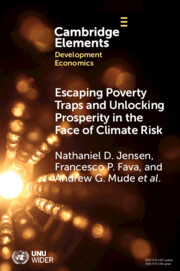
This Element outlines the origins and evolution of an international award-winning development intervention, index-based livestock insurance (IBLI), which scaled from a small pilot project in Kenya to a design that underpins drought risk management products and policies across Africa. General insights are provided on i) the economics of poverty, risk management, and drylands development; ii) the evolving use of modern remote sensing and data science tools in development; iii) the science of scaling; and iv) the value and challenges of integrating research with operational implementation to tackle development and humanitarian challenges in some of the world's poorest regions. This title is also available as Open Access on Cambridge Core.
Recent archaeological research in the Andes suggests that Indigenous herders carefully managed their environments through the modification of local hydrology and vegetation. However, the limited geographical scale of previous research makes it challenging to assess the range and prevalence of pastoralist land management in the Andes. In this article, the authors utilise large-scale, systematic imagery survey to examine the distribution and environmental contexts of corrals and pastoralist settlements in Huancavelica, Peru. Results indicate that corrals and pastoralist settlements cluster around colonial and present-day settlements and that a statistically significant relationship exists between pastoral infrastructure and perennial vegetation. This highlights the utility of remote survey for the identification of trans-regional patterns in herder-environment relationships that are otherwise difficult to detect.