To save content items to your account,
please confirm that you agree to abide by our usage policies.
If this is the first time you use this feature, you will be asked to authorise Cambridge Core to connect with your account.
Find out more about saving content to .
To save content items to your Kindle, first ensure no-reply@cambridge.org
is added to your Approved Personal Document E-mail List under your Personal Document Settings
on the Manage Your Content and Devices page of your Amazon account. Then enter the ‘name’ part
of your Kindle email address below.
Find out more about saving to your Kindle.
Note you can select to save to either the @free.kindle.com or @kindle.com variations.
‘@free.kindle.com’ emails are free but can only be saved to your device when it is connected to wi-fi.
‘@kindle.com’ emails can be delivered even when you are not connected to wi-fi, but note that service fees apply.
The book concludes by emphasising that HEL emerges as a reaction and response of the power holders to address challenges in their pursuit of economic growth and capital accumulation posed by environmental defenders without risking their legitimacy. In addition, it will also point out how the literature on environmental law is implicated by the findings discussed in the book. Finally, the book’s conclusion closes by providing insights for future research agenda on HEL.
This chapter compares HEL in Indonesia, Thailand, and the Philippines while interrogating the two strategic dimensions of geographies and weaponry. The geographical dimension encompasses three forms of jurisdiction: (1) subject-matter jurisdictions, that is, the legal procedures mobilised to silence, intimidate, or attack environmental defenders (criminal, civil, and administrative law); (2) territorial jurisdictions (legal institutions’ geographical scope of competence); and (3) sectoral jurisdictions (economic sectors where HEL is exercised). The weaponry dimension explains the legal provisions, including criminal offences, mobilised by state and private attackers to intimidate and punish environmental defenders. It reveals how environmental defenders in three countries are harassed through legal means, mainly the criminal justice system in resource-rich or industrialised regions.
This book documents the mobilisation of law to retaliate against, intimidate, and even punish environmental defenders in Southeast Asia. It draws on case studies from Indonesia, Thailand, and the Philippines, which have taken measures to provide legal protection to environmental defenders by adopting anti-SLAPP provisions. Despite these provisions, attacks utilising legal means against environmental defenders have persisted. Environmental activists and local communities defending their livelihoods and the environment against the encroachment of extractive industries and state-backed development projects are turned into defendants before the courts. The book explains 1) the nature of legal attacks on environmental defenders in Southeast Asia, 2) the consequences of these attacks on environmental movements in those countries, and 3) the responses of environmental movements in navigating the existing politico-legal structures to resist these attacks and their strategies to strengthen the protection of environmental defenders in the region.
Transnational corporations pose a dilemma for scholars of normative political economy. On the one hand, many think that such entities must be tamed by instruments of legal accountability and political control, lest they be allowed to act relatively untamed by legal and moral concerns. On the other hand, the very concern about regulating transnational corporations lends itself to suspicion of such efforts. Just as corporate power often reflects the interests of some class or national interest, efforts to extend normative standards can be seen as a vehicle for powerful nations and actors to extend their influence in the guise of moral or legal accountability. Reviewing three books that touch on different aspects of corporate accountability, this essay considers the way business ethics, human rights due diligence, and extraterritorial legal enforcement attempt to find the balance between these concerns. It concludes that meso-level institutions, which play an important role in all three books, may provide unique spaces for the mediation of normative accountability and power politics.
Chapter 4 identifies one of the most troubling developments in copyright law over the past generation: the surprising and remarkable story of how its exemption from First Amendment scrutiny has enabled powerful interests to cynically weaponize copyright as a forceful, state-backed vehicle of censorship to silence critics and suppress dissent. Thus, copyright has a growing free speech problem – one that threatens to undermine both the vitality of our regime governing the use of creative works and our most basic free speech rights. After surveying the growing use of copyright law to stifle legitimate discourse on issues of racism, religious discrimination, reproductive rights, gay rights, corruption, torture, and police brutality, the chapter examines the conditions empowering such lawfare and considers how we might better ensure that copyright law stops serving as a transparent censorial proxy enabling the powerful to silence the powerless and, instead, returns its focus to vindicating the appropriate economic interests of rightsholders.
This case study provides a comprehensive analysis of the intricate political risks faced by TikTok, the Chinese social media giant, within the complex US political landscape. Beginning with an exploration of the security concerns articulated by the US government, the discussion centers on TikTok’s data collection practices and their perceived impact on US national security. The narrative unfolds by elucidating the multifaceted strategies employed by TikTok and its parent company, ByteDance, to address these challenges, including litigation, endeavors toward Americanization, and technological adaptations. It also examines the evolution in the US government’s stance as well as TikTok’s adaptive strategies aimed at sustaining and expanding its presence in the US market. The study depicts the responses of the Chinese government to US policies, unraveling the broader implications of these developments on the global political-economic landscape, exploring the dynamics involved in US-China relations, and providing a deeper understanding of the complexities inherent in such interactions. Finally, this case study invites readers to engage in contemplation on the broader themes of political risks faced by multinational corporations, the challenges inherent in navigating global legal frontiers, and the intricate nature of US-China relations.
This article reviews the emergence of “lawfare” as a term in vogue in recent years. Despite its complexity, lawfare is widely used by scholars and policy-makers in a disparaging and polemical sense. Efforts have been made to attribute a neutral tone to the term with a clearer analytical framework. Taking Viet Nam and the South China Sea disputes as an illustration, the article probes whether and how a small, peripheral country works out a lawfare strategy. It finds that Viet Nam has employed elements of lawfare strategy to counter China’s expansionist claims at sea by recalibrating its national interests and legal positions over time. Lawfare is a long game, yet it holds out hope for Viet Nam, a peripheral country, amidst intense superpower rivalry.
Whistleblower protection laws are growing in strength and number across the globe. Whistleblowing workers enjoy stronger legal rights than ever before. But there are dangers. Laws can be undermined by powerful employers with deep pockets intent on exploiting loopholes to suppress public whistleblowing. Lawfare is one such tactic. Whistleblowers can find themselves exposed, and in extreme cases, prosecuted for speaking up. The high-profile story of Theranos’s Erika Cheung illustrates this chapter. As a twenty-three-year-old graduate, Erika blew the whistle on the most famous white-collar crime of recent years. After whistleblowing, she was aggressively pursued by her former employer’s legal counsel: a nationally renowned firm. Along with other whistleblowers, Erika’s testimony would prove pivotal in convicting senior executives. This chapter introduces the new world of whistleblower reprisal, including lawfare tactics ranging from NDAs to SLAPPs and over-reaching trade secrets laws. It points to the vulnerability faced by individual whistleblowers whose rights to protection ‘on paper’ offer scant help in practice. It shows how good lawyers are important, but in the end, they are often not enough.
The role of social movements and civil society actors in rights advancement has been frequently emphasised. The assumption is that legal mobilisation by civil society actors works towards the extension of rights and the emancipation and advancement of justice for distinctive (minority) groups in society. While traditionally, socio-legal attention on social movement and civil society actions around rights promotion was particularly prominent in the US, for some time now the European context has also been approached from such a socio-legal lens. However, a one-sided, liberal–progressive understanding of social mobilisation around rights has, importantly, been put to the test by recent manifestations of societal actors. Conservative actors tend to (1) promote a restrictive interpretation or a radical reinterpretation of existing rights (e.g. abortion, free speech), (2) limit the diffusion of new rights (e.g. the rights to euthanasia or legalizing surrogate maternity) and/or (3) call for the interruption of the further extensions of rights (e.g. with regard to same-sex marriage, LGBTIQ issues). The analysis of legal mobilisation by such conservative right-wing actors indicates that mobilisational repertoires are strikingly similar to those of liberal actors. This article will discuss the notions of civil society and legal mobilisation and call for a rethinking of these concepts, in part because of the increasing manifestation of societal actors that are in contrast to the traditional liberal paradigm. The article will subsequently engage in a detailed study of one such actor – the Polish legal think tank Ordo Iuris (OI) – with regard to its third-party or amicus curiae interventions at the European Court of Human Rights (ECtHR), stressing the difference of orientation of such interventions from those of liberal actors and also indicating dimensions of ambivalence and similarity in their approaches.
Chapter 1 provides an overview of Rwandas daring experiment in transitional justice – and of the many misconceptions surrounding it. This introductory chapter describes the countrys pursuit of accountability in the wake of the 1994 genocide as a justice facade and the final institutional design of the countrys so-called gacaca courts as an instantiation of “extremist institutionalism,” one that turned legalism into lawfare.
Chapter 2 introduces and configures the concept of lawfare. This framework chapter sets the theoretical scene for what is to come. Whereas both legalism and lawfare, in the books conception, serve the standard functions of regulation in a given polity, the author demonstrates that only lawfare is intended qua system to also serve a function otherwise considered the hallmark of warfare. The chapter elaborates defining attributes of – and pathways to – lawfare. It also situates the books theoretical argument about lawfare in existing work on the rule of violence.
Chapter 12 concludes the book and ties its different strands together. It explains why, and when, lawfare came to be seen by leading RPF cadres as a functional equivalent to warfare. The chapter further explains why Rwanda’s present resembles its past to a remarkable degree. More specifically, the analysis demonstrates that the government of threat and care in the twenty-first century was informed by a raison d’état that has driven the imposition of grand institutional designs ever since the precolony. What this concluding chapter offers is a path-dependent argument about the rise of lawfare in post-genocide Rwanda. As such, it illustrate the analytic payoff of taking the study of the country’s gacaca courts out of the context of transitional justice.
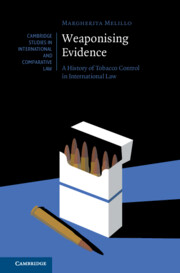
Chapter 1 sets the historical and theoretical background of the book. It starts by describing the regulatory battles that took place from the 1970s to adopt more stringent tobacco control measures. Then, it illustrates how the negotiations of the WHO Framework Convention on Tobacco Control and the subsequent WTO and international investment disputes can be considered the internationalisation of the tobacco wars. In this context, the concept of ‘lawfare’ is introduced as a descriptive device and analytical tool for the analysis of the book. The second part of the introduction introduces the second fil rouge of the book: evidence. It begins by defining the notion of evidence and by showing how, in the context of tobacco control, it can refer to different bodies of evidence that pertain both to the risk assessment and risk management dimension of tobacco control measures. This second part, moreover, shows how evidence has always been one of the key points of contention in the tobacco wars and has continued to be so in the international tobacco control lawfare. The introduction concludes with an explanation of the methodology employed, a reflection on its limits, and an outline of the content of the book.
In addition to summarising the main findings of the book, this final chapter offers some reflections on the lessons that emerge from the history of the international tobacco control lawfare. The reflections are organised around the two main themes of the book: lawfare (Section 5.1) and evidence (Section 5.2). The first part offers some thoughts on the value of using ‘lawfare’ as an analytical tool, zooming in on the role of business actors in international regulation (Section 5.1.1) and on a reflexive account on one’s research (Section 5.1.2). The second part summarises the main topics related to evidence that have emerged in the book: the different types of evidence in risk assessment and risk management (Section 5.2.1), international law’s overreliance on evidence (Section 5.2.2), evidence as a weapon (Section 5.2.3), and evidence as an ideological battleground (Section 5.2.4).
Weaponising Evidence provides the first analysis of the history of the international law on tobacco control. By relying on a vast set of empirical sources, it analyses the negotiation of the WHO Framework Convention on Tobacco Control (FCTC) and the tobacco control disputes lodged before the WTO and international investment tribunals (Philip Morris v Uruguay and Australia – Plain Packaging). The investigation focuses on two main threads: the instrumental use of international law in the warlike confrontation between the tobacco control advocates and the tobacco industry, and the use of evidence as a weapon in the conflict. The book unveils important lessons on the functioning of international organizations, the role of corporate actors and civil society organizations, and the importance and limits of science in law-making and litigation.
Political technology' is not a term much used in the West. But spin and political consulting are outdated labels. Spin doctors and political consultants do more than spin or consult; they also meet the definition of engineers of the political system. Particularly in the United States, where a different type of political universe has been constructed: Political Action Committees, dark money and astroturfing.
The Russian invasion of Ukraine has widely been seen as a failure of the international legal order, which could neither stop Russia from launching a war of aggression, nor prevent the perpetration of international crimes. In such a reading, great power politics have (once again) trumped international law. We argue instead that international law plays a crucial part in the conflict by providing a semantic infrastructure, which the opposing parties use to justify their actions, try to re-draw limits of permissible action and negotiate changing ‘red lines’ with the enemy. Drawing on the notion of lawfare, we show how the pragmatic (mis-)use of international law flexibly delineates boundaries and stabilizes expectations between adversaries even as they are contested in the current war. We focus on claims about self-determination and self-defence to justify the use of force; categorizations of combatants; and weapons transfers and the status of third states. That international law can be violated or reinterpreted to breaking point does not make it irrelevant. To the contrary, it recalls its important role as a language of conflict and compromise, beyond strictly legalist as well as dismissive realist views.
Modern state law excludes populations, peoples, and social groups by making them invisible, irrelevant, or dangerous. In this book, Boaventura de Sousa Santos offers a radical critique of the law and develops an innovative paradigm of socio-legal studies which is based on the historical experience of the Global South. He traces the history of modern law as an abyssal law, or a kind of law that is theoretically invisible yet implements profound exclusions in practice. This abyssal line has been the key procedure used by modern modes of domination – capitalism, colonialism, and patriarchy – to divide people into two groups, the metropolitan and the colonial, or the fully human and the sub-human. Crucially, de Sousa Santos rejects the decadent pessimism that claims that we are living through 'the end of history'. Instead, this book offers practical, hopeful alternatives to social exclusion and modern legal domination, aiming to make post-abyssal legal utopias a reality.
In this and the following chapters I analyse the history of abyssal exclusions brought about by modern state law. I define lawfare as any performance in the name of law (a declaration, norm, sentence, official action or omission) premised on the extreme strangeness of the addressee or target, either because the latter is not fully human (the stranger as a subhuman being) or because its actions must be sanctioned without the normative constraints of the rule of law (the stranger as an internal or external enemy). The long journey of lawfare is the long journey of capitalism, colonialism and patriarchy. It has undergone multiple metamorphoses and reincarnations since the sixteenth century. From colonial law to imperial law, from the penal law of the enemy to the criminalisation of protest, and from the war on corruption to the war on migration, the abyssal exclusion of targeted social groups has been carried out by lawfare. In every instance, modern domination has found ways of separating humanity from subhumanity, friend from enemy, and non-abyssal social exclusion from abyssal exclusion. There is no reason to believe that new metamorphoses will not appear. The abyssal line is the most resilient and most fundamental structure of Western domination. Only successful struggles against capitalism, colonialism and patriarchy will bring about the progressive dislocation of the abyssal line through sustained interruptions of the institutions upon which Western domination reproduces itself, namely the state and the law.
Frames such as political warfare, sharp power and weaponized interdependence do not capture the full spectrum of China's “reunification” operations targeting Taiwan, particularly in regard to the fundamental legal domain. Making use of primary materials and elite interviews, Beijing's lawfare against Taiwan is examined as part of a matrix of military threats, covert infiltration and measures aimed at attracting Taiwanese public opinion. This study argues that China's multi-domain Taiwan strategy should be understood as hybrid influencing. A foundational element of this strategy is Chinese lawfare, which can be boiled down to three axiomatic principles – namely, to reframe the relationship between Beijing and Taipei as an internal dispute, to close down Taiwan's international space and to contain any right to self-determination. As distinct from Anglophone conceptions, Chinese lawfare seeks in essence to exploit the uncertainty of Taiwan's status under international law to make strategic gains – maximally, “to win without fighting.”