Skip to main content Accessibility help
×
  • Cited by 4
    • Show more authors
    • You may already have access via personal or institutional login
    • Select format
    • Publisher:
      Cambridge University Press
      Publication date:
      30 April 2024
      02 May 2024
      ISBN:
      9781108586191
      9781108425391
      9781108442282
      Dimensions:
      (229 x 152 mm)
      Weight & Pages:
      1.253kg, 770 Pages
      Dimensions:
      (229 x 152 mm)
      Weight & Pages:
      1.093kg, 770 Pages
    You may already have access via personal or institutional login
  • Selected: Digital
    Add to cart View cart Buy from Cambridge.org

    Book description

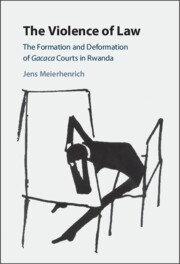
    'Lawfare' describes the systematic use and abuse of legal procedure for political ends. This provocative book examines this insufficiently understood form of warfare in post-genocide Rwanda, where it contributed to the making of dictatorship. Jens Meierhenrich provides a redescription of Rwanda's daring experiment in transitional justice known as inkiko gacaca. By dissecting the temporally and structurally embedded mechanisms and processes by which change agents in post-genocide Rwanda manoeuvred to create modified legal arrangements of things past, Meierhenrich reveals an unexpected jurisprudence of violence. Combining nomothetic and ideographic reasoning, he shows that the deformation of the gacaca courts – and thus the rise of lawfare in post-genocide Rwanda – was not preordained but the outcome of a violently structured contingency. The Violence of Law tells a disturbing tale and will appeal to scholars, advanced students, and practitioners of international and comparative law, African studies and human rights.

    Awards

    Shortlisted, 2025 Socio Legal Theory and History Prize, Socio-Legal Studies Association

    Winner, 2025 Best Book Award, African Politics Conference Group, American Political Science Association

    Finalist, 2025 Raphael Lemkin Book Award, Institute for the Study of Genocide

    Reviews

    ‘Law is violence, not always (let alone necessarily) an alternative to it, Jens Meierhenrich brilliantly documents in this long-awaited masterpiece, in the process entirely overturning congratulatory, melodramatic, and orientalist depictions of local ‘justice.’ A genuinely monumental work, in insight as well as in scope.’

    Samuel Moyn - Chancellor Kent Professor of Law and History, Yale Law School

    ‘Deeply informed theoretically, and truly interdisciplinary, The Violence of Law builds upon a granular account of Rwanda’s post-genocide experience, including a detailed ethnography of its widely noted gacaca courts, to develop an important argument of how legalism and ‘lawfare,’ consent and coercion, are simultaneously constructed and entangled in support of governmentality. The book deserves close attention from everyone interested in legal theory.’

    Mark Tushnet - William Nelson Cromwell Professor of Law Emeritus, Harvard Law School

    ‘The Violence of Law is a first-rate critique of transitional justice as injustice. It reveals a jurisprudence of violence unexpected by those who misunderstand rule-of-law promotion as an inherently good practice.’

    Laura Nader - Professor of Anthropology, University of California, Berkeley

    ‘Meierhenrich pulls back the veil of ignorance to show the violence embedded in the law. Meticulously and exhaustively researched and expertly analyzed, The Violence of Law is a magisterial accomplishment. Its findings go beyond the gacaca courts to question the entire transitional justice enterprise.’

    Michael Barnett - University Professor of International Affairs and Political Science, George Washington University

    Weaving together on-the-ground observations, political theories, photographic evidence, and historical narratives, The Violence of Law exposes how brutal effects of power can be accompanied by a narrative of victimhood, mobilizing international sympathy.’

    Martha Minow - 300th Anniversary University Professor, Harvard Law School

    Refine List

    Actions for selected content:

    Select all | Deselect all
    • View selected items
    • Export citations
    • Download PDF (zip)
    • Save to Kindle
    • Save to Dropbox
    • Save to Google Drive

    Save Search

    You can save your searches here and later view and run them again in "My saved searches".

    Please provide a title, maximum of 40 characters.
    ×

    Contents

    Metrics

    Altmetric attention score

    Full text views

    Total number of HTML views: 0
    Total number of PDF views: 0 *
    Loading metrics...

    Book summary page views

    Total views: 0 *
    Loading metrics...

    * Views captured on Cambridge Core between #date#. This data will be updated every 24 hours.

    Usage data cannot currently be displayed.

    Accessibility standard: Unknown

    Why this information is here

    This section outlines the accessibility features of this content - including support for screen readers, full keyboard navigation and high-contrast display options. This may not be relevant for you.

    Accessibility Information

    Accessibility compliance for the PDF of this book is currently unknown and may be updated in the future.