To save content items to your account,
please confirm that you agree to abide by our usage policies.
If this is the first time you use this feature, you will be asked to authorise Cambridge Core to connect with your account.
Find out more about saving content to .
To save content items to your Kindle, first ensure no-reply@cambridge.org
is added to your Approved Personal Document E-mail List under your Personal Document Settings
on the Manage Your Content and Devices page of your Amazon account. Then enter the ‘name’ part
of your Kindle email address below.
Find out more about saving to your Kindle.
Note you can select to save to either the @free.kindle.com or @kindle.com variations.
‘@free.kindle.com’ emails are free but can only be saved to your device when it is connected to wi-fi.
‘@kindle.com’ emails can be delivered even when you are not connected to wi-fi, but note that service fees apply.
Global capitalism is being reshaped by two major trends. States have become increasingly interventionist, reshaping their economies in response to crises and geopolitical tensions. Secondly, digital platform giants have emerged from the US and China that concentrate political economic power in private hands. This Element argues that these trends are increasingly symbiotic. Digital platforms are being folded into the spiralling rivalry between the US and China. As states tap into their extraterritorial governance capacities by exerting control over platforms, platform firms leverage state support to pursue and expand their internationalization strategies. Therefore, the US-China rivalry is increasingly being fought at the level of the technology stack, a dynamic the authors call state platform capitalism. The Element examines four fields in which this novel regime of competition is at play: digital currencies, technical standards, cyber security, and smart cities. This title is also available as Open Access on Cambridge Core.
Chapter 3 demonstrates the centrality of fiscal infrastructures to the action of Marlowe’s plays. His Tamburlaine plays, The Jew of Malta, and A Massacre at Paris all hinge on the agencies created by – and the violence associated with –wealth organized into treasuries. The protagonists of these plays – Tamburlaine, Barabas, and the Duke of Guise – draw attention to their own and others’ treasuries, and their stories underscore both the security and the volatility associated with treasuries in action. In each play, treasuries drive the action by creating security for some through extreme violence to others. For Marlowe, treasuries are central to his depiction of geopolitical existence. Fiscal realities, in turn, represent a primary formal mechanism impacting how Marlowe’s characters – and audiences – experience the antagonistic spaces of geopolitical existence. Marlowe’s awareness of the challenges of implementing sovereignty are thus central to his ongoing project of creating theatrical states of emergency.
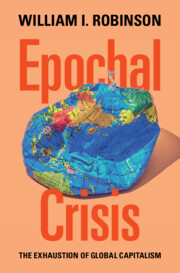
In a groundbreaking new study, acclaimed scholar of global capitalism William I. Robinson presents a bold, original, and timely 'big picture' analysis of the unprecedented global crisis. Robinson synthesizes the different economic, social, political, military, and ecological dimensions of the crisis, applying his theory of global capitalism to elucidate these multidimensional and interconnected aspects. Addressing urgent issues such as economic stagnation, runaway financial speculation, unprecedented social inequalities, political conflict, expanding wars, and the threat to the biosphere, he illustrates how these different dimensions relate to one another and stem from the underlying contradictions of a global system spiralling out of control. This is a significant theoretical contribution to the study of globalization and capitalist crisis, in which Robinson concludes that the conditions for global capitalist renewal are becoming exhausted.
Recommend this
Email your librarian or administrator to recommend adding this to your organisation's collection.