To save content items to your account,
please confirm that you agree to abide by our usage policies.
If this is the first time you use this feature, you will be asked to authorise Cambridge Core to connect with your account.
Find out more about saving content to .
To save content items to your Kindle, first ensure no-reply@cambridge.org
is added to your Approved Personal Document E-mail List under your Personal Document Settings
on the Manage Your Content and Devices page of your Amazon account. Then enter the ‘name’ part
of your Kindle email address below.
Find out more about saving to your Kindle.
Note you can select to save to either the @free.kindle.com or @kindle.com variations.
‘@free.kindle.com’ emails are free but can only be saved to your device when it is connected to wi-fi.
‘@kindle.com’ emails can be delivered even when you are not connected to wi-fi, but note that service fees apply.
To characterise hospital-treated multimorbidity patterns in people who subsequently died a drug-related death in Scotland, and to identify clinically meaningful associations among conditions and decedent to inform prevention and care.
Methods:
A register-based retrospective cohort study using nationally linked hospital admission (1996–2019) and mortality (2008–2019) records for 5,749 decedents. We identified hospital admissions for Elixhauser comorbidities using ICD-10 codes. Correlation analysis, network analysis, and Bayesian clustering were used to describe co-occurring conditions and identify patient clusters with distinct comorbidity profiles.
Results:
Over half (50.9%) of decedents had at least one admission for an Elixhauser comorbidity. The most frequent were related to alcohol use (38.2%), drug use (29.1%), other neurological disorders (18.0%, mainly epilepsy/seizures/anoxic brain injury), depression (15.2%), and psychoses (12.5%). Network analysis highlighted drug use, alcohol use, psychoses, depression, and neurological disorders as central conditions. Bayesian clustering identified seven distinct patient clusters, including groups characterised by: high psychiatric and drug-use admissions; extensive physical comorbidities; alcohol and liver disease; dominant neurological issues and depression.
Conclusions:
Individuals experiencing drug-related deaths exhibit substantial multimorbidity with distinct patterns often dominated by substance use and mental ill-health but also including significant physical health clusters. These distinct profiles underscore the need for integrated, tailored care strategies addressing substance use, psychiatric, and physical health needs to mitigate mortality risk.
This chapter traces the progression of nationalist writing in Wales and Scotland from the Popular Front fiction of the 1930s through to the devolved nations of the twenty-first century. Raymond Williams’s changing position on the nationalist question is charted and related to the work of the political theorist Tom Nairn. Williams is further analysed in the second half of the chapter as an indicative case study of a creative writer who drew on the legacy of the 1930s writers in order to tackle the centralist tendencies of English literature. In the process, Williams himself became a protagonist in the devolution struggle and is portrayed as such in John Osmond’s Ten Million Stars Are Burning (2018). The chapter concludes by discussing why documentary approaches, such as Osmond’s novel and James Robertson’s And the Land Lay Still (2010), are important to the fictional representations of the struggle for Welsh and Scottish independence.
Fiscal rules for devolved nations present some fundamental challenges not faced when making national fiscal Rules. Most importantly, rules across devolved nations involve a negotiation between the central and devolved governments who have very different objectives and so the framework created ends up as a mix of economics, politics and the vagaries of compromise. This article highlights how these issues have resulted in Scotland finances being heavily influenced by both inflation and population growth in ways that were never intended to become a long run feature of the funding framework.
Surveying a range of literary texts written in the vernacular languages of medieval Britain, this chapter is concerned with the ways in which the peoples of Ireland, Scotland, and Wales defined themselves in opposition to the dominant state power of England. Countering the Latin historical tradition which positioned British history as English history, writers working in Irish, Scots, Scottish Gaelic, and Welsh constructed origin myths and literary traditions that worked to build local communities and regional identities. Though the territories clustered around England were far from united in their political structures, they came together as peoples to resist the imperial ambitions of the English state.
The Statute of York in 1322 recognised that ‘in time past … troubles and wars have happened in the realm’, blaming this on the various attempts to restrict royal power in the thirteenth century. Reform, sometimes led by the crown and sometimes imposed upon it, was a key theme in the reigns of Henry III (1216–72) and Edward I (1272–1307). Two other themes, focused on the king’s interests beyond the borders of England, had significant effects on relations between the king and his English subjects, as the king sought to access their manpower, money and material. These interests were the king’s claims to sovereignty over all Britain and protecting his remaining lands in France.
In an era steeped in national stereotypes that bled into slanders and hatred, the English were notorious in later medieval Europe for three things: drunkenness, bearing a tail and killing their kings. But it is with the implications of another alleged propensity – for waging wars of conquest that sought to turn neighbours into subjects – that this chapter is largely concerned. By the later Middle Ages, the bellicose reputation of England’s kings reverberated across Christendom. Jean Froissart (d. c. 1405), the chronicler of chivalry who visited the court of Edward III, noted that, because of their great conquests, the English were ‘always more inclined to war than peace’.
Over the last decade, the Scottish Government have pursued a positive, highly visible immigration politics, despite Scotland lacking formal immigration powers and being enveloped within a United Kingdom that has simultaneously pursued an increasingly securitised approach. With securitisation intensifying globally, coupled with a rise in, and political success of, anti-immigration parties and actors, this article investigates the question of why the Scottish Government has pursued a desecuritising approach – a neglected strand of (de)securitisation studies that principally focuses on the how. We draw on insights from ontological security studies to investigate the Scottish Government’s desecuritisation activity between 2014 and 2024, demonstrating that, whilst there are rationalist-materialist explanations, desecuritisation was not inevitable. Instead, by exploring the relationship between immigration and the construction of the Scottish self at the ontological level we can more fully understand the drivers behind desecuritisation. Pursuing a desecuritised immigration politics is shown, first, to support the Scottish Government’s core autobiographical narrative about who ‘Scotland’ is (open, welcoming, and internationalist), and second, through nurturing a Lacanian fantasy, to be affectively rewarding. Last, the article contributes to the (re)conceptualisation of linearity and temporality in (de)securitisation studies, showcasing contemporary-orientated desecuritisation moves dovetailing with moves aimed at an institutional ‘future-proofing’ of desecuritised immigration governance.
The ninth chapter expands the analysis to Scotland and Ireland; in both kingdoms, wardship was instrumental in the disintegration of royal power. In Scotland, Charles I’s efforts to re-write the land law and extend his rights to wardships via an Act of Revocation (1633) was considered to be ‘the ground stone of all the mischeiffe that folloued after’ (sic), an arch reference to the rebellion that began in Scotland in 1638. In Ireland, wardship and the entire land law were deployed as a means of religious conversion. Wardship was thus an integral component of the bitter religious conflict that erupted in 1641. It was these rebellions which ultimately precipitated the English Civil War, that offered Parliament the opportunity to finally abolish the feudal tenures in 1646, an abolition confirmed at the Restoration of the Crown in 1660.
Social networks are a valuable object of investigation in historical sociolinguistics, as they can contribute both to the onset of change and to the maintenance of linguistic norms. However, their characteristics make them complex to analyse, as their intrinsic variability may hinder the identification of phenomena that span different networks across time and space. This chapter is focused on Late Modern English materials, to present new resources through which network contiguities can be studied; this is the case, for instance, with the exchanges of emigrants, political activists, scholars and business correspondents. After addressing a few methodological issues, the chapter presents an overview of the materials at hand and outlines how networks and coalitions have had an impact, not only on the usage of participants (as shown in recent studies) but also on how language has been perceived, described and codified.
Salvadore Cammarano’s libretto is based on the historical novel The Bride of Lammermoor by Walter Scott and thus invites us to examine the real-life sources for Scott’s published work. In addition, as the Scott work was published in 1819, it follows on the heels of the more famous novel by Mary Shelley, Frankenstein; or, the Modern Prometheus in 1818. Shelley’s gothic novel reveals a similar fascination with the sociopolitical environment of the early Enlightenment, as well as the spectres of madness, murder and the private lives of individuals caught up in vengeful forces beyond their control. Beyond the literary sources for the libretto, the opera also bears witness to the use of medical knowledge in defining the appearance and sound of a mentally ill young woman who has succumbed to hysteria. According to medical treatises of the time, hysteria was a disease that bore physical and emotional symptoms, the severity of which could be diagnosed with the relatively new invention of the stethoscope (1816). As Donizetti’s work premiered during a time of heightened listening, whereby audiences sought to hear within the notes of the music the inner world of the composer or the performer, the sound of pain or latent disease was now understood to reflect a lexicon of medically understood sounds that reveal themselves to the careful listener.
In this timely and impactful contribution to debates over the relationship between politics and storytelling, Lee Manion uncovers the centrality of narrative to the European concept of sovereignty. In Scottish and English texts traversing the political, the legal, the historiographical, and the literary, and from the medieval through to the early modern period, he examines the tumultuous development of the sovereignty discourse and the previously underappreciated role of narratives of recognition. Situating England and Scotland in a broader interimperial milieu, Manion shows how sovereignty's hierarchies of recognition and stories of origins prevented more equitable political unions. The genesis of this discourse is traced through tracts by Buchanan, Dee, Persons, and Hume; histories by Hardyng, Wyntoun, Mair, and Holinshed; and romances by Malory, Barbour, Spenser, and Melville. Combining formal analysis with empire studies, international relations theory, and political history, Manion reveals the significant consequences of literary writing for political thought.
Given the privileged position of anglophone literature, medieval travel writing from England has been covered more extensively than that originating in other literatures and traditions. This chapter will try to balance English and Scottish travel writing, while omitting three writers in particular that feature elsewhere in this volume: Sir John Mandeville, Margery Kempe, and William Wey. There is no shortage of travel writing situated in England and Scotland: Ohthere, The Stacions of Rome, or the General Prologue to The Canterbury Tales are only some instances. English and Scottish pilgrims to the Continent and Palestine have left numerous accounts, the most striking early example of which is Saewulf’s voyage to Jerusalem in 1102. This chapter will offer an overview of several central and remarkable English and Scottish travel texts. Furthermore, I will look at texts for which travel is central yet that have not been typically considered as travel writing. In this sense, I continue the theme of this volume in embracing a capacious definition of ‘travel writing’ as not only texts that make travel their express subject, but that contain and offer accounts of multiple journeys.
This chapter uses Bill Shankly’s appointment as manager as the jumping off point for a discussion of LFC and the city of Liverpool on the cusp of the 60s. It examines the pre-1959 career of Bill Shankly, his early (not immediately successful) years as LFC boss, and the club’s long and fruitful relationship with Scottish football. The arrival of the ultimate Scottish hero, Shankly, is placed in the context of e.g. the 1892/93 ‘Team of the Macs’ and popular players such as Alex Raisbeck and later Manchester United manager Matt Busby.
The contexts for the acquisition of Scottish Gaelic have changed significantly in recent decades through the impact of ongoing language shift to English in traditionally Gaelic-speaking communities and different kinds of language revitalisation initiatives, especially in relation to education (for adults as well as schoolchildren). This chapter reviews the sociolinguistic and policy dynamics that have brought about these changes and presents key findings from a range of studies involving linguistic demography, community language use, intergenerational language change, dialect maintenance, family language policy, language acquisition and attainment, and issues of affinity and identity.
This chapter discusses MacCormick’s childhood, growing up in a very political family in Glasgow. It examines the complex relationships between MacCormick and his father as well as his mother. It situates his father’s nationalist politics in the historiography of Scottish politics generally, from the 1920s to the 1950s. It describes the three main events in which MacCormick, as a boy, was exposed to his father’s particular kind of nationalism: the Convention (est. 1942) and Covenant (1949–51); the taking of the Stone of Destiny (1950); and the MacCormick v Lord Advocate case (1953). In focusing on MacCormick’s early family life, the chapter begins the process of seeking to explore his character – here, primarily by reference to his relationships with his parents.
This chapter tackles MacCormick’s lifelong engagement with and reflection on nationalism, including both in terms of how he lived it politically and how he philosophised it. It situates MacCormick’s nationalism in the historiography of Scottish nationalism, resisting attempts to frame the field on the basis of either pro- or anti-independence views. MacCormick’s nationalism cannot be shoehorned in this way. Instead, the chapter explores MacCormick’s particular kind of nationalism by reference to its relation to time – e.g., in the form of gradualism – as well as how he reflected on the constitutional importance of the Union of 1707. It also considers how MacCormick conceptualised nationalism – as liberal and civic – and how this was explored both in his philosophical work as well as in his political life, e.g., in his various campaigns as SNP candidate in Westminster elections. The chapter also considers MacCormick’s contributions to the SNP’s Constitutional Policy Committee, and in particular his work on the Draft Constitution for a Future Independent Scotland. In so doing, the chapter examines how MacCormick’s nationalism and constitutionalism can be read as a matter of character.
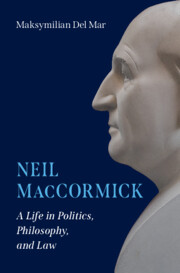
Neil MacCormick (1941–2009) was one of the twentieth century's most important legal philosophers and one of Scotland's most influential public intellectuals. This book tells the story of his political and philosophical life, from his intensely political childhood as the son of 'King John', one of the founders of the Scottish National Party, through to his involvement in Scottish politics – especially as the author of SNP's constitutional policy – and his role as a Member of the European Parliament, helping to draft the European Constitution. With special attention to MacCormick's character, this book offers a reading of his entire oeuvre, covering his contributions to theories of legal and moral reasoning, institutional legal theory, nationalism, post-sovereignty, subsidiarity, and constitutional pluralism in Europe. This book reads MacCormick as a highly creative thinker who excelled in the art of constructing inclusive middles and thereby developed his own distinctive approach to politics and philosophy.
While Shelley produced many of his most important works in self-imposed exile from Great Britain, various locales in England, Ireland, Scotland, and Wales played an important role in his personal and poetic development. Attending to Shelley’s experiences across Great Britain and Ireland, and to local sociopolitical dynamics in the places where he lived and worked, this chapter traces some formative influences upon his later poems and essays. It finds that Shelley’s political and aesthetic maturation owed much to his geographical and institutional surroundings and illuminates how these surroundings contributed to his alienation, radicalisation, and visionary zeal.
This chapter focuses on the impact of ecoviolence – in particular, climatic uncertainty – on the language and culture of three areas within the Northwest Wales Coastline and within the county of Gwynedd. These are considered the Cadarnleoedd y Gymraeg. The Cadarnleoedd is often contested as a political tool rather than a formally recognised linguistic or cultural territory, as is the Gaeltacht in Ireland and the Gaidhealtachd in Scotland. Here, it is used to describe the areas in Wales where the Welsh language is strongest, with at least 50 per cent of the population able to speak it. There has been a consistent decrease in the number of people able to speak Welsh in Wales, which is challenging the sustainability of the language in its traditional heartlands.
This chapter takes as its starting point the features identified as critical in understanding the process of educational reform, set out by McLaughlin and Ruby in their review of the case studies in Implementing Educational Reform: Cases and Challenges. These are: the historical and political context; models of implementation; timescale; internal and external actors; communication and discourse. It examines the relationship between structure and culture in promoting successful change in educational systems focusing particularly on the role of external actors in shaping the Scottish Government’s management of change and the tension between the broad curricular intentions and the narrow conception of assessment in upper secondary school. It also examines the extent to which governance reform is capable of enabling sustained cultural change; and the best means of encouraging teachers to develop a sense of agency, not simply the implementers of policy devised by external ‘experts’. It illustrates how educational reform in Scotland is complex, contested territory in which the policy intentions of government are interpreted and mediated through bureaucratic agencies, professional networks and an expanding field of interest and pressure groups.