Politics and Knowledge Shaping Educational Reform
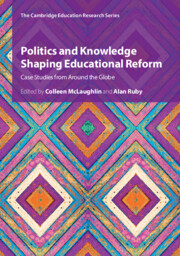

-
Select format
-
- Publisher:
- Cambridge University Press
- Publication date:
- 06 February 2025
- 13 February 2025
- ISBN:
- 9781009414753
- 9781009414807
- Dimensions:
- (244 x 170 mm)
- Weight & Pages:
- 0.54kg, 216 Pages
- Dimensions:
- Weight & Pages:
- Subjects:
- Teacher training and professional development, Education policy, strategy and reform, Education, Education, History, Theory
- Series:
- Cambridge Education Research
You may already have access via personal or institutional login- Subjects:
- Teacher training and professional development, Education policy, strategy and reform, Education, Education, History, Theory
- Series:
- Cambridge Education Research
Show more authors 
You may already have access via personal or institutional login
Book description
Have you ever wondered why education is always being reformed? This book provides ten case studies from all corners of the globe that illustrate how politics and data clash as education policies are developed, enacted, and assessed. A follow-up to the authors' previous book, Implementing Educational Reform, it highlights trends such as politicisation, showing where successful policies have been dropped, and where failed policies persist for ideological ends. Drawing on examples from South Africa, Ghana, Rwanda, Peru, Portugal, post-Soviet states and the UK, it shows how education policy can be disruptive and abrupt, or consensual and gradual. It challenges the managerial model of education reform that has dominated the last thirty years of education reform thinking, ultimately deepening our understanding of the importance of practical knowledge in designing and implementing policies. It is essential reading for practitioners, policy makers, and researchers of education research, education policy, and international education reform.
Contents
Contents
References
Metrics
Altmetric attention score
Full text views
Full text views helpTotal number of HTML views: 0
Total number of PDF views: 0 *
 Loading metrics...
* Views captured on Cambridge Core between #date#. This data will be updated every 24 hours.
Usage data cannot currently be displayed.
Accessibility standard: Unknown
Why this information is here
This section outlines the accessibility features of this content - including support for screen readers, full keyboard navigation and high-contrast display options. This may not be relevant for you.
Accessibility Information
Accessibility compliance for the PDF of this book is currently unknown and may be updated in the future.