To save content items to your account,
please confirm that you agree to abide by our usage policies.
If this is the first time you use this feature, you will be asked to authorise Cambridge Core to connect with your account.
Find out more about saving content to .
To save content items to your Kindle, first ensure no-reply@cambridge.org
is added to your Approved Personal Document E-mail List under your Personal Document Settings
on the Manage Your Content and Devices page of your Amazon account. Then enter the ‘name’ part
of your Kindle email address below.
Find out more about saving to your Kindle.
Note you can select to save to either the @free.kindle.com or @kindle.com variations.
‘@free.kindle.com’ emails are free but can only be saved to your device when it is connected to wi-fi.
‘@kindle.com’ emails can be delivered even when you are not connected to wi-fi, but note that service fees apply.
The treatment of Rome and its history in Ennius’ Annales has received significant scholarly attention in recent years. This work has shown well that the epic sets the city at the centre of a widening Roman world, thereby making it a cosmic hub of space and time. Such epic transformations also transform perspectives on the past and the present. What of Rome in the rest of Ennius’ wide-ranging literary output? How does the tri- or quadrilingual former Rudian approach his new unelected home and its socio-cultural practices in genres beyond epic? Taking into consideration the representation of (urban) space, monuments, social practices (especially ritual acts, praise, and elite self-presentation), and intersectional conceptions of Roman identity, this chapter examines the ways in which Ennius’ writings construct and reflect Rome qua city and set of cultural values and perspectives. The Scipio, Ambracia, and Sabinae anchor the chapter, but the contribution also uncovers key themes in less expected places, with some comment on the epigrams, Hedyphagetica, and philosophical works.
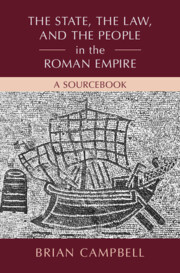
This volume makes more widely available to students and teachers the treasure trove of evidence for the administrative, social, and economic history of Rome contained in the Digest and Codex of Justinian. What happened when people encountered the government exercising legal jurisdiction through governors, magistrates, and officials within the legal framework and laws sponsored by the state? How were the urban environment of Rome and Italy, the state's assets, and human relations managed? How did the mechanisms of control in the provinces affect local life and legal processes? How were contracts devised and enforced? How did banks operate? What was the experience of going to court like, and how did you deal with assault or insult or recover loss? How did you rent a farm or an apartment and protect ownership? The emperor loomed over everything, being the last resort in moderating relations between state and subject.
Chapter 2 considers the state’s legal power in acquiring land and materials for construction and maintenance of public amenities, the management of the built environment in Rome and the activities of its inhabitants, the nature of urban life, and the provision and protection of amenities, such as corn, the water supply, baths, and games. The emperor assumed responsibility for the welfare of his people; this was his duty but was also politically important. The emperor provided for security and control in the city, sponsoring firemen (vigiles), urban cohorts, and praetorian guard under the command of officials with defined legal powers: prefects of the city, of the praetorians, and of the vigiles. Outside Rome: the management and status of communities in Italy, the organization of land and people, facilities including roads and bridges, important institutions in society, such as collegia and alimenta, and the legal jurisdiction of the praetorian prefect within Italy.
This chapter addresses the question of Casulana’s development as a composer. Through historical network analysis, it presents evidence suggesting that Casulana was connected to Nicola Vicentino for a significant part of her life, and that it was through him she established her first networks. Their paths led them both to Vicenza, to Siena during the siege of 1554–55, as well as to Rome, Venice, Milan, and more indirectly to Munich and Paris. Moreover, their networks intersected on several occasions. These data provide substantial evidence to argue that Casulana and Vicentino were somehow personally connected. Vicentino, the leading theorist of chromaticism in the mid-sixteenth century, had many students, including several women, and he was clearly not an opponent of female instruction. His implicit musical philogyny lends significant plausibility to the hypothesis that he may have had Casulana as a student.
This chapter focuses on Palmyra’s choices in weaving a wider network of social ties to both the Mediterranean and eastern world in order to enjoy the recognizable success that lasted several centuries. It gleans evidence of the presence of Palmyrenes in the Mediterranean, Egypt, the Persian Gulf and Indian Ocean, before discussing the observable strategies in terms of strengthening commercial ties or choices in items of trade based on their high commercial value and lightness in terms of transport, such as silk or pearls.
Chapters 5 and 6 focus on clusters of re-narrated episodes in Cyril’s response to Julian. Chapter 5 is organized by one of Julian’s own categories: the “gifts of the gods” which, he had argued, were given in surpassing quality and quantity to the Hellenic people. This chapter groups Julian’s various iterations of gifts and Cyril’s sprawling responses in three, interrelated categories: exemplary characters, intellectual superiority, and military and political domination. In Cyril’s responses, Minos was no legendary hero but rather imitated the fallen angels’ lust for domination; the Attic language itself (not to mention the convention of writing) derived from proto-Christian sources; and the Jewish people’s turbulent history and the present ascendance of Roman superiority equally reflect the Christian God’s management of the cosmos.
Rome continued to attract deep interest for its classical vestiges. The most cultivated among pilgrims and travellers also came to Rome to see what remained of the old monuments scattered within and without the 20 km of its city walls that enclosed a territory of 1,400 hectares and a population between 30,000 and 50,000 inhabitants. The variety of geographical origins, perspectives and approaches to Rome as a destination of travel, whether real pilgrimages and journeys or imaginary and intellectual journeys, produced a rich array of texts of different genres: itineraries amidst churches and ancient monuments of Rome, catalogues that described the city, its features, marvels (mirabilia), sites, buildings and history, pilgrims’ and travellers’ accounts in the form of journals of their trips to Rome, including routes and impressions of the city; simple itineraries; letters addressed to friends; various kinds of literary (poetic or narrative) representations of the pilgrimage or journey to Rome.
Throughout the early Stuart period, Catholic seminarians at the Venerable English College, Rome, staged elaborate religious plays for multinational audiences on a nearly annual basis, typically Neo-Latin dramas about martyred English saints. This study shares original archival findings to critically reconstruct the many varieties of music featured in these productions, from French solo song to English madrigals and balletts. This collection of dramatic music includes surviving evidence of English compositions performed in seventeenth-century Italy. The author argues that by embracing foreign musical cultures while also deploying their own musical talents, repertoires, practices, and patronage in service to dramatizations of Catholic martyrdom, this English community was uniquely positioned to build cultural, social, and political connections between Britain and the European Continent during a significant period of rising English hegemony in the Mediterranean region and wider world.
The wayfinding theory of Kevin Lynch, this article proposes, lays bare an underappreciated spatial modality deployed by inhabitants and visitors to the Roman city based on street-view navigation of the city’s legible topographical elements, ranging from natural to built features of the environment. In particular, wayfinding is positioned as a primarily non-elite and sub-elite – or subaltern – spatial modality that elites may have been aware of, but rarely had to make use of in their movement through the city. A survey of a diverse set of epigraphic corpora – graffiti, enslaving collars, dipinti, curse tablets, brick stamps, tesserae, and epitaphs – instead demonstrates the pervasive role of wayfinding across many aspects of subaltern Roman life, especially in connection to the practical conduct of business, and how this spatial modality was entangled in several matrices of domination. Ultimately, the theoretical lens of wayfinding should encourage us to reorient our approaches to the topography of Rome away from elite productions of cartography and towards subaltern, street-level conceptions of the space of the urbs.
Chapter 4 is in part an examination of a Mycenaean divine Potnia, one affiliated with the “labyrinth,” the Potnia of the dabúrinthos (δαβύρινθος). The labyrinthine space with which she is associated is an Asian cult notion introduced from Anatolia to Balkan Hellas. This chapter also examines the Rājasūya, a Vedic rite of consecration by which a warrior is made a king and a likely cult counterpart to the Mycenaean initiation of the wanaks.
Chapter 2 examines the Vedic sacrificial post called the yūpa and its role in ritual performances. A Mycenaean Greek cognate term and comparable ritual implement lies behind the Linear B form spelled u-po – that is, hûpos (ὗπος). Among other topics treated in this chapter are the Mycenaean deity called the po-ti-ni-ja, a-si-wi-ja, the Asian Potnia, and the u-po-jo po-ti-ni-ja, the Potnia of the u-po (that is, húpoio Pótnia [ὕποιο Πότνια]), a term matched exactly by Sanskrit patnī-yūpá-.
Chapter 6 examines Iranian cult and myth as evidenced in the Nart sagas of Transcaucasia, but also among Scythians as well as in Zoroastrian tradition, including the psychotropic cult substances Haoma (Iranian) and Soma (Indic). The Greek polis of Dioscurias in the Caucasus is explored as a place where Hellenic and Indo-Iranian divine-twin myth and cult affiliation meet, as indeed they do in the Pontic polis of Sinope. Aeolian connections are conspicuous at both locales.
This chapter foregrounds Liverpool’s first European Cup win against Borussia Mönchengladbach in Rome as the starting point for discussion of the self-styled Europeanisation of the club and, above all, its supporters in the 1970s and 1980s. Drawing heavily on oral history, it analyses Liverpool’s emergence as an international cultural phenomenon, via supporters’ clubs, samizdat publications, fashion, television, and cheap travel.
Chapter 3 examines the Mycenaean wanaks and lāwāgetās, figures responsible for leading Mycenaean society in specific ways and who correspond notionally to figures implicit in Indic and Iranian social structures – figures who descend from still more ancient Indo-European antecedents charged with the task of leading society through the spaces of the Eurasian Steppes and in migrations southward out of the Steppes.
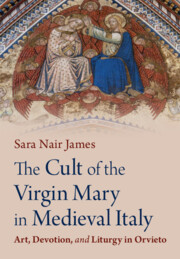
Late medieval Italy witnessed the widespread rise of the cult of the Virgin, as reflected in the profusion of paintings, sculptures, and fresco cycles created in her honor during this period. The cathedral of papal Orvieto especially reflects the strong Marian tradition through its fresco and stained-glass window narrative cycles. In this study, Sara James explores its complex narrative programs. She demonstrates how a papal plan for the cathedral to emulate the basilica of S. Maria Maggiore in Rome, together with Dominican and Franciscan texts, determined the choices and arrangement of scenes. The result is a tour de force of Marian devotion, superior artistry, and compelling story-telling. James also shows how the narratives promoted agendas tied to the city's history and principal religious feasts. Not only are these works more interesting, sophisticated, and theologically rich than previously realized, but, as James argues, each represents the acme in their respective media of their generation in central Italy.
This chapter deals with the history of money in ancient times. We start with ancient Mesopotamia, where fundamental value (silver and barley) was stored in temples. Clay tablets circulated openly, supporting fundamental value and contractual arrangements. Coinage in ancient Greece and Rome was a step forward in terms of ease of use but involved the risk of debasement – reduction of the content of precious metals. We describe debasement of coins from the late Roman empire to the Middle Ages, then move to China, where the first banknotes were printed in the early part of the second millennium. The use of paper in finance spread to Europe, where it became the key technology supporting the rise of banks in the late Middle Ages and the Renaissance. We describe the rise of central banks in Europe, starting from Sweden and ending with Germany and Italy. We draw several lessons from these experiences. The main one is that a successful money is a private–public partnership, where “public administration” and “private interest” combine and complement each other. The chapter ends with the birth of telecommunication in the nineteenth century and its early applications at the beginning of the twentieth century, which gave rise to radical changes in monetary technology in the subsequent period.
This chapter expands on and completes the analysis of Aristides’ political use of lyric. It argues that both Athens and Rome are depicted by the sophist through lyric and song imagery, and that these musical representations allow for a comparison between the two cities and how Aristides conceived of their role as imperial centres. Among other texts, a close reading of the celebration of past and present Athens in Or. 1 and that of imperial Rome in Or. 26 shows that the ways in which the two capitals ‘make music’ foreground some important similarities between their imperial politics. At the same time, Athenian and Roman ‘music’ point to the difference between Greek and Roman political cultures and approaches. Rather than indicating a critical attitude towards the current Empire, however, Aristides’ musical depiction of Athens and Rome is open to ambiguity and enables different co-existing interpretations, adding complexity and depth to our understanding of the political dimension of Aristides’ corpus.
This chapter explores Percy Shelley’s lifelong engagement with ‘empire’ by focusing on some of his major poems. His fascination with the ruins of empires, both ancient and modern, leads to a thorough critical examination of imperial violence. In Prometheus Unbound, Shelley redefines ‘empire’ as self-government that limits imperial dominance, which has far-reaching and international repercussions, as seen in the Gandhians’ resistance against British rule. Shelley goes on to examine the nature of empire in his final unfinished poem, ‘The Triumph of Life’, in which a triumphal chariot, the relentless force of empire originating from ‘Imperial Rome’, continues the cycle of subjugation throughout history. Against this chariot, Shelley places a resisting poet/narrator, who is asked, along with the readers of contemporary and future generations, to undertake the difficult task of envisioning a future unbound by imperial chains after the collapse of ‘empire’.
Most scholars hold a skeptical view of the war elephant of ancient India. I show that the skepticism of present-day historians derives from ancient Rome, at the end of the Republic and the beginning of the Empire, when the Romans, having defeated the elephant-deploying powers of the Hellenistic period, ended the use of war elephants in its growing empire for all time. Late Roman war elephant skepticism was taken up by Quintus Curtius Rufus, who embraced it and strengthened it rhetorically in speeches he devised and put into Alexander’s mouth, in his history of Alexander. In this way Roman skepticism about the value of the Indian war elephant was attributed to Alexander, two centuries previous to its formation among the Romans. In modern times the late Roman view that elephants have a tendency to panic and become a greater danger to their own side was turned into a settled truth about elephant physiology, but it does not accord with the evidence offered.
Archdeacon Hildebrand, who became Pope Gregory VII (r. 1073–85), is associated with a radical and swift change in the Roman Church. The vision of a Christendom jointly administered by emperor and clergy, the famous model advanced by Pope Gelasius II (r. 492–96), was transformed into a new order where regnum and sacerdotium occupied separate stacked spheres, with the spiritual claiming superiority. Unlike tenth-century reform movements, the later eleventh-century Roman reforms centered on the papacy. Popes assembled a curia featuring more professional officials, legates, councils, and other technologies of power. The reformed Church cultivated trained lawyers and sympathetic lay leaders. It has been credited with launching a legal “big bang,” the invention of propaganda, the creation of a semi-institutionalized public sphere, and the formation of a persecuting society. Closer examination of institutional changes helps reveal the achievements and limits of this “new world order.”