To save content items to your account,
please confirm that you agree to abide by our usage policies.
If this is the first time you use this feature, you will be asked to authorise Cambridge Core to connect with your account.
Find out more about saving content to .
To save content items to your Kindle, first ensure no-reply@cambridge.org
is added to your Approved Personal Document E-mail List under your Personal Document Settings
on the Manage Your Content and Devices page of your Amazon account. Then enter the ‘name’ part
of your Kindle email address below.
Find out more about saving to your Kindle.
Note you can select to save to either the @free.kindle.com or @kindle.com variations.
‘@free.kindle.com’ emails are free but can only be saved to your device when it is connected to wi-fi.
‘@kindle.com’ emails can be delivered even when you are not connected to wi-fi, but note that service fees apply.
Modern Hebrew literature has been driven by a call to productivity from its inception. Zionist history was born out of a break with its traditional and religious past, a historical transformation that coincided with the birth and perseverance of the productive Jew. However, even well into twentieth and twenty-first-century Hebrew literature, these tensions remain active. They illuminate not only the ways in which capitalization and secularization are ongoing processes but also latent yet available possibilities of resistance to the demands of productivity. The chapter focuses on the figure of the Shabbat and other forms of inoperativity and nonwork inherent within it in the poetry of Zelda Schneurson. It offers a reading of Zelda’s poetry from a materialist and political-theological perspective to locate her poetry and her depictions of nonwork within the intertwined histories of Zionism, secularism, and capitalism.
This paper deals with the question: To what extent do individual religious characteristics, in addition to collective religious characteristics, contribute to the explanation of formal and informal volunteering in the Netherlands at the beginning of the 21st century? To answer this research question, we used the SOCON 2005–2006 dataset. Our main finding concerns informal volunteering: we found that spirituality increases the likelihood of informal volunteering, implying that openness to other people’s needs increases the likelihood of the actual provision of help. There are no other aspects of religiosity that are related to informal volunteering. With regard to formal volunteering we found that, in line with previous research, religious attendance is related positively to formal volunteering, religious as well as secular volunteering, which can be regarded as support for the proposition that religious involvement is important for norm conformity. Further, having a more religious worldview decreases the likelihood of formal volunteering which might show that those with a strong religious worldview are more concerned with the ‘otherworldly’ and less so with what they do in this world. We found no influence of individual religious characteristics on formal volunteering. These results confirm the idea that integration into a religious community plays quite a large role in explaining formal volunteering. Informal volunteering, however, seems to be independent of social networks: it rather depends on individual motivation.
Research on volunteering has emphasized the positive role played by individual religiosity on this type of civic engagement. There are fewer studies on the relation between contextual religiosity and volunteer work. Several of them have concluded that the higher the macro-contextual religiosity, the higher the propensity to get involved in volunteering. Thereby, researchers might be inclined to conclude that secularization is a threat to this social participation. This article shows that such a conclusion is unfounded. From a data set including the 27 countries of the European Union and using a multilevel analysis to control for the compositional effects of the national sample, we obtain a negative correlation between macro-contextual religiosity and volunteering. From these results, we suggest that the relationship between volunteering and contextual religiosity cannot be considered as deterministic but it has to be comprehended in a more global cultural context.
This article analyzes the role of three antecedents of life satisfaction (LS) among healthcare volunteers in Malaysia. The antecedents are: personality traits, motives to volunteer, and spiritual capital. This study has empirically tested the impact of individual dimensions of personality traits, motives, and spiritual capital along with their inter-relationships in explaining the LS. The volunteers of St. John Ambulance participated in this study. The model has been tested using structural equation modeling and it has been found that the three constructs have an explanatory power of 53 %. The main results are: (1) neuroticism, value motives, protective motives, personal well-being, and spirituality have a direct impact on LS and (2) enhancement motives, social motives, and religiosity have an indirect impact on LS. These results can provide insights to researchers and managers regarding profiling the right volunteers, providing the necessary infrastructure, and providing proper training to the volunteers.
Recognition of the multi-cultural nature of the Canadian population has led companies across a wide array of business domains to reach beyond their traditional bases of support to focus on hitherto untapped communities as potential markets for their goods and services. Competitive conditions within the voluntary sector have pushed nonprofits along this same path. However, no systematic Canadian research reports on the attitudes, social norms, benefits sought, expectations, opportunities, experiences, or behaviors of sub-communities in the voluntary sector. This paper examines philanthropic behavior by religion using data from the Statistics Canada 2000 National Survey of Giving, Volunteering and Participating. The paper compares and contrasts the voluntary and philanthropic behaviors of the Canadian population across religious groups; compares and contrasts the motivations for and perceived impediments against such behaviors; and articulates and examines a model that traces the influence of religion on voluntary and philanthropic behavior in Canada’s multi-cultural society.
Individual motivation is the core of the actualization and continuity in voluntary work from both the standpoint of theoretical research and practical volunteerism. Volunteer motivation also provides an excellent research area for investigating the wider sociological theme of late-modern participation. This study, based on the data from 18 interviews, explores volunteer motivation utilizing a phenomenological approach to individual experience and the meaning of volunteerism. Using a phenomenological approach illuminates the nature of volunteer motivation more holistically. The research includes 767 motivational elements in 47 themes and develops an innovative four-dimensional octagon model of volunteer motivation—the theoretical and practical applications of which are discussed.
We examine the relationship between likelihood to volunteer and a range of human capital, social capital, religious capital and ubuntu variables in South Africa seven years after the official end of apartheid. Using the 2001 World Values Survey we find that education is positively associated with volunteering, but employment has a negative association with volunteering when including controls for wealth and income. Religiosity has a strong positive association with volunteering and a broad base, cutting across the socio-economic and racial divides. This suggest that religious congregations in collaboration with other sectors could be a vehicle to increase access to volunteer opportunities for those who lack the status to take part in other volunteering activities.
This chapter reviews the psychological research examining the relationship between religious faith and life purpose. First, because defining the constructs of religious faith and life purpose have been such an empirically challenging task, the author offers various definitions adopted in the social sciences. Second, the author describes theoretical propositions about possible mechanisms that help to explain why religious faith contributes to life purpose. Although research is limited, the author then reviews the empirical literature that has addressed the link between religious faith and life purpose, including findings to date that suggest that various religious faith constructs may play a key role in cultivating one’s sense of life purpose. The author also reviews the literature that has examined the complex relationships between religious faith, life purpose, and well-being. Throughout, the author offers suggestions for future research to advance the science examining religious faith and life purpose. The chapter closes with a discussion of the implications of this research to inform understandings of the development and importance of religious faith, and life purpose to optimal human functioning.
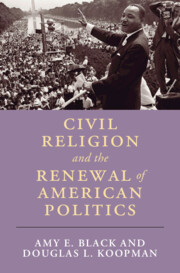
Although the United States was established with a distinctly Christian framework, over time the religious landscape has changed. American civil religion has adapted to make room for growing religious pluralism and the rise of secularism.
Religion is central to human experience. This chapter examines the influence of religion on the political culture from America’s founding to the present, provides a framework for classifying and measuring religion, and gives an overview of religious belief, belonging, and behavior.
American culture is evolving rapidly as a result of shifts in its religious landscape. American civil religion is robust enough to make room for new perspectives, as religious pluralism is foundational for democracy. Moreover, as Amy Black and Douglas L. Koopman argue, American religion and politics are indivisible. In this study, they interrogate three visions of American identity: Christian nationalism, strict secularism, and civil religion. Whereas the growth of Christian nationalism and strict secularism foster division and threaten consensus, by contrast, a dynamic, self-critical civil religion strengthens democracy. When civil religion makes room for robust religious pluralism to thrive, religious and nonreligious people can coexist peacefully in the public square. Integrating insights from political science, history, religious studies, and sociology, Black and Koopman trace the role of religion in American politics and culture, assess the current religious and political landscape, and offer insights into paths by which the United States might reach a new working consensus that strengthens democracy.
This chapter brings into conversation two powerful, imbricated forces in contemporary Nigeria: the dramatic rise in fundamentalist religious Christian and Islamic formations that place hope and prosperity in the afterlife, and the proliferation of community-based technology projects that offer ordinary victims and survivors the power of data as a way to make sense of past and future violence. The chapter argues that these trends are imbricated both with one another and with the history of colonialism from earlier periods to the contemporary moment. The chapter raises questions about the extent to which this Nigerian case study foreshadows a more global shift away from long established (western) authorities – in particular, the law and the nation-state – and toward futures where more and more people could turn toward a kind of moral and political vigilantism, taking the tools for creating hope and meaning (back) into their own hands.
This study analyzes Turkey’s political landscape by harnessing computational social science techniques to parse extensive data about public ideologies from the Politus database. Unlike existing theoretical frameworks that focus on the ideologies of political elites and cadres, this study examines public ideologies in a contentious political manner. Exploiting an artificial intelligence-based data generation pipeline on digital traces, it distills the eight most prevalent ideologies down to the city level and employs exploratory statistical analyses. Principal component analysis delineates two fundamental axes: the traditional left–right political spectrum and a separate spectrum of secular–religious inclination, encompassing both political and cultural dimensions. Then, cluster analysis reveals three distinct groups: left-leaning and religiously inclined; center-right-leaning and religiously inclined; and those with a center-right-leaning focus and a pronounced secular orientation. The outcomes provide valuable insights into the political and cultural axes within political society, offering a clearer understanding of the most recent ideological and political climate in Turkey.
Auditory hallucinations (hearing voices in the absence of physical stimuli) are present in clinical conditions, but they are also experienced less frequently by healthy individuals. In the non-clinical population, auditory hallucinations are described more often as positive and not intrusive; indeed, they have received less attention.
Aims
The present study explores the phenomenology of non-clinical auditory hallucinations and their possible relationship with religiosity.
Method
Starting from previous findings suggesting that non-clinical auditory hallucinations are often described as a gift or a way to be connected with ‘someone else’, we administered standardised questionnaires to quantify proneness to experiencing auditory hallucinations, religiosity and anxiety/depression scores.
Results
Regression analysis carried out using an auditory hallucinations, index as the dependent variable on a final sample of 680 responders revealed that a total of 31% of the variance was explained by a five-steps model including demographic characteristics (i.e. being young, a woman and a non-believer) and negative (e.g. being afraid of otherworldly punishments) and positive (e.g. believing in benevolent supernatural forces) components of religiosity, anxiety and depression. Crucially, compared with believers, non-believers revealed higher scores in depression, anxiety and in a specific questionnaire measuring proneness to auditory hallucinations.
Conclusions
Results suggests that religiosity acts as a potential protective factor for proneness to paranormal experiences, but a complex relationship emerges between religious beliefs, mood alterations and unusual experiences.
Research on whether religiosity promotes or reduces prejudice has produced plenty of paradoxical findings. In this article, we address the relationship between religiosity and anti-diversity attitudes (xenophobia and homophobia) among Christians in Western Germany. We ask what the relationship between religiosity and anti-diversity attitudes is and how it can be explained. Two (complementary) theoretical explanations are presented: the religious-ideology explanation emphasizes the role of fundamentalism, and the loss-of-privileges explanation underscores the importance of perceived disadvantage. Our analysis is based on a representative sample of Christians in Western Germany and provides evidence of a curvilinear religiosity–prejudice relationship. Up to a certain level of religiosity, xenophobia and homophobia decrease as religiosity increases; however, the relationship then reverses—anti-diversity attitudes are particularly pronounced among the highly religious. The level of xenophobia among the highly religious is fully explained by fundamentalism and perceived disadvantage, whereas their level of homophobia is only partially explained.
Existing research suggests a negative correlation between reflective thinking and religious belief. The dual process model (DPM) posits that reflection diminishes religious belief by limiting intuitive decisions. In contrast, the expressive rationality model (ERM) argues that reflection serves an identity-protective function by bolstering rather than modifying preexisting beliefs. Although the current literature tends to favor the DPM, many studies suffer from unbalanced samples. To avoid this limitation, we recruited comparably large number of participants for both religious believers (n = 580) and non-believers (n = 594) and observed the relationship between reflection and two measures of religious belief: belief in God and disbelief in evolution. Our findings corroborate the negative associations found between higher levels of reflection and both types of belief, independent of religious affiliation. Our results align with the broader literature, supporting the DPM but not the ERM.
Many of the greatest minds in psychology have tried to unravel the mysteries, power, appeal, and consequences of religion. The task of understanding human behaviour will never be complete without the use of science and logic to examine the psychology of religion and spirituality. This undergraduate textbook provides an engaging and accessible tour of the field, drawing on historical, theoretical, and cutting-edge sources. It explores the origins and meaning of various forms of religious belief around the globe, with enhanced coverage of non-Christian religions, non-believers, and diverse populations. By focusing on the personal, medical, moral, social, and political consequences of religion, it explores how these findings can be applied in real-world scenarios. Students are supported by clear learning objectives, defined key concepts, varied end-of-chapter questions, further reading suggestions, and visual content, making this an invaluable resource for undergraduates in the psychology of religion and spirituality.
In recent decades, scientific efforts to probe religious behavior and mental states have increased markedly in quantity and sophistication, yet the fascinating story of the psychology of religion remains unfamiliar not only to the general public, but also to many social scientists. This chapter starts with case studies of how religion has functioned in several prominent human lives. We consider why the psychology of religion matters and delve deeply into the many problems associated with defining religion, spirituality and the psychology of religion. The psychology of religion probes religious beliefs, attitudes, behaviors, emotions, experiences, and relationships, paying particular attention to the consequences of religion for health, well-being, morality and social relations. Scholars debate: (1) the importance of the field’s history and grand theories, (2) the acceptability of the historical emphasis on Western Christianity, (3) the generalizability of much empirical work, (4) the meaning of spirituality outside of religion, and (5) whether the discipline is biased in favor of or against religion.
We study the effect of an immigration ban on the self-selection of immigrants along cultural traits, and the transmission of these traits to the second generation. We show theoretically that restricting immigration incentivizes to settle abroad individuals with higher attachment to their origin culture, who, under free mobility, would rather choose circular migration. Once abroad, these individuals tend to convey their cultural traits to their children. As a consequence, restrictive immigration policies can foster the diffusion of cultural traits across boundaries and generations. We focus on religiosity, which is one of the most persistent and distinctive cultural traits, and exploit the 1973 immigration ban in West Germany (Anwerbestopp) as a natural experiment. Through a diff-in-diff analysis, we find that second generations born to parents treated by the Anwerbestopp show higher religiosity.
Economic studies of religion tend to focus on religious affiliation and attendance at religious services to the exclusion of other dimensions of religion, including religious belief. We address this lacuna, using data from the World Values Survey to construct an index of religious beliefs based on whether an individual believes in God, heaven, hell, an immortal soul, and the afterlife. Following the approach in a seminal article, we compare the roles of religious beliefs and attendance in determining economic values related to cooperation, patriarchy, institutional trust, lawfulness, thrift, markets, and market fairness. Controlling for denominational, country and period fixed effects and a set of individual-level characteristics, we find that religious beliefs matter for six of these seven values, relative to five for attendance. In addition, beliefs are more important than attendance for promarket and patriarchal values and less important for thrift, market fairness, lawfulness, and institutional trust. We also consider the relationships between beliefs, attendance, and economic values for eight religious’ affiliations: Protestant, Catholic, Orthodox Christian, Muslim, Buddhist, Hindu, other religions, and non-religious. Taken together, beliefs and attendance are most important for patriarchal values, promarket attitudes, lawfulness, and institutional trust. Relative to attendance, beliefs matter most for patriarchal attitudes and least for institutional trust. Our results suggest that religious beliefs constitute an important dimension of religious life. An exclusive focus on attendance may understate the role of religion in economic values.