To save content items to your account,
please confirm that you agree to abide by our usage policies.
If this is the first time you use this feature, you will be asked to authorise Cambridge Core to connect with your account.
Find out more about saving content to .
To save content items to your Kindle, first ensure no-reply@cambridge.org
is added to your Approved Personal Document E-mail List under your Personal Document Settings
on the Manage Your Content and Devices page of your Amazon account. Then enter the ‘name’ part
of your Kindle email address below.
Find out more about saving to your Kindle.
Note you can select to save to either the @free.kindle.com or @kindle.com variations.
‘@free.kindle.com’ emails are free but can only be saved to your device when it is connected to wi-fi.
‘@kindle.com’ emails can be delivered even when you are not connected to wi-fi, but note that service fees apply.
This chapter lays out the book’s argument in two parts. First, it first develops the concept of self-determination as understood by state and non-state actors in the Global South to apply to the legitimate exercise of power in the international system. Rather than requiring strict sovereignty and exclusion of outside actors, self-determination is about the nature of cooperation and international involvement. It requires that people, through their governments, be able to domestically affirm international rules and to meaningfully participate in their enforcement. The second part of this chapter explains how establishing regional organizations as an authority over issue areas can be a strategy for realizing self-determination and why, in the case of human rights, it necessitated compromising on the norm of non-interference. This strategy is effective at deterring pressure from Western governments because it combines and appeals to widely held beliefs about the legitimacy of self-rule with beliefs about the importance of exercising power through international organizations.
This chapter explores implications of the argument made in this book for other areas of international relations scholarship and for contemporary international politics, with regional authority and self-determination continuing to occupy an important place in the international politics of the Global South. It considers how incorporating the importance of self-determination, and the idea of regional organizations as a means of realizing it, can provide more complete understandings of contemporary political phenomena. I discuss how the argument in this book sheds light on the Global South’s dissatisfaction with liberal norms and institutions, the openness of democratic states in the Global South to cooperation with illiberal powers, and present-day dynamics of regionalism, including the creation of “new” regions and the growth of “authoritarian” regional organizations.
Latin America was the first and most intense target of the imposition of economic enforcement of human rights. The strategy of establishing regional organizations as authorities over human rights emerged in response to these new enforcement policies. This meant greatly expanding the authority of the Organization of American States and, for the first time, allowing it to interfere in member states’ internal affairs to enforce human rights. This strategy emerged first as an authoritarian survival strategy put forward by the Chilean government in response to unprecedented challenges to its domestic behaviors. However, democratic leaders in the region transformed it into a strategy involving real enforcement once economic pressure spread to the entire region. As this chapter demonstrates, the idea that regional organizations have special authority over human rights had not been taken for granted prior to this, as human rights were not understood as an issue that could be altered to fit local contexts. Instead, Latin American leaders–including democracies and leaders supporting human rights enforcement–argued forcefully for this new authority.
What happens when Western law is no longer the default referent for legal modernity? This is a deceptively simple question, but its implications are significant for such fields as comparative law, international law, and law and development. Whereas much of comparative law is predicated on the idea that modern law flows West to East and North to South, this volume proposes the paradigm of 'Inter-Asian Law' (IAL), pointing to an emerging field of comparative law that explores the legal interactions between and among Asian jurisdictions. This volume is an experimental and preliminary effort to think through other beginnings and endings for law's movement from one jurisdiction to another, laying the grounds for new interactions between legal systems. In addition to providing an analytical framework to study IAL, the volume consists of fifteen chapters written by scholars from Asia and who study Asia that provide doctrinal and empirical accounts of IAL. This title is also available as Open Access on Cambridge Core.
Following the 2020 Karabakh War, the emerging geopolitical realities compelled Iran to recalibrate its South Caucasus policy, prompting a shift away from its longstanding posture of neutrality. Despite the potential for Tehran to engage in cooperation through proposed regionalist projects by other actors, a significant shift towards regionalism in Iran’s approach to the South Caucasus remains elusive. This article delves into two primary sets of factors to understand the reasons behind this absence of regionalism in Iran’s foreign policy towards the South Caucasus. The first set encompasses general approaches in Iran’s foreign policy and the impact of domestic political dynamics on their development. It discusses Iran’s perceived impossibility of aligning with the South Caucasus states, the absence of a robust neighborhood policy, and Iran’s strategic isolation in the region, attributed to its unique political system and the ideological stance of its ruling elite. The second set examines external dynamics, including constant international pressure on the Islamic Republic, Iran’s deep-seated ideological and security attachment to the Arab Middle East, and the fluctuating nature of Tehran’s relations with the West. Collectively, these factors significantly limit Iran’s capacity to craft a coherent strategy for regional integration in the South Caucasus.
This article examines the construction of statistics on labor emigration to France and the attempt of the Algerian state to integrate this emigration into development planning after independence. It draws on extensive primary sources in France, Algeria, and Switzerland, including colonial records, the ministries and offices of independent Algeria, international organizations and academic studies. To trace colonial legacies, it first considers the colonial expertise of the 1950s before turning to the Algerian emigration planning projects in the 1960s. Extending the work of James Scott and Timothy Mitchell, it argues that Algerian planners both recognized the biases embedded in colonial representations of migration, and sought to develop a form of statistical modernity that was critical and reflexive. They engaged in careful assessments of available data while simultaneously valuing it as a tool for action. In particular, critiques and reflections within the Algerian Ministry of Labor on the 1969 emigration planning model point to the need for a nuanced understanding of statistical modernity. Rather than perpetuating a colonial gaze on society, the introduction of this model primarily sought to address the limited informational capacities of the independent state. Demographic statistics thus became the main instrument for regulating emigration, but they were valued out of pragmatism rather than ideology. Given the limitations of other socio-economic indicators, such as unemployment rate, population statistics were among the few reliable sources available to allocate exit permits fairly across the regions of origin of prospective emigrants.
As ethnic competition gained momentum on the local level, similar developments occurred at the regional level. Decolonization in the postwar period involved constitutional reform and the slow development of African political parties. The British government used constitutional reform to ensure its political and economic interest to maintain the status quo, while emerging African political parties engaged constitutional reform to make various claims for self-determination. The British government insisted African political parties operate at the regional level and discouraged any efforts to form broad, multi-ethnic, cross-regional nationalist parties, such as the National Council of Nigeria and the Cameroons (NCNC) had aimed for. By 1952, broad nationalist sentiments had distilled into a regionally focused politics. In this context, ethnic majorities within each region had more power than their minority counterparts. The emerging regionalist politics informed the development of a minority consciousness among Niger Delta elites in the 1950s, and they engaged the constitutional reform process through their positions as minorities to claim the right to self-determination.
Framing nineteenth-century American realism within William Dean Howells’s dialect movement, which encouraged authors from Mark Twain to Stephen Crane to capture characteristic accents from every corner of the country, this chapter argues that America’s “native-born” speech came to serve as the correlative of “native-born” citizenship on the page. As a literary solution to a legal battle over American belonging, the dialect movement produced not only a distinctively American national canon but also facilitated the rise of the modern nation-state, demonstrating how diverse ethnic populations could be made to speak with one voice: the voice of the people. Yet as illustrated by a close reading of Howells’s 1890 A Hazard of New Fortunes, there remained one kind of accent that could never be assimilated: the voice of a poor man. As a closely-inspired allegory of the 1886 Haymarket Affair scapegoating German socialist August Spies, Hazard demonstrates that a poor man, speaking as a poor man on behalf of the principles of international socialism, could never be made to count as a good American because the engine of the nation-state relies on the difference between rich and poor to make it run.
Although there is a clear rise in academic interest in region formation, theoretical approaches to the topic vary greatly, stemming from geopolitical identifications of objective regional boundaries, through functionalist ideas of regional linkages, to post-structuralist ideas about fluid regional belonging. This article provides a typology of region formation approaches, based on the ontological assumptions of its authors. The typology is based on two main debates within contemporary international relations ontology: regarding the basic components of reality (material vs. ideational) and regarding the status of theories (transfactual vs. phenomenalist). The presented matrix provides an ideal-typical position for each of these four iterations and illustrates its viability in the case of region formation literature on the Asia-Pacific. Doing so, the text contributes to (meta) theoretical discussions of how regions are formed while at the same time illustrating the often-overlooked stories of region formation.
This chapter explores how country and city stand in as proxies for political, racial, and cultural positions. The country operates as the custodian of the “real America,” which becomes imagined as white, masculine, traditionalist, and working class. The city, meanwhile, teems with the elite and the cosmopolitan. Such gestures conjure away any trace of Indigenous peoples, migrant farmers and ranchers, urban–rural labor alliances, black agrarian Populists, and the city’s intersectional working class. Even as we must acknowledge the generative role country-and-city scholarship has played in US literary criticism, this chapter ultimately calls for rethinking this binary by turning to texts that provide a different account of the rural – a narrative that the country as a concept so effectively obfuscates. Writing by authors such as Hamlin Garland and Zitkála-Šá, conventionally categorized as local-color or regionalist, demonstrates that scarcity and survivance rather than city and country shaped the cultural politics of rural spaces in the nineteenth century. They both challenged the bureaucratic state, as an entity that protected the interests of finance capital by subjecting settlers to constant precarity and violently seeking to dispossess Indigenous peoples of their own land, liberty, and literature.
Under what conditions do South American states create regional institutions that consolidate or undermine the liberal international order (LIO)? To address this question, we compare two cases of contestation of the LIO through counter-institutionalization in the domains of migration and election monitoring, both of which are closely related to the LIO’s core political principles. We argue that the variation in the effects of counter-institutionalization—LIO-consolidating in the case of migration and LIO-undermining in the case of election monitoring—results from the interaction of two explanatory factors: the source of dissatisfaction with the LIO’s norms and institutions in a specific domain, and the preferences of the state that exercises regional leadership in support of counter-institutionalization. The article sheds light on the coexistence of liberal and illiberal tendencies in South America’s regionalism and contributes to the debate on the determinants and effects of contestations of the LIO in the Global South.
Although some modern popular songs are deliberately composed for the purpose of commentary or protest, most are produced for commercial reasons. However, such songs may nonetheless be adopted by political, cultural, and social movements, and in these cases, fans’ participatory meaning-making has an important role in the songs’ new purpose. Taking the 1935 Korean ballad ‘Tears of Mokp’o’ as a representative example, this article traces how the melancholy love song acquired successive layers of meaning against the backdrop of changing politico-economic contexts throughout the twentieth century. Drawing on political, popular music, and sports histories, I first examine how ‘Tears of Mokp’o’ became known as an anti-colonial anthem under Japanese rule, a position that persisted in postwar South Korea. I then investigate the ways in which fans of the Haitai Tigers, a professional baseball team, utilized the song to express a complex set of emotions and commitments regarding their politically oppressed and economically neglected home region of Chŏlla. Against the backdrop of their traumatic memories of the 1980 Kwangju Uprising, Haitai fans, through their collective singing of ‘Tears of Mok’po’ in stadiums during games, transformed it from a colonial-era pop hit/anti-colonial anthem into a baseball fight song that expressed their spirit of regional insubordination in the 1980s and 1990s. Entering the twenty-first century, ‘Tears of Mok’po’ no longer played the same role for the Tigers and their fans, and it receded into historical memory. This change in meaning and association shows how the political and historical meaning-making of popular songs can be constructed, reintegrated, and even dismissed.
The Middle East has traditionally been understood as a world region by policy, political science, and the public. Its borders are highly ambiguous, however, and rarely explicitly justified or theorized. This Element examines how the current conception of the Middle East emerged from colonialism and the Cold War, placing it within both global politics and trends within American higher education. It demonstrates the strategic stakes of different possible definitions of the Middle East, as well as the internal political struggles to define and shape the identity of the region. It shows how unexamined assumptions about the region as a coherent and unified entity have distorted political science research by arbitrarily limiting the comparative universe of cases and foreclosing underlying politics. It argues for expanding our concept of the Middle East to better incorporate transregional connections within a broader appeal for comparative area studies.
This introduction outlines the main questions and debates which the book addresses, followed by an overview of the history of the Heimat idea and the study’s methodological approach. While scholars have looked at post-war cinematic and literary Heimat tropes, the book argues for more attention to Heimat as specific sites of home. On the question of the concept’s Germanness, it steers a middle path that recognizes how the history of German-speaking Europe has shaped the concept, while acknowledging its connection to broader questions about place attachment. Rather than positing a single “German” understanding across time and space, the work approaches discussions about Heimat as an evolving and contested discourse about place attachments and their relationship to diverse political and social issues. The introduction continues by outlining the book’s contribution to debates about West German democratization, reconstruction, post-war confrontation with dissonant lives, and expellee history. It concludes by outlining the book’s findings on the history of efforts to eliminate the concept in the 1960s and left-wing attempts to re-engage with Heimat in the 1970s and 1980s.
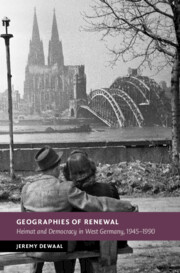
The term 'Heimat', referring to a local sense of home and belonging, has been the subject of much scholarly and popular debate following the fall of the Third Reich. Countering the persistent myth that Heimat was a taboo and unusable term immediately after 1945, Geographies of Renewal uncovers overlooked efforts in the aftermath of the Second World War to conceive of Heimat in more democratic, inclusive, and pro-European modes. It revises persistent misconceptions of Heimat as either tainted or as a largely reactionary idea, revealing some surprisingly early identifications between home and democracy. Jeremy DeWaal further traces the history of efforts to eliminate the concept, which first emerged during the Cold War crisis of the early 1960s and reassesses why so many on the political left sought to re-engage with Heimat in the 1970s and 1980s. This revisionist history intervenes in larger contemporary debates, asking compelling questions surrounding the role of the local, the value of community, and the politics of place attachments.
Chapter 8 analyzes East Asian regionalism projects, which demonstrate that the choices of governments and non-state actors constitute the structure of East Asian international relations, albeit within evolutionary constraints. East Asian countries are not integrating in a European Union sense, but their desire for and efforts at regional cooperation remain strong. East Asian regionalism was underdeveloped compared to Europe and some other developing regions, but an economic regionalism open to non-East Asian countries emerged when the Cold War ended. The 1997 Asian Financial Crisis trigged greater East Asian efforts at creating more exclusive economic and financial groups, but East Asia has shifted to mega regionalism since the early 2010s, reflecting growing great power rivalries between Japan, China, and the United States. Other East Asian countries, particularly those in the Association of Southeast Asian Nations (ASEAN), have their own agency and drive the process in more immediate terms.
This chapter examines the post-WWII era where the idea of exclusive Convention Peoples Party (CPP) radicalism and Pan-Africanism rests most thickly. It argues that debates about the CPP’s Citizenship Act complexifies its pan-African credentials. Also, the CPP’s political philosophy was not radical and distinct compared to its opponents, as it fits within a broad liberal/ cosmopolitan tradition rooted in Europe and America. So-called conservatives were oftentimes more radical, as shown in parliamentary debates on the “Motion of Destiny.” Contentious discussions about whether to achieve self-government by proclamation or negotiation, are obscured by the dyad of radical versus conservative. Debates about federalism, regionalism, and unitary government remain unexplored because the grand narrative rebukes the opponents of Kwame Nkrumah’s socialist agenda, while granting him hero status. Nkrumah’s prolific writing and the squeezing out of his opponents after he became Prime Minister in 1957 are identified as the architects of Ghana’s grand narrative.
This chapter explores the rapid “coming apart” of white working-class communities across the American South as the New Age of Inequality (post-1980) settled in. As the economic doldrums took hold across swaths of the American South and its diaspora during the decades since 1980, social dysfunction emerged with a vengeance in white working-class communities, a phenomenon that captured national attention through J. D. Vance’s depiction in his best-selling Hillbilly Elegy (2016). Older industrial cites suffered and declined as the economy deindustrialized. The many challenges the faltering economy presented to white southern workers and their communities stimulated a visceral response from disaffected workers, a response manifest in angry efforts to reclaim white privilege and the aggressive championing of “traditional” values, and ultimately an unprecedented level of death and despair. The complex story of disruptive economic forces, lingering racial resentments, and fierce atavistic loyalties led white southern workers to choose clinging to cultural values over building alliances that might redress their economic grievances.
Operetta, with its well-structured production systems, constituted a dynamic sphere of activity that stretched across Unified Italy. This activity was rarely acknowledged by the representatives of so-called ‘high culture’, even as it stimulated the growth of the social structures that would later give rise to cinema and other forms of mass entertainment. Though in recent years scholars have focused on the foreign influences on light music theatre in Italy in the years following Italian unification, little attention has been bestowed on Italian operetta. This article concentrates on the origins of this genre, offering a detailed analysis of the dialect theatre tradition from which the first French-style operetta productions in Italy emerged. Specifically, I examine the urban contexts of Milan and above all Rome, a city of crucial importance in the diffusion of operetta in dialect, whose highly local (even parochial) connotations would exert a significant influence on the formal, social and cultural evolution of operetta right up to the turn of the century.