Geographies of Renewal

-
Select format
-
- Publisher:
- Cambridge University Press
- Publication date:
- 19 December 2024
- 02 January 2025
- ISBN:
- 9781009513401
- 9781009513432
- Dimensions:
- (229 x 152 mm)
- Weight & Pages:
- 0.687kg, 386 Pages
- Dimensions:
- Weight & Pages:
You may already have access via personal or institutional login
Show more authors 
You may already have access via personal or institutional login
Book description
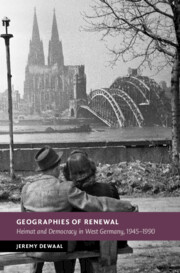
The term 'Heimat', referring to a local sense of home and belonging, has been the subject of much scholarly and popular debate following the fall of the Third Reich. Countering the persistent myth that Heimat was a taboo and unusable term immediately after 1945, Geographies of Renewal uncovers overlooked efforts in the aftermath of the Second World War to conceive of Heimat in more democratic, inclusive, and pro-European modes. It revises persistent misconceptions of Heimat as either tainted or as a largely reactionary idea, revealing some surprisingly early identifications between home and democracy. Jeremy DeWaal further traces the history of efforts to eliminate the concept, which first emerged during the Cold War crisis of the early 1960s and reassesses why so many on the political left sought to re-engage with Heimat in the 1970s and 1980s. This revisionist history intervenes in larger contemporary debates, asking compelling questions surrounding the role of the local, the value of community, and the politics of place attachments.
Reviews
‘Geographies of Renewal is a meticulously researched, empirically rich, wide-ranging and stimulating account of the much-contested idea of Heimat in the Federal Republic of Germany. It draws on a great variety of sources, which are imaginatively combined, and subjected to thorough analysis. Anyone interested in local identities, ‘Heimat’, and democratic reconstruction will find enormous value in this account, which is full of fascinating detail, lucidly presented, and cogently argued throughout.’
Riccardo Bavaj - University of St Andrews
‘DeWaal provides a fascinating reinterpretation of regionalism in West-Germany during the Cold War era, debunking the idea that the Heimat movement went down with the Nazis. Instead it thrived, while reviving traditions of local democracy and international cooperation.’
Eric Storm - Leiden University
Contents
Contents
Metrics
Full text views
Full text views helpTotal number of HTML views: 0
Total number of PDF views: 0 *
 Loading metrics...
* Views captured on Cambridge Core between #date#. This data will be updated every 24 hours.
Usage data cannot currently be displayed.
Accessibility standard: Unknown
Why this information is here
This section outlines the accessibility features of this content - including support for screen readers, full keyboard navigation and high-contrast display options. This may not be relevant for you.
Accessibility Information
Accessibility compliance for the PDF of this book is currently unknown and may be updated in the future.