To save content items to your account,
please confirm that you agree to abide by our usage policies.
If this is the first time you use this feature, you will be asked to authorise Cambridge Core to connect with your account.
Find out more about saving content to .
To save content items to your Kindle, first ensure no-reply@cambridge.org
is added to your Approved Personal Document E-mail List under your Personal Document Settings
on the Manage Your Content and Devices page of your Amazon account. Then enter the ‘name’ part
of your Kindle email address below.
Find out more about saving to your Kindle.
Note you can select to save to either the @free.kindle.com or @kindle.com variations.
‘@free.kindle.com’ emails are free but can only be saved to your device when it is connected to wi-fi.
‘@kindle.com’ emails can be delivered even when you are not connected to wi-fi, but note that service fees apply.
Scholars debate whether the presence of multiple parties in the legislature stabilizes dictatorships or promotes their demise. We show that authoritarian regimes face a dilemma: allowing for multipartism reduces the risk of bottom-up revolt, but facilitates protracted top-down democratization. Concessions to the opposition diminish the long-term benefits of authoritarian rule and empower regime soft-liners. We test our theory in Latin America—a region with a broad range of autocracies —using survival models, instrumental variables, random forests, and two case studies. Our theory explains why rational autocrats accept multipartism, even though this concession may ultimately undermine the regime. It also accounts for democratic transitions that occur when the opposition is fragmented and without a stunning authoritarian defeat.
Canadian political scientists have often taken a normative approach to political institutions like the constitution, the electoral system, and Parliament. An assumption that institutional reform can itself be a solution to political problems is also reflected in general public commentary and at times has been openly encouraged and supported by the Canadian state itself. This approach has many strengths but also deficiencies, particularly the degree to which it replicates existing understandings of the state, focused on the distribution of power among white men. The study of political institutions in Canada must continue growing to incorporate and integrate a greater diversity of perspectives, including interrogating and challenging their very foundations.
This article examines legislative waffling behavior—where legislators reverse their position between bill sponsorship and floor voting—in the South Korean National Assembly from 2004 to 2020. Using multilevel logistic regression analysis of 21,292 bill-legislator observations across four legislative terms, we develop a novel theoretical framework that disaggregates waffling into three distinct strategic types: dissent (voting against), abstention, and no-show (strategic absence). Our findings challenge US-based theories by revealing that minority party members in Korea exhibit significantly higher rates of waffling across all types, with the effect particularly pronounced when bills are passed as chairman’s substitutes in majority-controlled committees. We demonstrate that ideologically extreme legislators are more prone to waffling, while main sponsors maintain greater consistency throughout the legislative process. The analysis of committee control structures reveals complex dynamics where minority party members face heightened waffling pressures even in committees they control, suggesting that formal institutional authority cannot fully overcome broader power imbalances in consensus-based systems. These findings highlight how Korea’s distinctive institutional features—including proportional distribution of committee chairs, mixed electoral system, and consensus-oriented legislative culture—create fundamentally different incentive structures for legislative behavior compared to majoritarian systems, underscoring the importance of developing context-specific theoretical frameworks for comparative legislative studies.
This chapter explains how liberal democratic institutions provide a solution to the problem that rulers cannot otherwise credibly commit to forgoing the introduction of regulations that increase state control over church activities. In particular, churches have greater autocratic risk when they have historically invested in activities, such as church schools, that the state has high capacity to regulate. As a result, churches with significant education systems have greater incentive to speak out in support of liberal democratic institutions, although this incentive is mitigated when their schools are fiscally dependent on the government to operate.
This chapter discusses the implications of the book for understanding democracy and democratic activism beyond churches in sub-Saharan Africa. It emphasizes that some churches employ coalitional strategies to advance their interests, and, in such cases, their attitudes toward liberal democracy are contingent on whether doing so will advance or hinder the power of their preferred parties. It also shows that some churches rely on liberal democracy as an institutional guarantee of their interests, suggesting that my argument applies to churches beyond Africa. It concludes by explaining how the theory can be applied to other types of actors in other regions of the world.
This chapter demonstrates that churches have often engaged in activism for liberal democratic institutions in sub-Saharan Africa, and yet existing scholarship provides little guidance in explaining why churches sometimes engage in this type of activism while others do not. It sketches out an argument for why some churches have an interest in liberal democratic institutions because they protect them from rulers unilaterally introducing regulations that reduce their control of key church activities. It argues that church schools have particular risk of regulation by rulers, giving churches that run greater number of schools particular incentives to support liberal democratic institutions. It also argues that this risk is mitigated when churches are highly dependent on the state for financing activities.
Why have some churches in Africa engaged in advocacy for stronger liberal democratic institutions while others have not? Faith in Democracy explores this question, emphasizing the benefits of liberal democratic protections for some churches. The book explains how churches' historic investments create different autocratic risk exposure, as states can more easily regulate certain activities – including social service provision – than others. In situations where churches have invested in schools as part of their evangelization activities, which create high autocratic risk, churches have incentives to defend liberal democratic institutions to protect their control over them. This theory also explains how church fiscal dependence on the state interacts with education provision to change incentives for advocacy. Empirically, the book demonstrates when churches engage in democratic activism, drawing on church-level data from across the continent, and the effects of church activism, drawing on micro-level evidence from Zambia, Tanzania and Ghana.
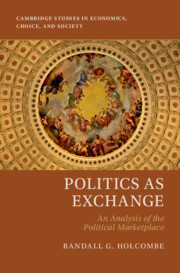
Political institutions have been depicted by academics as a marketplace where citizens transact with each other to accomplish collective ends difficult to accomplish otherwise. This depiction supports a romantic notion of democracy in which democratic governments are accountable to their citizens, and act in their best interests. In Politics as Exchange, Randall Holcombe explains why this view of democracy is too optimistic. He argues that while there is a political marketplace in which public policy is made, access to the political marketplace is limited to an elite few. A small group of well-connected individuals-legislators, lobbyists, agency heads, and others-negotiate to produce public policies with which the masses must comply. Examining the political transactions that determine policy, Holcombe discusses how political institutions, citizen mobility, and competition can limit the ability of elites to abuse their power.
Thousands of federal policies have been produced by coalitions of executive agencies over the last few decades. Despite this, little attention has been paid to why agencies collaborate. The decision among relatively autonomous agencies to collaborate and therefore cede some of their power demands theoretical attention. I argue that agencies form coalitions to overcome legislative oversight attempts by activating veto points and exploiting collective action problems in Congress. Using data on dozens of agencies over twenty-four years, I find that agencies form policy-making coalitions when it helps them activate veto points and exploit collective action problems among their overseers in Congress: namely, committee freeriding in oversight and legislative gridlock in lawmaking. These collective action problems, in turn, inhibit Congressional attempts to overturn bureaucratically led policies and therefore allow agency policies to stick. Agencies form coalitions actively in order to insulate their policies against congressional oversight.
In the USA states, there is substantial institutional variation among executive branch administrative officials, with state executive branch offices varying by their selection method. Prior scholarship has devoted little attention to the policy implications of this institutional variation. In this article, we explore the consequences of this administrative characteristic by examining state attorneys general. We develop the theoretical rationale that during periods of high crime, for states with an elected attorney general, there should be an increase in the state’s incarceration rate. Conversely, for states with appointed attorneys general, increases in crime will have little effect on the state’s incarceration rate. When analyzing the incarceration rates among all USA states across a seventeen-year period, we find some evidence to support our theoretical expectation. These results highlight the implications that executive branch design has on public policy and governance in several ways.
Chapter 2 presents the bounded accountability theory of incumbency bias and its main empirical predictions and outlines the core empirical strategy for testing the theory across the country–office cases. After offering a conceptualization and typology of incumbency bias, the chapter explains how the nature of the information environment encourages retrospective voting and leads to the emergence of incumbency bias. Based on this general mechanism, the chapter predicts that the alignment of policy scope and fiscal institutions explains why some democracies exhibit incumbency advantage while others display an incumbency disadvantage, and demonstrates how exogenous shocks may lead to within-country changes in incumbency bias. The chapter also derives predictions about why there are differences between personal and party incumbency bias. It concludes by developing a novel estimation framework that extends the close-election regression discontinuity design to measure incumbency bias in different political systems and document variation in direction and type within them.
The article examines the patterns of turnover of Latin American legislators. It contributes (1) by introducing a large original dataset of turnover rates in 204 elections between 1985 and 2023 based on manually coded lists of all Latin American legislators elected since 1985, (2) by describing the cross-national and temporal patterns of turnover in Latin America, and (3) by examining empirically the relationship between turnover rates and temporal institutional arrangements designed to regulate the time horizons of legislators. The data reveals that turnover rates in Latin America are extremely high on average (around 70%) compared to democracies in other regions, although with significant variation. Institutional determinants governing time horizons of politicians are associated with turnover, with term limits, the presence of staggered elections and term length being positively associated with elevated turnover rates.
Politicians in all democracies have goods to distribute, and they employ different modes of distribution to deliver them. They can offer voters goods in the hope those goods turn into votes. Alternatively, they can try to make the distribution of a good conditional on how someone votes. The latter mode is clientelism. I point out that the literature on clientelism has been preoccupied with the idea that politicians form clientelistic relationships with individuals. This has led to an intense scholarly focus on how politicians can consummate such vote buying deals to their satisfaction, given that the secret ballot prevents them from observing how people vote. I argue that under a certain configuration of political institutions, it makes sense for politicians to form clientelistic relationships with groups of voters. To do so, a politician’s electoral district must be divisible into groups of voters, at which electoral support is observable and to which resources are targetable. I take four longstanding questions of interest in the clientelism literature, concerning brokers, economic development, democratic integrity, and club goods and explain how the theory of group-based clientelism opens up new lines of inquiry in each.
The concluding chapter identifies three broad contributions of the book: explaining the choices made by states about language; offering explicit historical institutionalist accounts of the politics of language by centering the analysis on the state and using notions of legacies, critical juncture, path dependency, layering, conversion, and drift, among others; and, the further development, leveraging, and testing of the concept of state traditions as a theoretical and analytical focus for explaining language policy. The chapter also synthesizes the important points coming out of the case studies drawn from a multiplicity of contexts, namely that processes of state-making and state-building are central in forging the state traditions that steer linguistic policies towards specific developmental paths; that the specific nature and configuration of political institutions within a state, not only at founding but also as it evolves over time when adjusting to changing societal dynamics and circumstances, heavily condition the choices states make about language; and that political ideas and norms are central to state traditions since they tend to structure both political and policy development by conditioning the choices of political actors, pushing societies into specific paths of linguistic choices at the expense of others.
Does regional inequality give rise to political cleavages in African countries? If so, why and how? At what scale of politics? How do regional difference and inequality shape national politics and policy? The theory of regional politics advanced here is drawn from comparative politics theories of regional tensions that arise in the course of state-building and national economic integration. These are accentuated when socioeconomic inequality and territorial institutions align. This book argues that regional economic differentiation and spatial inequalities, in interaction with strongly territorial state institutions, shape politics and policy in African countries as they do in countries in other parts of the world. National economic integration and state-building activate subnational interests and fuel political tensions over the integration of subnational regions into the national polity and the national market. Regional economic and political heterogeneity and cross-regional inequalities shape both preferences and the relative bargaining power of subnational collectivities. These forces combine to produce persistent regional cleavage structures in national politics. Empirical support is drawn from electoral data from 44 elections across 12 countries, historical maps, and nighttime luminosity, household survey, and crop production data.
This chapter collects the historical threads about the economic growth of the two Iberian nations. From a disappointing nineteenth century, during which they fell behind the rest of Europe, and the conflicts of the first half of the twentieth century, the two nations quickly caught up from the 1950s. Growth was mostly extensive and pulled by physical capital accumulation, with small contributions from human capital or productivity. The Iberian divergence from its European peers has often been blamed on natural endowments, modest domestic markets and savings, as well as on second-nature geography (market access). However, this volume shows that all of these were endogenous to the growth itself, which requires looking for deeper explanations. Institutions and the political equilibria that underpin them loom large here. After a century of fragile liberal monarchies and radical republican regimes, the two nations stood out for their long authoritarian regimes. Inward-looking economic policies promoted by the dictators favoured domestic incumbents but harmed the growth potential of the two countries. Only their gradual reopening from the 1950s unleashed this potential. Nevertheless, the gains from growth have not been equally distributed and convergence stalled in the new millennium, with the adoption of the Euro.
In autocracies, party membership offers benefits to citizens who join the ruling party. The recruitment process consists of (i) citizens' applying to become party members, followed by (ii) ruling parties' selection among applicants. Hence, I propose that ruling parties can face a “recruitment dilemma” when the citizens who apply for party membership with an eye on its benefits do not overlap with the ruling party's targeted population. Previous research assumes that the Chinese Communist Party's (CCP) interest in co-opting white-collar workers is matched by those workers’ interest in becoming party members. However, it is their emergence as an essential social group that changed the CCP membership's pattern, leading it to adapt its co-optation strategy to solve the recruitment dilemma. Using surveys across multiple waves between 2005 and 2017, I show (i) changes in application patterns, (ii) the CCP's recruitment dilemma when they receive applications from more laborers than white-collar workers, and (iii) the CCP solution of rejecting laborers in favor of white-collar workers.
Why do executive agencies form coalitions? Legislative coalitions are widely theorized and studied, but less attention has been paid to executive coalitions. Executive agencies’ dependence on the political branches calls for a distinctive theory of coalition building. This article presents such a theory, arguing that agencies form coalitions to optimize their autonomy given their subordinate position in a separation of powers system by signaling to overseers that their policies are efficient and should be maintained. Bureaucrats form coalitions actively to advance their policy goals in the face of political opposition. Using data on dozens of agencies over seventeen years, I find that agencies are most likely to form coalitions when their preferences are misaligned with the president but aligned with each other. I also find evidence that coalitions send credible signals that bureaucratic policies are efficient since Office of Information and Regulatory Affairs is less likely to request regulatory revisions of policies produced by coalitions.
The Islamic Republic relies on a number of distinct but related institutional clusters to maintain power. This include the institutional means through which the state politically incorporates social groups into its orbit; institutional mechanisms of control; a number of “veto players”; those institutions that help maintain the system; the deep state; intra-elite competition; and, patronage and clientelism.
This chapter describes the relationships between domestic political institutions and war. Moving beyond older debates comparing democracies and autocracies, it presents a conceptual structure for differentiating among different types of autocracies. Autocracies vary as either being personalist or non-personalist, and also as being led by either military officers or civilians. Personalist regimes are less constrained by domestic audience costs, and military leaders are more likely to embrace the effectiveness and legitimacy of using force. The likely onset and outcome of conflicts vary across autocracy types. The chapter explores other ideas linking domestic politics and war, including the diversionary theory of war, coup-proofing (when autocrats take steps to reduce their risk of being overthrown in a military coup d’état), and the marketplace of ideas (when foreign policy issues can be freely debated in government and society). The chapter applies many of these ideas to a quantitative study on what kinds of political systems are more likely to win their interstate wars, and a case study of Iraq’s 1990 invasion of Kuwait.