To save content items to your account,
please confirm that you agree to abide by our usage policies.
If this is the first time you use this feature, you will be asked to authorise Cambridge Core to connect with your account.
Find out more about saving content to .
To save content items to your Kindle, first ensure no-reply@cambridge.org
is added to your Approved Personal Document E-mail List under your Personal Document Settings
on the Manage Your Content and Devices page of your Amazon account. Then enter the ‘name’ part
of your Kindle email address below.
Find out more about saving to your Kindle.
Note you can select to save to either the @free.kindle.com or @kindle.com variations.
‘@free.kindle.com’ emails are free but can only be saved to your device when it is connected to wi-fi.
‘@kindle.com’ emails can be delivered even when you are not connected to wi-fi, but note that service fees apply.
Chapter 2 examines Joel Augustus Rogers’ semi-autobiographical debate novel From “Superman” to Man (1917), which features an erudite Pullman porter methodically debunking the anti-Black racist arguments of a Southern senator traveling on his route. Signifying on the pseudoscientific foundations of Jim Crow bigotry, the New Negro porter turns what Eric Lott calls the “black mirror” back on the senator to reveal, ultimately, the utter abjection of white supremacy. Having already “proved” the Negro’s humanity through his erudition, the porter’s explicit reading of a gruesome lynching becomes a catalyst for the senator’s “liminal crucible” moment, a moral transformation great enough that he offers the porter a job in his film studio now devoted to producing some films that “create a better understanding of the Negro.” By examining the revisions Rogers made to his 1917 novel in his 1923 serialization, I reveal Rogers’ increasing anger over the growing brutality and frequency of white mob violence as well as the race-baiting newspapers that fomented it.
During the Jim Crow era, jails were an essential tool for the enforcement of white supremacy. For Dr. Martin Luther King Jr., the long-term goal of the civil rights movement was to destroy the Jim Crow system through a vigilant strategy of nonviolent protest that would fill the jails and shine a light on injustice. King elevated this strategy through his own arrest, incarceration, and subsequent Letter from Birmingham Jail. King’s letter offered a scathing indictment of the gradualist strategy for achieving racial justice in Alabama that had led to unsolved bombings of Black institutions, unfair treatment in the legal system, and police brutality. In response to those who criticized his presence in Birmingham for the march, he wrote that he could not “sit idly by” in Atlanta and continue to be indifferent. “Injustice anywhere was a threat to justice everywhere.”
The chapter illustrates what it meant for Carolyn Beatrice Parker (1917–1966) to be a Black woman physicist in the US during the Jim Crow era. Her father, a physician, and her mother, a teacher, shepherded her into Fisk University, an historically Black college. As a physics major she studied infrared spectroscopy with the Black physicist Elmer Imes, graduating with a BS in 1938. She later attended the University of Michigan, obtaining an MA in physics in 1941. But like many Black women, she spent time before and after graduate school teaching in the K–12 system. In 1943, she became a research physicist at the Aircraft Radio Laboratory in Dayton, Ohio, where she stayed for four years. Although she co-authored a governmental report about her work on signal attenuation in coaxial cables, her name only appeared in the acknowledgments of the ensuing academic publications, thus partly obscuring her contributions. In 1947, Fisk University welcomed Parker on the faculty, but she soon after enrolled in a nuclear physics PhD program at the Massachusetts Institute of Technology. After dropping out, she worked as a laboratory technician until she grew too ill and died a short time later.
American Baptist Theological Seminary (ABTS), founded as a black Baptist school in 1924, sprung from an unusual partnership between black and white Baptists in the Jim Crow South. The black National Baptist Convention (NBC) and white Southern Baptist Convention (SBC) jointly funded and governed the Nashville seminary, emphasizing from the outset the strength of their common Baptist identity, though persistent frictions reared up with regularity. The relationship between two leaders involved with ABTS in the mid-twentieth century – National Baptist David V. Jemison and Southern Baptist Eugene P. Alldredge – offers an intriguing lens for viewing the hopes and pitfalls that attended Baptist interracialism in the segregated South. Their correspondence in the 1940s reveals a growing friendship and fellowship as they collaborated in seminary work and bonded over their likeminded Baptist convictions, followed by an abrupt rift after Alldredge’s paternalistic meddling in NBC politics led Jemison to defend black Baptist autonomy. Thus, the Jemison–Alldredge relationship poignantly illustrates two conflicting realities facing such attempts at Baptist interracialism: Baptist identity did offer a legitimate nexus for interracial fellowship, yet the racial hierarchy and prejudices of a segregated society also circumscribed those efforts, as black Baptists walked a tightrope between assuaging white concerns and maintaining their own independence.
Martha Washington set countless precedents as first lady—including the use of enslaved labor in the Washingtons’ presidential household. One-third of America’s first ladies were born or married into slave–owning families, making it an important but often overlooked part of their identities and actions in the White House and beyond. The relationship between first ladies and race goes far beyond the subject of slavery. Throughout history, these women have used their platform to bring attention to issues affecting Americans, champion causes, and encourage the president to act. As unelected participants in an administration, first ladies have sometimes been able to pursue civil rights with more freedom and flexibility than their spouses, speaking out against lynching, segregation, and other concerns facing the Black community. This chapter will explore the complex role of first ladies in the fight for equal rights using case studies from the nineteenth and twentieth centuries.
Ledbetter and Lomax set out on an arduous journey to record in Arkansas, Alabama, Georgia, South Carolina, North Carolina, and Texas – primarily on prison farms overwhelmingly holding Black prisoners. Ledbetter learns some tunes for which he will later become famous, including “The Rock Island Line.” The strain of their grossly unequal relationship wears Ledbetter down, even as Lomax’s hopes to present the performer to northern audiences build. This chapter explores Ledbetter’s musical aspirations, from his early years as a child prodigy to his time in the Dallas area with Blind Lemon Jefferson.
This article explores the sudden spate of stories concerning the so-called “blue gum negro” (the Blue Gum) that circulated in the national press from the late 1880s to the late 1890s. These reports concerned purportedly blue-gummed, Black assailants, whose bite was alleged to be poisonous, and of whom African Americans were supposedly terrified. This article argues that, although these narratives reinforced white notions of Black criminality and credulity, they marked a particular moment of racialization, in which fears of bodily contagion, generated by the recent revolution in germ theory, were harnessed to notions of embodied racial difference, to express and galvanize white anxieties about racial impurity. Because Blue Gums embodied dysgenic menace, white journalists and writers were often reluctant to disavow their existence, instead capitalizing on the slippage between figurative and literal language that characterized discourse on race. However, in appropriating Black culture and presenting a figure from folklore as a racial type, white writers betrayed not only the essentially superstitious character of racial thought but also the interwoven nature of dominant and subjugated cultures in the United States.
“Black Ecological Insurgencies” charts the formation of an insurgent ecological tradition in the Tidewater of Virginia from slavery through the emergence of Jim Crow, underscoring the relationship between these formations and the re-grounding of Black subjectivity within the Black body in contrast to the latter’s abstraction and extraction in the service of expropriation and accumulation associated with plantation and post-emancipation transformations of the landscape. Engaging court documents, bills of sale, slave narratives, state records related to the consolidation of fisheries, as well as historical newspapers articles and related images, I excavate the dynamic relation between Black collective self-creation, fugitivity, resistance, land and aquacultural cultivation, and the rejoining of Black subjectivity and embodiment outside the premises of fungibility and disposability.
The most glaring disparity in America’s search for equality has been and continues to be slavery and its legacy. In this chapter, we discuss the history of slavery, its purported elimination at the time of the Civil War and through the Reconstruction Amendments to the Constitution, then its reemergence through Jim Crow laws. The unfortunate reality is that the fight for equality is ever present. John Lewis, the long-serving member of the House of Representatives from Georgia, is emblematic of the importance and continuing nature of that fight. As a young man, he was nearly killed on the Edmund Pettus Bridge during the March on Selma. He continued to fight for racial equality throughout his life to the point of penning an op-ed published posthumously in the New York Times just days after his death. The federal government played an essential role in trying to advance the fight for racial equality, primarily through cases such as Brown v. Board of Education and legislation such as the Civil Rights Act of 1964 and the Voting Rights Act of 1965. Markets did not eliminate racial discrimination; they perpetuated and profited from it.
Socrates identified hubris as the principal obstacle to wisdom and knew that most people will not listen to reason until they are taken down a few notches. Martin Luther King similarly knew that Southern white leaders would not negotiate in good faith until their racial hubris was challenged. Socratic questioning created a personal crisis, that is, a teachable moment, for those subjected to it; King’s protests created a political crisis and a teachable moment in those Southern towns subjected to it. Martin Luther King is well known for his stirring denunciations of American racism, militarism, and poverty; King is less well known for his denunciations of the complacency of the Christian church in America, both Black and white. Yet King’s prophetic witness led to his persecution by political leaders as well as his excommunication from his own Black Baptist Church convention. Americans like to think of their country as the promised land, but for many of its Black citizens, the American experience has been more like bondage in Egypt than freedom in Canaan. In King’s prophetic vision, America will be redeemed by the suffering of its Black citizens, especially in the South. Like Moses, King hoped to liberate his people from bondage; and like Jesus, King would liberate his people not by conquest but by redemptive suffering.
The Great Migration, which began in the late nineteenth century and witnessed the movement of more than six million Black folk from the agrarian US South to the urban North between 1919 and 1970, and the flourishing of “Black Renaissances” in Harlem, Chicago, Pittsburgh, and other Northern urban centers were the essential soil in which are rooted not only the two works that are the subject of this book, but also the lives and careers of Margaret Bonds, W. E. B. Du Bois, and Langston Hughes. This chapter explores the roles of those two large societal seizings of freedom for the poor and oppressed as the context for Margaret Bonds’s career and the source of her career-long commitment to using her art to uplift what she in 1942 called “our oppressed Race” and work for global equality.
Margaret Bonds’s Credo sets the nine articles of W. E. B. Du Bois’s iconic manifesto for global equality – first penned in 1904, revised in 1920, and modeled on the sacred symbol of the arch – as a symmetrical set of seven movements for soloists, chorus, and piano (1965) or orchestra (1965–67). This chapter offers a close reading of Du Bois’s anti-racist, anti-sexist, anti-colonialist, anti-imperialist, pacifist text and examines the means by which Bonds translated it into a musical structure all her own that reflects diverse influences ranging from gospel song through the cantatas of J. S. Bach (whom she called “the father of all good music”), also emphasizing womanist themes that are at best minimally present in Du Bois’s text.
Describes the life, political career, and impeachment of President Andrew Johnson, with particular emphasis on the post-Civil War context of the case and the constitutional issues in the case.
While Republicans enjoyed unified control of the national government during the 1920s, scandals involving executive patronage and GOP state bosses in the South dogged the national party throughout the decade. The Republican Party in the South had been a set of “rotten boroughs” for decades, used by national politicians—especially presidents—for the sole purpose of controlling delegates at the Republican National Convention. This patronage-for-delegates arrangement was generally understood among political elites, but the murder-suicide involving a U.S. postmaster in Georgia in April 1928 brought the Southern GOP’s patronage practices to national light. This forced Republican leaders in an election year to call for a Senate investigation. Chaired by Sen. Smith W. Brookhart (R-IA), the committee investigation lasted for eighteen months, covered portions of two Republican presidential administrations, and showed how state GOP leaders in Georgia, Mississippi, South Carolina, and Texas engaged in office selling. The fallout would be a thorn in the side of President Herbert Hoover, who tried to clean up the corrupt GOP organizations in the South—and build an electorally-viable Republican Party in the ex-Confederate states—but largely failed.
This chapter examines Light in August and Absalom, Absalom! as Faulkner’s first novels to depict the racial ideology of the South as unstable and incoherent. Whereas the author initially attempted to understand how information continuously flows through a networked system as culture, these novels depict entropic states capable of undermining and destroying the social order. In Absalom, Absalom! especially, we see how regimes of power fail from within – with a network of individuals increasingly unable to relate to each other, so mediated are they by the ideological and racial abstractions of the plantation system. These emergent entropic states, though perilous to the wellbeing of many, are not simply to be feared. As ideological surfaces waver in their ability to disseminate cultural directives, there emerges the potential for reorganization and renewal, trajectories of novelty and behavior that gesture beyond the seemingly intractable bounds of social space and the self-reflexive epistemology of textual space that reinforces them.
The Sound and the Fury depicts how information at a certain level of complexity acquires its own quasi-agency – a hyper-mimetic ability to replicate itself through surfaces and selves. Among the many objects and surfaces that exhibit this mimetic agency, two images – the clock and the statue – lie at the heart of Faulkner’s cartography of the postbellum plantation system and allow us to understand the author’s diagnosis of the modernization of the planter system, not simply as a scaling social order, but as a coercive flow of ideology in the the era of Jim Crow ascendency. This chapter shows that Faulkner imagines planter heritage as a social force that invades the psyche, vertiginously scaling through a series of mimetic surfaces to find expression both in the financialization of the New South and in the Confederate monuments that replicate ideology through the social body. The statue of the Confederate soldier is the ultimate case in point. The mimetic semblance is not alive, yet a commonality of plantation culture is enacted between this information object and those who are forced to endure its imprint, to become mimetic surfaces robbed of depth and immanent life.
This chapter explores how the African American novel imagined a better world, experimented with form, and reflected the artistic and cultural sophistication of Black people in the twentieth century. It argues that understanding the twentieth-century African American novel in the context of various overlapping liberation movements helps us organize our thinking about the ways in which writers used long fiction to explore the social, political, ideological, and historical realities that informed the time period in which they were writing. Focusing on African American fiction produced within and around several Black liberation movements and historical interregnums – i.e., Post-Reconstruction, the Harlem Renaissance, the Black Arts Movement (BAM), and the post-BAM Toni Morrison era – the chapter examines the nuances and complexities of novelists who used the novel as form to reflect and inspire shared visions of a liberated future.
Part Two: “Ostracism/Initiation,” examines twentieth-century Japanese immigrants and their descendants in relation to structural anti-Blackness and its instantiation in a nationwide system of racial segregation and anti-Black violence. Entering the U.S. in the wake of Chinese exclusion, the Japanese inherited the mantle of the Asiatic/Mongolian, much to their dismay. Despite the pointed burdens associated this label, they discovered that the constitutive not-Blackness of the Asiatic/Mongolian also enabled their qualified and uneven advancement and mobility in an anti-Black order. This remained true even during the turbulent, traumatic events of the Second World War. The wartime internment of Japanese Americans constituted not only the extreme limit of their ostracism, but also, as others have noted, their symbolic initiation into the nation. As the Cold War unfolded, accounts of Japanese Americans as an ascendant “model minority” were just one symptom of how they came to be weaponized against the Black freedom struggle and in defense of the U.S. state and racial capitalism. Like the Chinese before them, Japanese Americans deployed their not-Blackness to their advantage in their efforts to achieve residential mobility, educational success, occupational advancement, and social assimilation in the postwar era.
Part One: “Exclusion/Belonging,” traces the construction of the nineteenth-century Chinese immigrant laborer as the original Asiatic/Mongolian, a figure who was not-white but above all not-Black, a wage worker who was degraded but nonetheless categorically superior to the slave. If we consider the Chinese immigrant laborer in relation to the white worker, Chinese foreignness was a site of dispossession, persecution, and exclusion. But if we consider the Chinese immigrant laborer in relation to the slave, we discover that Chinese foreignness was also, paradoxically, a site of plenitude, standing, and belonging. The exclusion movement expelled the Chinese immigrant from the nation, but not from the Family of Man. The U.S. state developed its pattern of weaponizing the Asiatic against the Black struggle during this period, as explained here in a new interpretation of Yick Wo v. Hopkins and Plessy v. Ferguson. For their part, Chinese immigrants grasped the value of their not-Blackness and developed strategies to take advantage of it, from displacing freed people on plantations during Reconstruction to refusing to allow their children to attend “colored” schools in the Mississippi Delta in the interwar years.
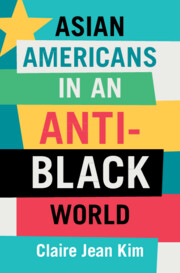
Where do Asian Americans fit into the U.S. racial order? Are they subordinated comparably to Black people or permitted adjacency to whiteness? The racial reckoning prompted by the police murder of George Floyd and the surge in anti-Asian hate during the COVID-19 pandemic raise these questions with new urgency. Asian Americans in an Anti-Black World is a groundbreaking study that will shake up scholarly and popular thinking on these matters. Theoretically innovative and based on rigorous historical research, this provocative book tells us we must consider both anti-Blackness and white supremacy—and the articulation of the two forces—in order to understand U.S. racial dynamics. The construction of Asian Americans as not-white but above all not-Black has determined their positionality for nearly two centuries. How Asian Americans choose to respond to this status will help to define racial politics in the U.S. in the twenty-first century.