To save content items to your account,
please confirm that you agree to abide by our usage policies.
If this is the first time you use this feature, you will be asked to authorise Cambridge Core to connect with your account.
Find out more about saving content to .
To save content items to your Kindle, first ensure no-reply@cambridge.org
is added to your Approved Personal Document E-mail List under your Personal Document Settings
on the Manage Your Content and Devices page of your Amazon account. Then enter the ‘name’ part
of your Kindle email address below.
Find out more about saving to your Kindle.
Note you can select to save to either the @free.kindle.com or @kindle.com variations.
‘@free.kindle.com’ emails are free but can only be saved to your device when it is connected to wi-fi.
‘@kindle.com’ emails can be delivered even when you are not connected to wi-fi, but note that service fees apply.
This chapter examines three Renaissance social and cultural types, the merchant, the courtier, and the artist, the latter category encompassing not only painters, sculptors, and architects but also performance artists and skilled artisans and makers. The chapter uses self-descriptive writings produced by members of these professional groups to draw out their collective identities and value systems. Merchants are studied through the Florentine tradition of merchant ‘family books’, as well as in the more literary writings of Leon Battista Alberti and Benedetto Cotrugli, while the ethos of courtiers is examined through the justly famous analysis of Baldassare Castiglione. Where artists are concerned, an initial section on painters and sculptors, drawing on the writings of Giorgio Vasari, is followed by a discussion of lesser-known writings by court professionals, from dance masters to horse trainers to specialists associated with the arts of the table, such as cooks, stewards, and virtuoso carvers. The chapter argues that the much-studied rise of painting and sculpture from a lowly craft status to that of liberal arts was one instance of a broader phenomenon.
This chapter examines the ways in which classical influences intersected in Italian Renaissance culture with modernizing impulses in an era of rapid social and material change. The early sixteenth century in Italy brought a series of devastating wars and a loss of political independence at the same time that Italian culture was absorbing significant novelties, such as the introduction of printing in Europe and the geographical ‘discoveries’ of the period, especially that of the transatlantic New World. The chapter foregrounds the sense of novelty and progress that was a marked feature of the later Renaissance in Italy, balancing humanism’s reverence for classical antiquity. This dialectic is examined through detailed case studies of the histories of geography and cartography, of the theory and practice of anatomy, of art-historical writing and conceptions of artistic progress, and of the social and cultural impact of print.
The fifteenth- and sixteenth-century revival of Vitruvius’s theory of architecture as art and science as well as the Reformation and the rise of print spurred a “figural turn” in architectural culture and the advent of a new genre of architectural images. In northern Europe, four institutions – artist guilds, publishers, masons’ lodges, and courts – acted as the key contexts for the figural turn. Artists began to specialize in forming architectural images, thereby making inroads into architectural professions and enriching the conventional practices of architectural design with new artistic and scientific modes of visual research. Matthias Grünewald’s Isenheim Altarpiece, façade paintings by Wendel Dietterlin and Hans Holbein the Younger, and printer Bernhard Jobin’s collaborations with builder Daniel Specklin to form scientifically informed architectural prints all exemplify the figural turn. So, too, did Dietterlin’s botanically rich mural for the Strasbourg Masons and Stonecutters, as well as an empirically conceived, microcosmic interior Dietterlin made for the Duke of Württemberg. By the middle of the sixteenth century, artists and natural philosophers had introduced empirical visual research methods to northern Europe’s developing culture of architectural images, setting the stage for Dietterlin’s seminal Architectura.
Although no direct claim for the autonomy of spheres was advanced in the scholastic speculations discussed in Chapter 5, such notions would be put forward in the circles where humanism and the artistic renewal pursued in contact with it emerged in Renaissance Italy. A powerful example was Giorgio Vasari’s assertion that what caused art and architecture to decline from its ancient heights was the substitution of religious values for aesthetic ones by Christianity as it became established under the Roman Empire. This defense of aesthetic autonomy would become more general and explicit as the expansion of the audience for painting and sculpture and the display of art objects in locations specifically dedicated to them – museums and galleries instead of churches or princely and noble residences – confronted viewers with “art as such,” and it would be theorized in Kant’s aesthetics at the end of the eighteenth century, which removed both religious and social value from judgments about art. But this development was singularly European. No similar move toward attributing autonomy to the aesthetic sphere would take place in India, China, or Muslim territories, despite the many beautiful objects produced in all of them and the exalted position attributed to artists in some.
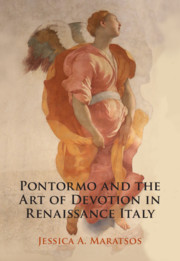
Both lauded and criticized for his pictorial eclecticism, the Florentine artist Jacopo Carrucci, known as Pontormo, created some of the most visually striking religious images of the Renaissance. These paintings, which challenged prevailing illusionistic conventions, mark a unique contribution into the complex relationship between artistic innovation and Christian traditions in the first half of the sixteenth century. Pontormo's sacred works are generally interpreted as objects that reflect either pure aesthetic experimentation, or personal and cultural anxiety. Jessica Maratsos, however, argues that Pontormo employed stylistic change deliberately for novel devotional purposes. As a painter, he was interested in the various modes of expression and communication - direct address, tactile evocation, affective incitement - as deployed in a wide spectrum of devotional culture, from sacri monti, to Michelangelo's marble sculptures, to evangelical lectures delivered at the Accademia Fiorentina. Maratsos shows how Pontormo translated these modes in ways that prompt a critical rethinking of Renaissance devotional art.
Recommend this
Email your librarian or administrator to recommend adding this to your organisation's collection.