The Italian Renaissance
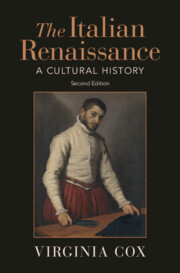

-
Select format
-
- Publisher:
- Cambridge University Press
- Publication date:
- 11 December 2025
- 15 January 2026
- ISBN:
- 9781009474221
- 9781009474245
- 9781009474252
- Dimensions:
- (229 x 152 mm)
- Weight & Pages:
- 0.65kg, 338 Pages
- Dimensions:
- (229 x 152 mm)
- Weight & Pages:
- 0.54kg, 338 Pages
- Subjects:
- Area Studies, European History after 1450, History, European Studies
You may already have access via personal or institutional login- Subjects:
- Area Studies, European History after 1450, History, European Studies
2nd edition
Show more authors 
You may already have access via personal or institutional login
Book description
The extraordinary creative energy of Renaissance Italy lies at the root of modern Western culture. In this magisterial study, Virginia Cox offers a fresh vision of this iconic moment in cultural history. Her lucid and absorbing book explores key artistic, literary and intellectual developments, as well as histories of food and fashion, map-making, exploration and anatomy. Alongside towering figures from Petrarch and Boccaccio to Leonardo, Machiavelli, and Isabella d'Este, Cox unveils lesser-known Renaissance protagonists including printers, travel writers, actresses, courtesans, explorers-even celebrity chefs. This extensively revised and expanded edition includes an incisive overview of Italy's relationship with the European and non-European worlds, embracing ethnic and religious diversity within Italy, the global dissemination and hybridization of Italian Renaissance culture, and Italian global encounters, including Jesuit missions to Asia. Pulling together the latest scholarship with original research and insight, Cox's book speaks both to general readers and specialists in the field.
Contents
Contents
Metrics
Full text views
Full text views helpTotal number of HTML views: 0
Total number of PDF views: 0 *
 Loading metrics...
* Views captured on Cambridge Core between #date#. This data will be updated every 24 hours.
Usage data cannot currently be displayed.
Accessibility standard: WCAG 2.2 AAA
Why this information is here
This section outlines the accessibility features of this content - including support for screen readers, full keyboard navigation and high-contrast display options. This may not be relevant for you.
Accessibility Information
The PDF of this book complies with version 2.2 of the Web Content Accessibility Guidelines (WCAG), offering more comprehensive accessibility measures for a broad range of users and attains the highest (AAA) level of WCAG compliance, optimising the user experience by meeting the most extensive accessibility guidelines.
Content Navigation
Table of contents navigation
Allows you to navigate directly to chapters, sections, or non‐text items through a linked table of contents, reducing the need for extensive scrolling.
Index navigation
Provides an interactive index, letting you go straight to where a term or subject appears in the text without manual searching.
Reading Order and Textual Equivalents
Single logical reading order
You will encounter all content (including footnotes, captions, etc.) in a clear, sequential flow, making it easier to follow with assistive tools like screen readers.
Short alternative textual descriptions
You get concise descriptions (for images, charts, or media clips), ensuring you do not miss crucial information when visual or audio elements are not accessible.
Full alternative textual descriptions
You get more than just short alt text: you have comprehensive text equivalents, transcripts, captions, or audio descriptions for substantial non‐text content, which is especially helpful for complex visuals or multimedia.
Visualised data also available as non‐graphical data
You can access graphs or charts in a text or tabular format, so you are not excluded if you cannot process visual displays.
Visual Accessibility
Use of colour is not sole means of conveying information
You will still understand key ideas or prompts without relying solely on colour, which is especially helpful if you have colour vision deficiencies.
Use of high contrast between text and background colour
You benefit from high‐contrast text, which improves legibility if you have low vision or if you are reading in less‐than‐ideal lighting conditions.