To save content items to your account,
please confirm that you agree to abide by our usage policies.
If this is the first time you use this feature, you will be asked to authorise Cambridge Core to connect with your account.
Find out more about saving content to .
To save content items to your Kindle, first ensure no-reply@cambridge.org
is added to your Approved Personal Document E-mail List under your Personal Document Settings
on the Manage Your Content and Devices page of your Amazon account. Then enter the ‘name’ part
of your Kindle email address below.
Find out more about saving to your Kindle.
Note you can select to save to either the @free.kindle.com or @kindle.com variations.
‘@free.kindle.com’ emails are free but can only be saved to your device when it is connected to wi-fi.
‘@kindle.com’ emails can be delivered even when you are not connected to wi-fi, but note that service fees apply.
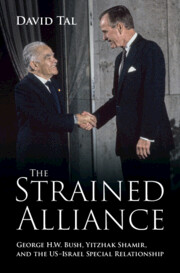
This chapter examines the complex diplomacy between the United States and Israel during the administration of President George H. W. Bush and Prime Minister Yitzhak Shamir, with a particular focus on the road to the Madrid Peace Conference in 1991. It argues that US Secretary of State James Baker ultimately played a pivotal role in shaping the negotiations. Drawing on newly available archival materials from the George H. W. Bush Presidential Library, the Israel State Archives, and the American Jewish Archives, the chapter presents a detailed account of the tensions that characterized the period. It explores how emotions - alongside interests and strategy - shaped diplomatic behavior, particularly over the peace process and the request for US loan guarantees to support the absorption of Soviet Jewish immigrants in Israel. The chapter also investigates the parallel strains in US relations with American Jewish organizations. In contrast to accounts that treat this period as an aberration in the U.S.-Israel "special relationship," the chapter shows how it encapsulated the recurring frictions and deep-rooted affinities that have long defined the alliance. It also reflects on the broader historiographical and methodological implications of using newly declassified sources to reassess well-known diplomatic episodes.1
When George H. W. Bush ascended to the American presidency in 1989, one of the more urgent relationships that he was faced with building was that with Israel's Yitzhak Shamir. Drawing on newly declassified materials, from American and Israeli state and non-state archives, this book reveals the complexities of a relationship defined by both deep cooperation and sharp tensions. From the peace process to loan guarantees, from military aid to emotional diplomacy, The Strained Alliance uncovers the debates, conflicts, and strategic decisions that shaped this critical period between 1989–1992. In doing so, David Tal challenges the traditional perception that US-Israel relations were dominated by policy disagreements, highlighting instead the broader foundation of collaboration that endured behind the scenes. Tal provides fresh insights into the intricate dynamics of diplomacy, ideology, and leadership, offering a balanced perspective on one of the most pivotal chapters in US-Israel history.
The period since the 1990s has proved, in an ironic way, the strength of Israel–US relations. In 1991, American president, George H. W. Bush, clashed with Israel, and since 1996, Prime Minister Benjamin Netanyahu had strained Israel–US relations in an unprecedented manner. In both cases, the constants that determined the course of the Israel–US relationship, religion, shared values, and history, proved to be stronger than any individual, regardless of their position. The period covered in this chapter was characterized by a close friendship and strategic partnership between the two nations. During those years, the two countries signed several memoranda of understanding which solidified the American commitment to Israel’s security and ensured its qualitative military edge, as well as expanding the cooperation on economic and cultural matters. The military-industrial cooperation as well as security cooperation between the two countries deepened. The growing Israeli attachment to American culture and values was another manifestation of the deepening relations between the two countries. The Israeli economy changed from socialist to neoliberal under the influence of American economic thinking. Neoconservatism spread across Israel’s political and intellectual elites through institutions and people, most notably Prime Minister Benjamin Netanyahu. The Israelis adopted many of the characteristics of American culture and economy, bringing their country closer to the United States in form and content. The ties between Israel and the Christian Zionist Evangelicals deepened as well. With the Evangelicals returning to the forefront of American politics since the mid-1970s, they became a major force in the support of Israel, a tendency that was especially encouraged by the right wing in Israel. Evangelical support for Israel has only increased during the 1990s and 2000s.
This chapter examines how the first Bush administration built domestic and international coalitions to respond to Saddam Hussein's invasion of Kuwait in August 1990. I argue that Bush's plan for the Persian Gulf War was to weaken Saddam as much as possible and then establish a system of containment based on multilateral sanctions, inspections, and military deterrence in the aftermath. The administration hoped Saddam would fall from power as a result of the conflict but did not make this a policy goal to avoid breaking up the international coalition and bogging the United States down in occupying Iraq. Lastly, this chapter examines domestic political debates on Iraq during the Gulf Crisis and explores the conflict between “minimalists,” who wanted to focus on ejecting Saddam from Kuwait, and “maximalists,” who wanted to use the crisis to ensure Saddam's removal.”
This chapter shows how the United States and its allies established a containment regime on Iraq after the Gulf War in the hope of using sanctions to compel Saddam to cooperate with UN weapons inspections. This chapter argues that despite the military victory in the Gulf War, a political narrative emerged in 1991 that Bush had missed several opportunities to overthrow Saddam and abandoned rebels who rose up against the Iraqi government, making the Gulf War a flawed victory. As Saddam obstructed inspections and challenged containment over the next two years, Democrats and neoconservatives developed the argument that containment could not address the Iraqi threat because it did not target the Iraqi regime, the source of its misbehavior, for removal. Containment thus became the US policy toward Iraq in an atmosphere of disappointment and recrimination that created a political bias against restrained approaches to Iraq and in favor of the more immediate pursuit of regime change.
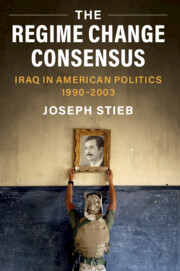
Why did the United States invade Iraq, setting off a chain of events that profoundly changed the Middle East and the US global position? The Regime Change Consensus offers a compelling look at how the United States pivoted from a policy of containment to regime change in Iraq after September 11, 2001. Starting with the Persian Gulf War, the book traces how a coalition of political actors argued with increasing success that the totalitarian nature of Saddam Hussein's regime and the untrustworthy behavior of the international coalition behind sanctions meant that containment was a doomed policy. By the end of the 1990s, a consensus belief emerged that only regime change and democratization could fully address the Iraqi threat. Through careful examination, Joseph Stieb expands our understanding of the origins of the Iraq War while also explaining why so many politicians and policymakers rejected containment after 9/11 and embraced regime change.
Examines George H. W. Bush’s efforts to establish a new world order and reliance on traditional Cold War strategies and alliances. Assesses Bush Sr.’s successes (e.g. German reunification) and failures (in Yugoslavia and Iraq). Documents beginning of post-Cold War US wars of Muslim liberation, a pattern continued by the presdients that followed him.
Argues for continuity (with the Cold War) and success (in the post–Cold War era) of American foreign policy. Assesses major interpretations and historiography of the Cold War and post–Cold War eras.
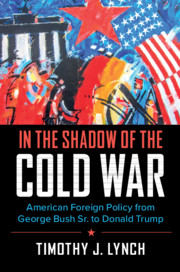
This book offers a bold re-interpretation of the prevailing narrative that US foreign policy after the Cold War was a failure. In chapters that retell and re-argue the key episodes of the post-Cold War years, Lynch argues that the Cold War cast a shadow on the presidents that came after it and that success came more from adapting to that shadow than in attempts to escape it. When strategic lessons of the Cold War were applied, presidents fared better; when they were forgotten, they fared worse. This book tells the story not of a revolution in American foreign policy but of its essentially continuous character from one era to the next. While there were many setbacks between the fall of Soviet communism and the opening years of the Trump administration, from Rwanda to 9/11 and Iraq to Syria, Lynch demonstrates that the US remained the world's dominant power.
Recommend this
Email your librarian or administrator to recommend adding this to your organisation's collection.