
Skip to main content Accessibility help
×
  • Cited by 2
    • Show more authors
    • You may already have access via personal or institutional login
    • Select format
    • Publisher:
      Cambridge University Press
      Publication date:
      November 2019
      December 2019
      ISBN:
      9781139027120
      9780521199872
      9780521136761
      Dimensions:
      (228 x 152 mm)
      Weight & Pages:
      0.5kg, 272 Pages
      Dimensions:
      (228 x 152 mm)
      Weight & Pages:
      0.4kg, 344 Pages
    You may already have access via personal or institutional login
  • Selected: Digital
    Add to cart View cart Buy from Cambridge.org

    Book description

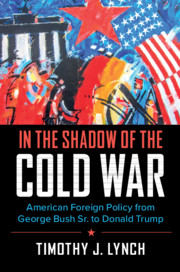
    This book offers a bold re-interpretation of the prevailing narrative that US foreign policy after the Cold War was a failure. In chapters that retell and re-argue the key episodes of the post-Cold War years, Lynch argues that the Cold War cast a shadow on the presidents that came after it and that success came more from adapting to that shadow than in attempts to escape it. When strategic lessons of the Cold War were applied, presidents fared better; when they were forgotten, they fared worse. This book tells the story not of a revolution in American foreign policy but of its essentially continuous character from one era to the next. While there were many setbacks between the fall of Soviet communism and the opening years of the Trump administration, from Rwanda to 9/11 and Iraq to Syria, Lynch demonstrates that the US remained the world's dominant power.

    Reviews

    'Readers will be intrigued and provoked by Timothy J. Lynch’s new book. Insisting that there have been more continuities than discontinuities in America’s post-Cold War foreign policy and that there have been more successes than failures, his arguments should stimulate constructive debate about what has been and what should be US strategy in a complex and challenging world.'

    Melvyn P. Leffler - University of Virginia

    'Timothy J. Lynch mounts a powerful, witty, and erudite challenge to prevailing assessments of US foreign policy. He argues that America’s international role remains indispensable and durable and makes the case for a remarkable degree of policy continuity since the Cold War.'

    Robert J. Lieber - Georgetown University and author of Retreat and Its Consequences: American Foreign Policy and the Problem of World Order

    'Timothy J. Lynch has written a cogent, graceful, provocative account of American foreign policy in the wake of - but, he argues, still powerfully influenced by - the Cold War.'

    Michael Mandelbaum - author of The Rise and Fall of Peace on Earth

    'This wide-ranging and astute account of American foreign policy since 1989 grabs the reader from the opening sentence and never lets go. Whereas others see a sharp break after the collapse of the communist bloc and highlight differences across the last five American presidents, Lynch observes the shadow of the Cold War to the present day, and casts his eye on the continuities that persist across Democratic and Republican administrations.'

    James Goldgeier - American University

    ‘… As a practical examination of US foreign policy actions, this text is a significant contribution to the body of literature on the post-Cold War era.’

    J. R. Clardie Source: Choice

    Refine List

    Actions for selected content:

    Select all | Deselect all
    • View selected items
    • Export citations
    • Download PDF (zip)
    • Save to Kindle
    • Save to Dropbox
    • Save to Google Drive

    Save Search

    You can save your searches here and later view and run them again in "My saved searches".

    Please provide a title, maximum of 40 characters.
    ×

    Contents

    Metrics

    Altmetric attention score

    Full text views

    Total number of HTML views: 0
    Total number of PDF views: 0 *
    Loading metrics...

    Book summary page views

    Total views: 0 *
    Loading metrics...

    * Views captured on Cambridge Core between #date#. This data will be updated every 24 hours.

    Usage data cannot currently be displayed.

    Accessibility standard: Unknown

    Why this information is here

    This section outlines the accessibility features of this content - including support for screen readers, full keyboard navigation and high-contrast display options. This may not be relevant for you.

    Accessibility Information

    Accessibility compliance for the PDF of this book is currently unknown and may be updated in the future.
