To save content items to your account,
please confirm that you agree to abide by our usage policies.
If this is the first time you use this feature, you will be asked to authorise Cambridge Core to connect with your account.
Find out more about saving content to .
To save content items to your Kindle, first ensure no-reply@cambridge.org
is added to your Approved Personal Document E-mail List under your Personal Document Settings
on the Manage Your Content and Devices page of your Amazon account. Then enter the ‘name’ part
of your Kindle email address below.
Find out more about saving to your Kindle.
Note you can select to save to either the @free.kindle.com or @kindle.com variations.
‘@free.kindle.com’ emails are free but can only be saved to your device when it is connected to wi-fi.
‘@kindle.com’ emails can be delivered even when you are not connected to wi-fi, but note that service fees apply.
This chapter turns to Abdulrazak Gurnah’s Swahili coast narratives, focusing on his novel Desertion (2005), which tells stories about interracial intimacies between Indian, Swahili, and European characters across multiple generations in colonial and postcolonial periods. In the nineteenth century, colonial debates on Indian emigration to Africa insisted on a clear racial separation between “native” Africans and Indian “settlers.” Late twentieth-century East African nationalist discourses reproduced this racialized indigeneity as national identity. Gurnah’s critique of this racial nationalism lies in the novel’s experimental aesthetics, which involve perspectival storytelling, nested stories, and inclusion of multiple genres. The novel’s layered narration gives expression to abject, repressed Indian Ocean intimacies, reconfiguring colonial models of racial encounter as part of the longer history of migration and exchange in Indian Ocean. The melancholic return of Indian Ocean affiliations troubles both the racial-dystopic conception of nationhood in postcolonial East Africa and the utopic imagining of a multiracial community of the past or future.
This chapter examines the applicability of the term “cosmopolitanism” to Indian Ocean contexts through the question of language, asking: How does one represent a multilingual past using the medium of historical fiction? It examines the use of multilingualism and translation in Amitav Ghosh’s Sea of Poppies (2008) and Abdulrazak Gurnah’s Paradise (1994), novels that draw on multilingual nineteenth-century sources to tell stories of cross-cultural encounters in the Indian Ocean. These novels use various textual strategies, such as direct inscription of multiple languages or indirect description of linguistic difference, to portray a multilingual Indian Ocean encounters. Closely examining these textual moments alongside the novels’ sources reveals the limits of liberal cosmopolitanisms constructed both within and through the texts. They articulate a politics of language that shapes cosmopolitan intercourse in the Indian Ocean, and in doing so, self-reflexively critique the Anglophone text as a medium of cosmopolitan exchange today.
This chapter connects the threads from the preceding two chapters by examining representations of “India” as part of the social, cultural, and physical landscape of Eastern Africa in fictional works by African authors of Indian descent. In Sophia Mustafa’s In the Shadow of Kirinyaga (2002) and Barlen Pyamootoo’s Bénarès (1999), the diasporic imagination cites and sites symbolic Indian spaces within local African contexts hierarchized by race, class, gender, and ethnicity. Placing these texts in a shared but differentiated discourses of race, colonialism, and nationalism in Mauritius and East Africa, the chapter demonstrates that they inscribe Indian cultural spaces in diasporic locations not to express nostalgia for a distant homeland or to make cultural claims on the locality; but instead, their diasporic imagination moves through local, unresolved histories of colonial, racial, and gendered violence, uniquely sustained by ongoing forms of displacement and dispossession. Anarchival movements in these texts uncover Black migration histories as entangled and interdependent with Indian diasporic insinuation of transnational ties.
The Indian Ocean has long connected people, objects, and ideas across continents and cultures. This book asks how contemporary writers reimagine the Indian Ocean through literary figurations of the past. In doing so, it offers an oceanic perspective for rethinking the paradigms of postcolonialism by way of rich historical context and intertextual readings of Afro-Asian fiction. Drawing on historiographical research, archival theory, and literary analysis, this book explores how writers including Amitav Ghosh, Abdulrazak Gurnah, Sophia Mustafa, Ananda Devi, Shenaz Patel, and Barlen Pyamootoo imaginatively probe the historical and cultural legacies of transoceanic pasts within the political contradictions and identarian divisions of the postcolonial present. Traveling between South Asia and Eastern Africa and between the past and the present through literary, filmic, theoretical, and archival texts, this book contends that any understanding of South Asian or African present is incomplete without a consideration of their entangled pasts.
Hypertension (HTN) is the primary cause of preventable cardiovascular-related deaths globally, representing the most important modifiable risk factor for preventing such deaths. Nearly 700 million of the 1.3 billion adults with HTN worldwide remain untreated, most of whom live in low-and middle-income countries, including East Africa. Barriers to the diagnosis of HTN also impact treatment adherence after diagnosis and the initiation of treatment. This scoping review used a qualitative synthesis method to describe studies examining the cultural and contextual factors influencing HTN treatment adherence in East Africa and the lived experiences of patients with HTN to gain a better understanding of these factors in the region. A total of 34 studies, 25 qualitative and 9 mixed-methods designs from five East African nations were included in the final review. Reported influencing factors are classified into individual, structural, and social factors. Lack of HTN literacy and limited risk perception were often cited as individual barriers to adherence, along with mental health challenges, including fear of stigma, while trust and HTN literacy enhanced adherence. Inconsistent healthcare delivery, lack of access, and financial constraints were the most reported structural factors. Social norms surrounding health behaviours and attitudes towards HTN treatment were identified as key determinants of adherence at the social level. The findings underscore the complex interplay of individual, structural, and social factors associated with HTN treatment adherence in East Africa, offering practical ways to enhance adherence in the region at all three levels.
This article examines women’s storytelling and nanga (harp) performances in nineteenth- and twentiethcentury western Uganda to investigate how these songs shaped community identity and norms. Drawing on musical recordings, archival sources, and interviews, this article demonstrates that these performances functioned as important public histories, teaching audiences about past famines, droughts, climate change, and cattle events. These narratives both chronicled regional histories and provided the shared intellectual material from which community norms and a shared identity could be articulated. Extant scholarship has focused overwhelmingly on how male intellectuals contributed to ideas of race, nation, or ethnicity. This article thus provides an important alternative by showing how women produced histories that contributed to group identity—yet this historical production occurred through musical performances rather than in books, tracts, or petitions. In doing so, this article reintegrates western Ugandan women into narratives of imperial encounters and intellectual history.
This article is a case study of the Kasarani Stadium in Kenya as a heuristic through which to understand President Daniel Arap Moi’s political style and priorities during the first decade of his regime. Drawing primarily from national and international newspapers, the archives of national and international sporting organizations and associations, records of the Kenyan government and biographies of Moi, I explore how Moi gave political meaning to sport to advance his populist politics at home and project Kenya on(to) the international stage. At home, he used sports to define himself as a leader of the ordinary mwananchi (citizen), in touch with the experiences, challenges, and visions of the common Kenyan. Internationally, he used sports to chart Kenya’s foreign policy and fashion himself as an international political personality. The article concludes that the study of sports and sporting infrastructure offers a productive way to write social, political, and cultural histories of postcolonial Africa.
This chapter outlines the rise of Arabic Islamic print in the British-BuSaidi protectorate of Zanzibar c. 1880–1940. It argues that the availability of printed Arabic material set off two processes: The emergence of a new public of specialised readers who read primarily silently and alone (individual readers, often associated with modernist Islamic ideas) and mass distribution of texts primarily intended for communal reading and/or performance (often associated with Sufi practices). It traces the rise of local print enterprises such as the Government Press and the rise of Arabic-language journals. Furthermore, the chapter traces the publishing habits of Zanzibari authors, whose didactic works were printed locally while religious tracts were primarily printed in Egypt. Finally, this chapter outlines the circulation of texts from printing presses abroad, primarily India and Egypt, highlighting the availability of cheaply printed devotional texts primarily meant for local usage.
This paper examines the life trajectories, social contexts and living conditions of women of uncertain status in post-slavery, colonial-era Tabora, with a focus on those involved in the production and consumption of beer. It thereby searches insights into the aftermath of slavery in this region, particularly for women. It reflects on the persistent social unease surrounding slavery and its aftermath, and on the way it shapes and limits sources, arguing that a focus on post-slavery is nevertheless productive. Set in context, brewers’ life stories provide a vivid illustration of a competitive urban environment, the chances for self-emancipation that it offered, and the concomitant challenges and dangers. They thereby also enable fresh insight into the social history of alcohol and of urban women in colonial Africa. We find evidence of more successful brewing careers than existing studies would predict, but also of very stark vulnerability and persistent quests for safety in family networks. This spread of outcomes highlights the contingent nature of emancipation and the endlessly varied ways in which social constraints and personal motivations combined in individual lives.
This study assesses the seroprevalence of Rift Valley fever (RVF) in ruminants in Dhobley, Somalia, following a 2021 outbreak in Kenya. Among 142 ruminants sampled, 4.9% were seropositive for RVF virus (RVFV) antibody, with IgM antibodies (1.4%) indicating recent exposure, though no cases were RT-PCR-positive. Unregulated livestock movement and limited surveillance pose significant risks for future outbreaks, underscoring the need for enhanced surveillance systems and One Health strategies.
Chapter 3 examines the programmatic consolidation, destruction, and removal of sensitive documents in Kenya and East Africa to London as constitutional negotiations were underway as a way to simultaneously curate, in ways favorable to British interests, materials for the writing of colonial history and for the making of a postcolonial political order. It presents recordkeeping as a political project through which the outgoing colonial government in Kenya attempted to strategically furnish the incoming independent government with documents that would facilitate structural continuity during the transition to political independence while at the same time removing those which might jeopardize British interests, at the personal and governmental levels, thereby creating the conditions for impunity.
This study examines Swahili-language Islamic marital booklets (vijitabu) written between 1932 and 2020, focusing on their gendered chronotopes and nostalgic elements. These booklets, written by and for Muslim men, offer advice on marriage, sexuality, and related topics, reflecting societal changes and the influence of reformist Islam in East Africa. The analysis identifies four prominent chronotopic formulations: the contemporary East African context, the time and place of the Prophet Muhammad, the pre-Islamic world (jahiliya), and the modern West. A potential fifth chronotope, the afterlife (akhera), is contingent on adherence to the first four. The booklets valorize the Prophet Muhammad’s era while criticizing other temporal and spatial contexts, advocating for a return to early Islamic gender norms and marital practices to achieve happiness in the afterlife. This study highlights the booklets’ role in shaping gender norms and religiopolitical ideologies, revealing the interplay between nostalgia, religious authority, and sociopolitical context in East African Muslim communities.
Archaeological research on pastoralism has mostly occurred within the silos of separate regionally specific traditions in the Middle East, Central Eurasia, North Africa, and East Africa. The common questions concerning pastoral ecologies and economies outlined in Chapter 6 and the social research agendas discussed in Chapter 7 open space for a more robust comparative archaeology of pastoralism across disparate regions and longer time spans.
Independent Christian Churches were an important aspect of African anticolonial activism, but the political afterlives of these movements in the immediate postcolonial period have been broadly overlooked. This article studies the African Independent Pentecostal Church, focusing on its entanglement with the politics of reconciliation and state-building in a decolonising Kenya. During the 1950s Mau Mau uprising, the church lost its entire portfolio of land, churches, and schools. The article explores how church adherents sought to re-establish themselves on these holdings. These contests reveal that churches were political agents engaged in debates about the boundaries of postcolonial political community and the nature of post-conflict reconciliation. Churches’ roles as landowners and education providers meant denominational rivalries masked political struggles over justice for past violations. Embedded in intra-ethnic conflicts, churches negotiated with elites seeking to establish ethnic constituencies. Through this conflict and compromise, the brokered nature of the postcolonial nation-building project is revealed.
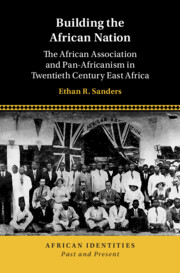
How did people in East Africa come to see themselves as 'Africans,' and where did these concepts originate from? Utilizing a global intellectual history lens, Ethan Sanders traces how ideas stemming from global black intellectuals of the Atlantic, and others, shaped the imaginations of East Africans in the early twentieth century. This study centers on the African Association, a trans-territorial pan-Africanist organization that promoted global visions of African unity. No mere precursor to anti-colonial territorial nationalism, the organization eschewed territorial thinking and sought to build a continental African nation from the 1920s to the 1940s, at odds with later forms of nationalism in Africa. Sanders explores in depth the thought of James Aggrey, Paul Sindi Seme, and Julius Nyerere, three major twentieth-century pan-Africanists. This book rethinks definitions of pan-Africanism, demonstrating how expressions of both practical and redemptive pan-Africanism inspired those who joined the African Association and embraced an African identity.
This article explores the development of the Safari Rally in the context of intertwined trends in mobility, sports, and consumerism at local, global and intermediate levels. The first section briefly presents the Safari Rally. The second section discusses the significance and development of the sport of rallying in the context of global automobility and changes in the motor industry, highlighting in particular the professionalisation of sport and the forces driving it. The third section analyses why the Safari became relevant to so many stakeholders in Africa and across the globe, and how these shaped its development from its colonial origins through decolonisation and beyond. Highlighting the factors accounting for the rise, and decline, of the Safari as a sporting event of global significance contributes to understanding how mobility, sports, and consumerism were interlinked across continents in the second half of the 20th century.
This essay is a study in bureaucratic knowledge production using the example of the postal system in German East Africa. There is a great deal of historical literature that focuses on bureaucratic-knowledge-as-power: bureaucracies produced information that was used to quantify and, ultimately, to control populations both in the metropole and the colony. In this piece I want to emphasize another kind of bureaucratic knowledge production: namely, information about the bureaucratic system that was created through bureaucratic practice — what I call “studied bureaucratic knowledge.” Beyond understanding German attempts to translate (linguistically, administratively, and culturally) one understanding of bureaucracy, the historian who pays attention to the users of colonial bureaucratic structures can uncover bureaucratic knowledge created by those who encountered those structures in their daily lives — and how that information in turned shaped their use of the bureaucratic system.