To save content items to your account,
please confirm that you agree to abide by our usage policies.
If this is the first time you use this feature, you will be asked to authorise Cambridge Core to connect with your account.
Find out more about saving content to .
To save content items to your Kindle, first ensure no-reply@cambridge.org
is added to your Approved Personal Document E-mail List under your Personal Document Settings
on the Manage Your Content and Devices page of your Amazon account. Then enter the ‘name’ part
of your Kindle email address below.
Find out more about saving to your Kindle.
Note you can select to save to either the @free.kindle.com or @kindle.com variations.
‘@free.kindle.com’ emails are free but can only be saved to your device when it is connected to wi-fi.
‘@kindle.com’ emails can be delivered even when you are not connected to wi-fi, but note that service fees apply.
The first of the three topics that occupied censors across the regimes was ‘religion’, which predominantly meant Catholicism. This chapter traces examples of self- and bureaucratic censorship under the Ancien Régime, when the king was in power through divine right, through the Revolution, where plays criticizing the Church exploded, and onto the Empire and the Restoration, both of which had an uneasy relationship with biblical and Catholic material for the theatre, especially on secondary stages like the Vaudeville. Generally, the larger the role the Catholic Church played at the time, the more difficult the representation of religious material became. However, when such material did make it to the boards, lateral censorship meant that religion could quickly act as an ersatz vehicle to discuss the ruling regime. Religion was an even tricker subject as reactions were far from homogenous: context was key, and whilst a play might be acceptable to one audience, another could boil over into violence in its quest to promote or silence specific worldviews.
This chapter begins with reference to the veneration and obscurity that characterises Webb’s reputation. It relates the early Webb’s mentoring by Norman Lindsay and his subsequent rejection of Lindsay’s secular aesthetics and anti-Semitism. Webb’s expatriate years in Canada and then England are discussed as a search for creative independence, although England was the place of his first hospitalisation for mental illness. The chapter observes that some of Webb’s most resonant poems are responses to the East Anglia landscape. It traces Webb’s return to Australia, his continued hospitalisation, and his Catholic devotion. The chapter explores the concept of schizophrenia as a pathology of language to understand Webb’s poetic language, particularly its metaphorical aspects. Lastly, the chapter focuses on Webb’s ‘explorer’ poems, their metaphorics of journeying, and their relationship to Australia’s cultural history, or national mythology, in the late 1950s and 1960s.
This chapter considers the fraught and complex history of religion and poetry in Australia, given the context of settler – colonialism, Aboriginal understandings of Country, and Australia’s growing cultural diversity. Discerning that anti-religious sentiment has emerged through a perception of Christianity as too close to settler – colonialism, it argues for a broad understanding of religion to include major world faiths and Aboriginal spirituality. It considers how nineteenth-century poets responded to the crises of faith brought about by Darwin’s theory of evolution, and then how poets grappled with meaning-making and value-making following the two world wars. At the same time, it recognises that many poets; including Francis Webb, James McAuley, Vincent Buckley; and Les Murray; still shared an institutional understanding of religion. The chapter considers how recent poets have meditated on the relationship between the secular and the sacred. It analyses the mosaic quality of Fay Zwicky’s reflections on her Jewish ancestry, as well as the navigation of Buddhism in poets like Harold Stewart, Robert Gray; and Judith Beveridge; Christianity in the work of Kevin Hart and Lachlan Brown; and Islam in the work of Omar Sakr.
What does 'Irish romanticism' mean and when did Ireland become romantic? How does Irish romanticism differ from the literary culture of late eighteenth- and nineteenth-century Britain, and what qualities do they share? Claire Connolly proposes an understanding of romanticism as a temporally and aesthetically distinct period in Irish culture, during which literature flourished in new forms and styles, evidenced in the lives and writings of such authors as Thomas Dermody, Mary Tighe, Maria Edgeworth, Lady Morgan, Thomas Moore, Charles Maturin, John Banim, Gerald Griffin, William Carleton and James Clarence Mangan. Their books were written, sold, circulated and read in Ireland, Britain and America and as such were caught up in the shifting dramas of a changing print culture, itself shaped by asymmetries of language, power and population. Connolly meets that culture on its own terms and charts its history.
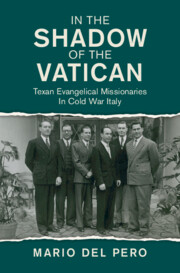
After a successful fundraising campaign, the Church of Christ missionaries arrived in Italy in early 1949. They acquired a villa in Frascati, in the Castelli Romani area southeast of Rome, where they established a school and an orphanage and launched an ambitious missionary effort. Their activities quickly alarmed the local Catholic clergy and Vatican hierarchies, who viewed the mission as part of a broader Protestant strategy to undermine the Catholic Church’s near monopoly on religion in Italy. The Vatican promptly urged the Italian government to take action, relying on Fascist-era laws to curb the missionaries' activities. The Italian Ministry of the Interior, led by the conservative Christian Democrat Mario Scelba, targeted the Texas evangelicals for overstaying their short-term tourist visas and for opening a school without the requisite authorizations. Efforts to spread their message in various towns of the Castelli Romani were met with significant resistance, including violent attacks by locals. As tensions escalated, the missionaries grew increasingly frustrated with what they perceived as the indifference of US diplomats stationed in Rome. They began lobbying their congressional representatives in Washington, and soon members of Congress took up their cause, pressuring the State Department to intervene.
In 1948, joining the wave of post-World War II evangelical missionary activism, the small, nondenominational Church of Christ from Lubbock, Texas, decided to establish its own mission in Italy. The missionaries believed that by promoting religious freedom, they would help spread democracy and American values. But they were also motivated by fervent anti-Catholicism and a conviction that they could challenge the Vatican's near monopoly on religion in Italy. Their zeal and naivety were met with a harsh response from the Catholic Church and its allies within the Italian government. At the same time, the omnipresent Cold War soon forced all the actors involved to adapt their strategies and rhetoric to leverage the situation to their advantage.
This chapter traces the history of Roman Catholicism in American politics and society, beginning with an overview of the tenets of the Catholic faith. The chapter then discusses historic tensions and division between Protestants and Catholics, tracing patterns of assimilation and eventual acceptance of Catholicism into American civil religion.
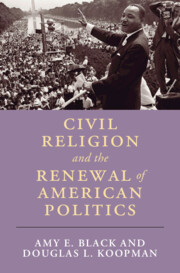
American culture is evolving rapidly as a result of shifts in its religious landscape. American civil religion is robust enough to make room for new perspectives, as religious pluralism is foundational for democracy. Moreover, as Amy Black and Douglas L. Koopman argue, American religion and politics are indivisible. In this study, they interrogate three visions of American identity: Christian nationalism, strict secularism, and civil religion. Whereas the growth of Christian nationalism and strict secularism foster division and threaten consensus, by contrast, a dynamic, self-critical civil religion strengthens democracy. When civil religion makes room for robust religious pluralism to thrive, religious and nonreligious people can coexist peacefully in the public square. Integrating insights from political science, history, religious studies, and sociology, Black and Koopman trace the role of religion in American politics and culture, assess the current religious and political landscape, and offer insights into paths by which the United States might reach a new working consensus that strengthens democracy.
After the death of their beloved dog Whym Chow, Katharine Bradley and Edith Cooper, who write collectively as Michael Field, underwent a radical spiritual and poetic shift by converting to the Roman Catholic Church. Each partner viewed this shift differently. Bradley focused on the ways in which Whym Chow’s death represented a rupture in their domestic Trinity, while Cooper focused on the sacrificial aspects of euthanising the dog as an act of their own will. Converting to the Roman Catholic Church impacted both Bradley and Cooper’s relationship with one another and their poetic creativity and dominated the final years of their shared life.
This chapter considers Michael Field’s position as ‘Victorian decadents’ in the early twentieth century. It outlines Katharine Bradley and Edith Cooper’s ambivalent response to fin-de-siècle decadence, as seen in their reactions to the likes of Oscar Wilde and The Yellow Book. The chapter then proposes that Michael Field actually became more attached to decadence as the ‘yellow nineties’ waned, focusing on how Bradley and Cooper’s dedication to decadence is expressed most clearly in poems about Whym Chow, their beloved dog whose death in 1906 catalysed their conversion to Catholicism. The chapter finally discusses the decadent tropes found in Whym Chow: Flame of Love (1914) and Michael Field’s Catholic poems.
This chapter proposes new readings of the poems of Whym Chow: Flame of Love based on ideas of unconventional domesticity, alternative divinity, and queer, chosen families. The chapter explores the ways in which animal characteristics disrupt and subvert conventional poetic form and religious teachings in the volume, specifically elegy and Catholicism. It also focuses on connections between Michael Field’s writing and animal poetry found in the work of other fin-de-siècle and modernist writers. The chapter proposes that these poems can and should be celebrated for their eccentricity, oddity, and queerness rather than overlooked and marginalised within Michael Field’s oeuvre.
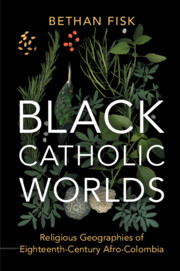
Centring the lived experiences of enslaved and free people of colour, Black Catholic Worlds illustrates how geographies and mobilities – between continents, oceans, and region – were at the heart of the formation and circulation of religious cultures by people of African descent in the face of racialisation and slavery. This book examines black Catholicism in different sites – towns, mines, haciendas, rochelas, and maroon communities – across New Granada, and frames African-descended religions in the region as “interstitial religions.” People of African descent engaged in religious practice and knowledge production in the interstices, in liminal places and spaces that were physical sites but also figurative openings, in a society shaped by slavery. Bringing together fleeting moments from colonial archives, Fisk traces black religious knowledge production and sacramental practice just as gold, mined by enslaved people, again began to flow from the Pacific coast to the Atlantic world.
This chapter takes up Zola’s self-portrait as Saint Thomas in the wake of his much-commented visit to Lourdes in 1892. The novel he went on to write about the Pyrenean shrine, ‘that divine land of dreams’, was largely based on those supposedly miraculous events he had witnessed, and about which he remained sceptical. This chapter looks to Zola’s Lourdes (1894), in conjunction with the heated polemic it provoked, to better understand the stakes of the author’s divisive foray into matters of Catholic practice and dogma. More than an expression of Zola’s anti-clericalism, the novel aroused debates that were aesthetic as much as ideological, as adversaries argued over questions of representation, proofs, facts, documents, and faithfulness. The chapter reads a set of material penned by Catholic detractors, who were determined to defend the divine status of the miracle, casting Zola’s naturalism as an illegitimate, unbelievable – even, à la limite, idealist – aesthetic mode.
Joyce’s repudiation of Catholic Ireland and his countering declaration of artistic independence are well-known and integral features of his life-long dedication to writing. The most important of Joyce’s Irish predecessors was the poet James Clarence Mangan (1803–1849), whose tragic life was represented by Joyce as an emblem of the fate of the Irish artist, betrayed through identification of himself with his country. Joyce’s obsession with betrayal manifests itself in the lectures he delivered on Mangan, in Dublin in 1902 and in Trieste in 1907. Wherever he looked, in Irish political or literary history, he found betrayal. The great political crisis that dominated his early life – the fall of Parnell – governed this reading of his country’s past and helped him define the nature of the embattled relationship between him and his Irish audience. Parnell was, in Joyce’s view, a heroic spirit brought low by his own people, who listened to Parnell’s plea that they should not throw him to the English wolves.
The first instalment of Zola’s novel Vérité appeared on 10 September 1902, just nineteen days before the author died under suspicious circumstances that were likely related to his involvement in the Dreyfus Affair. The novel provided an allegorical transposition of the contemporary political drama that had divided the nation, but which, as yet, had been denied its proper dénouement. This chapter explores how Zola imagined the right and just resolution of the legal case, as well as of the national crisis it galvanised. Working across Zola’s journalistic and fictional versions of the Affair, it argues that Zola understood the Dreyfus case as an aesthetic problem: as a matter of style, taste, plot, and plausibility. In order for the truth to win out, Zola must imagine the aesthetic and ethical re-education of a nation; and this happy ending involves harnessing an acceptable version of the idealist imagination.
Most religious traditions and movements have majorities of women, but most are led by men and are based on deeply embedded patriarchal assumptions. That underlying reality is played out in multiple different Christian traditions and shapes the subsequent contests for power, representation, and influence. This chapter is animated by a primary question from which other questions naturally flow: What are the characteristics of the religious networks constructed by women and to what extent do they function differently from those built largely by men? In attempting to answer that question, I identify five different kinds of networks representing different varieties of female leadership and participation. It is important to state that this typology should not be read as either an ascension or declension narrative about women’s agency and the role of patriarchy in shaping that agency.
This chapter provides a detailed comparative overview of domestic religion in seventeenth- and eighteenth-century London, setting out evidence of a range of domestic devotional activities as performed by households of different faiths, and introducing the legislation which, to varying extents, restricted the open religious expression of these different communities. It considers how larger domestic gatherings involving participants other than members of the household would have been restricted by legislation such as the Conventicle Acts (1664–89), as well as self-regulation within the recently established Jewish communities. This legislation or congregational law drew a distinction between household and family prayer and ‘gathering for worship’ in domestic spaces. The chapter suggests that domestic gatherings for worship were permitted in certain circumstances, and that these circumstances generally coincided with life-cycle events.
Historians of Christianity, even when innovative in theory and method, have mostly written within national, denominational, or institutional frameworks. Yet many of the most important changes and developments within Christianity have been transnational in scope, trans-denominational in character, and not easily contained within institutional or hierarchical structures. What difference would it make to reimagine the history of Christianity in terms of transnational networks, nodal junction boxes of encounter and transmission, and a greater sense of the core memes and messages of religious traditions and expressions? That is the principal question to be explored in the following chapters.
What does it mean to be a public Catholic institution in Canada? How does this Catholic identity evolve with the secularisation and diversification of society, and with the rising awareness of the complicated legacy of Catholicism and colonisation in Canada? This article explores those questions drawing on document analysis and interviews with staff working in Catholic health care. Taking a legal pluralist approach, it documents how Catholic health-care institutions navigate between transnational canon laws and ethics, and human rights law. Catholic health care is situated in a web of national and transnational legal regimes. We argue that this navigation takes different forms to adapt to societal changes, such as the authorization of Medical Assistance in Dying (MAiD). This article speaks directly to how Christianity continues to play a subtle, but still constant presence in Canadian Catholic hospitals, and debunks tropes that construct relationships between state and religion as one of clear separation.
O’Casey was born into a Protestant family and his father worked as a clerk for the Irish Church Missions, an evangelical society that aimed to convert Catholics. This chapter argues that O’Casey radically reimagined Christianity, depicting characters that inadvertently travesty or re-enact Christianity’s meanings. More broadly, however, he treats the love of the divine as parallel to the love of freedom and country; rather than a strict code, such love is a life-affirming source of inspiration akin to art and poetry. O’Casey’s sophisticated understanding of the value of Christianity has little to do with sectarian differences or superstition, but inheres in caring actions, love of life, and a determination to feed the spirit along with the body.