To save content items to your account,
please confirm that you agree to abide by our usage policies.
If this is the first time you use this feature, you will be asked to authorise Cambridge Core to connect with your account.
Find out more about saving content to .
To save content items to your Kindle, first ensure no-reply@cambridge.org
is added to your Approved Personal Document E-mail List under your Personal Document Settings
on the Manage Your Content and Devices page of your Amazon account. Then enter the ‘name’ part
of your Kindle email address below.
Find out more about saving to your Kindle.
Note you can select to save to either the @free.kindle.com or @kindle.com variations.
‘@free.kindle.com’ emails are free but can only be saved to your device when it is connected to wi-fi.
‘@kindle.com’ emails can be delivered even when you are not connected to wi-fi, but note that service fees apply.
Between 2011 and 2017, excavations by a joint German-Georgian team at the Tabakoni settlement mound in the Colchis lowlands of western Georgia uncovered complex wooden constructions preserved in the waterlogged soils. Combined radiocarbon and dendrochronological dating, the first undertaking of its kind in Colchis, reveals that construction on a stable foundation for the site began in the twentieth century BC and identifies early evidence for the cultivation of millet. Subsequent occupation phases saw the careful levelling of previous structures and the addition of backfill, gradually building up the mound until it was ultimately abandoned in the second half of the first millennium BC.
Occupied from around 1600 BC and linked to the Cherkaskul and Alekseevka-Sargary cultures, Semiyarka is a newly identified 140ha Late Bronze Age settlement in north-eastern Kazakhstan. The site represents a unique settlement with planned architecture—including a central monumental structure—low-density pottery scatter and evidence for organised tin-bronze production.
Excavations at Aketala reveal traces of human activity at the oases of the western Tarim Basin, north-western China, by at least 2200 BC. The recovered artefacts indicate that, by 1800 BC, the Andronovo culture had reached this region, bringing agropastoralism and developing the earliest regional evidence of bronze manufacturing techniques.
Sheath-ends are poorly represented in works regarding weaponry of the Cimmerian period (10th–7th century BC), despite forming an important component, particularly among the melee weapons of the time. There are several reasons for this neglect: until recently, the number of known sheath-ends was quite small, thus making it impossible to speak of types, variants or cultural affiliations; also, most of the previously published sheath-ends are spread over a large territory and were published many decades ago. Therefore, some of them may be unknown to researchers due to the age of publications, as well as linguistic and cultural barriers. Over the past few years, a larger number of new sheath-ends has emerged. Some of them belong to previously known types, others are completely new. Their analysis is here conducted using the comparative method. The total number of sheath-ends now known makes it possible to begin a discussion about their types, chronology and origins, which will undoubtedly develop as new finds appear.
In this book, Jonathan Valk asks a deceptively simple question: What did it mean to be Assyrian in the second millennium bce? Extraordinary evidence from Assyrian society across this millennium enables an answer to this question. The evidence includes tens of thousands of letters and legal texts from an Assyrian merchant diaspora in what is now modern Turkey, as well as thousands of administrative documents and bombastic royal inscriptions associated with the Assyrian state. Valk develops a new theory of social categories that facilitates an understanding of how collective identities work. Applying this theoretical framework to the so-called Old and Middle Assyrian periods, he pieces together the contours of Assyrian society in each period, as revealed in the abundance of primary evidence, and explores the evolving construction of Assyrian identity as well. Valk's study demonstrates how changing historical circumstances condition identity and society, and that the meaning we assign to identities is ever in flux.
An intensive archaeological surface survey of the El Argar site and its hinterland has provided new information for the discussion of early sociopolitical complexity in the western Mediterranean. This article presents the preliminary interpretation of a long-term settlement pattern, particularly in the Bronze Age.
Archaeologists have long investigated the rise of inequality in prehistoric Europe. I argue that images of steadily increasing inequality are usually based on cherry-picking outstanding cases and selectively interpreting the results. Based on a large-scale qualitative assessment of the Central Mediterranean, I make two claims. First, a broad review of evidence suggests that social inequality was not a major organizing principle of most prehistoric societies. Instead, throughout prehistory, inequality formed part of a heterogeneous, heterarchical social order. Second, this was not simply due to historical chance or stagnation. As my outline of the “people’s history” of prehistoric Europe suggests, many of the archaeologically most visible developments in every period were actively aimed at undermining, encapsulating, or directing the potential development of hierarchy. In this sense, Europe’s long prehistory of limited and ambiguous hierarchy does not represent a failure of social evolution but rather widespread success in developing tactics for maintaining equality.
Despite an early surge in copper-ore mining during the sixth and fifth millennia BC (the ‘boom’), evidence for metal production in the Balkans dwindles in the fourth millennium (the ‘bust’). Here, the authors present new evidence for copper mining at Curak in south-west Serbia, c. 3800 cal BC, during this apparent downturn. By integrating field surveys, excavations and provenance analyses, they explore activity at the site, challenging the visibility bias in the archaeological record of this region for this key period. Rather than a societal collapse, the authors argue, fewer artefacts may instead reflect a widening Balkan sphere of influence.
Bronze Age–Early Iron Age tin ingots recovered from four Mediterranean shipwrecks off the coasts of Israel and southern France can now be provenanced to tin ores in south-west Britain. These exceptionally rich and accessible ores played a fundamental role in the transition from copper to full tin-bronze metallurgy across Europe and the Mediterranean during the second millennium BC. The authors’ application of a novel combination of three independent analyses (trace element, lead and tin isotopes) to tin ores and artefacts from Western and Central Europe also provides the foundation for future analyses of the pan-continental tin trade in later periods.
Ever since the first discovery of urn burials in eastern Serbia during the 1980s, their dating has been uncertain and based on distant analogies and typological parallels. In this paper, we present radiocarbon dates from five urn cemeteries and three associated settlement sites, showing that the initial dating (Late Bronze Age; 14th–11th BCE) is highly questionable. Instead, radiocarbon dating and modeling presented here connect the urn cemeteries—characterized by a specific grave architecture and associated with settlements that display evidence of copper production—to a period between the 20th and 16th centuries BC. The fact that many of our dates come from cremated bones requires a discussion with regard to the circumstances of carbon exchange during cremation. The absolute dates thus far available for most urn cemeteries from the neighboring regions of the Balkans are all markedly younger (15th–11th century BC) than the data presented here and fall in the frame of the overall expansion of cremation in Europe during the Urnfield period. The new absolute dates from eastern Serbia provide a possibility to change our understanding of the Bronze Age dynamics of the 2nd millennium in the broader area of southeastern Europe and indicate a much earlier acceptance of cremation among certain groups than previously thought.
The Eridu region in southern Mesopotamia was occupied from the sixth until the early first millennium BC, and its archaeological landscape remains well preserved. The present study has identified and mapped a vast, intensive, well-developed network of artificial irrigation canals in this region.
The European shores of the Mediterranean are characterised by well-known sociocultural and economic dynamics during the Bronze and Early Iron Ages (2200–550 BC), but our understanding of the African shores is comparatively vague. Here, the authors present results from excavations at Kach Kouch, Morocco, revealing an occupation phase from 2200–2000 cal BC, followed by a stable settlement from c. 1300–600 BC characterised by wattle and daub architecture, a farming economy, distinctive cultural practices and extensive connections. Kach Kouch underscores the agency of local communities, challenging the notion of north-western Africa as terra nullius prior to Phoenician arrival.
The River Thames, winding through the English capital of London, is the source of a substantial archaeological assemblage that includes hundreds of human bones, but the lack of a robust chronology for these finds limits interpretation. Here, 30 new radiocarbon dates are reported for the human remains. In combination with other available dates (some of which are also published here for the first time), this improved chronological framework demonstrates a predominance of Bronze and Iron Age dates and emphasises the need to explore the Thames assemblage in the broader context of watery deposition practices of later prehistoric north-west Europe.
The chronology of the Bronze Age in the Carpathian basin is largely based on relative chronologies, i.e. stylistic analysis of ceramic (and other) materials. While the number of radiocarbon dates is generally increasing, certain important sites are still poorly dated. One of the largest necropolises from this period, i.e. Mokrin necropolis, which traditionally belongs to Maros culture, is dated only with 6 radiocarbon dates. Here we synthesize the previous 6 radiocarbon dates with 13 new radiocarbon dates, with two goals in mind: 1) to explore the absolute chronology of the site, specifically to determine its chronological limits; and 2) to test hypotheses about the spatio-temporal organization of the site. Our data show that the chronological limits of the necropolis were most probably between 2073 and 1822 BC. Concerning traditional relative chronologies, none of the previous hypotheses about the internal chronological development of the necropolis is supported by data. Our results suggest that all parts of the necropolis were used relatively simultaneously.
This study examines settlement evidence from south-eastern Norway during the Late Neolithic and Bronze Age, revealing unique aspects of regional architectural and social organization. Notably, smaller and uniform house sizes suggest a divergence from the monumental power displays seen in southernmost Scandinavia. The uniformity in house sizes and significant spatial distances between contemporary houses imply a social structure akin to segmentary societies with symmetrical power relations, reliant on mobility and mixed subsistence practices. Changes in settlement patterns and house sizes during the Late Bronze Age could have been the result of increased social stratification or responses to population growth. Overall, the settlement patterns and house sizes in south-eastern Norway reflect a society that, while connected to the broader Nordic Bronze Age world, developed distinct social and economic strategies. These findings highlight the importance of considering regional variations and responses to environmental and social challenges in prehistoric societies.
This chapter covers the shift in metal procurement sites from the Carpatho-Balkans to the Caucasus during the Eneolithic of Europe, and the apparent demographic changes that resulted; the relationship to the Kura-Araxes phenomenon and the Khirbet-Kerak wares of Palestine; examines influences from the Near East and Anatolia on sites such as Leilatepe (Azerbaijan), Tekhuta (Armenia), Berikldeebi (Georgia), and Trialeti (Georgia); and describes the advent of steppe influences in the form of kurgan and wagon cultures.
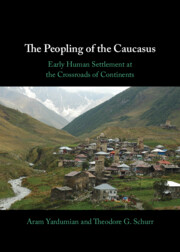
Located at the crossroads of Europe, Asia, and the Middle East, the Caucasus region has played a critical role in the dissemination of languages, ideas, and cultures since prehistoric times. In this study, Aram Yardumian and Theodore Schurr explore the dispersal of human groups in the Caucasus beginning in the Palaeolithic period. Using evidence from archaeology, linguistics, and anthropological genetics, they trace changes in settlement patterns, cultural practices, and genetic variation. Highlighting the region's ecological diversity, natural resources, and agricultural productivity, Yardumian and Schurr reconstruct the timings and likely migration routes for human settlement following the Last Glacial Maximum, as well as the possible connections to regional economies for these expansions. Based on analysis of archaeological site reports, linguistic relationships, and genetic data previously published separately and in different languages, their synthesis of the most up to date evidence opens new vistas into the chronology and human dynamics of the Caucasus' prehistory.
This paper presents the radiocarbon context of the megalithic monument El Amarejo 1, situated in the corridor of Almansa in the southern region of La Meseta in Spain. The monument was constructed using small and medium-sized masonry, comprising a short corridor and two separate chambers in which burials were carried out. The results of the 14C analyses of each of the 11 individuals documented indicate that the monument was in use between approximately 1900 and 1200 cal BC. Bayesian modeling of the radiocarbon dates allows for the proposition of hypotheses regarding the construction, utilisation dynamics, and abandonment of the monument. The combination of these new data with the analysis of the 14C dating of other burials from the Bronze Age of La Mancha reveals a complex and heterogeneous panorama. The evidence presented and analyzed in this paper suggests that burial practices associated with fortified settlements and their domestic areas shared space and time with the construction of megalithic monuments located near settlements.
Western Zhou Dynasty (ca. 1046–771 BC) was established soon after conquering the Shang Dynasty (ca. 1600–1046 BC) and brought about the earliest enfeoffment system in Chinese history. Yan was one of the vassal states of the same clan as Zhou. According to historical records, the capital of Yan state was located near Yan mountain, which is now known as the Liulihe site in the Fangshan District, Beijing. This study carries out the high-precision dating of two newly discovered Western Zhou Dynasty noble tombs at the Liulihe site. The man in tomb M1902 participated in the groundbreaking ceremony of Yan’s capital according to inscriptions on the bronze vessel found in this tomb. Samples of different materials, especially different parts of human skeletons from the tombs, were selected to form a sample series in chronological order. Wiggle-matching models were established in OxCal program based on the growth and development time of different teeth and bones of human skeletons. More accurate ages were acquired for the death of the individuals. The results indicate that the most probable distribution range of the death date of the individual in M1902 is about 1045–1010 BC. The radiocarbon dates of M1902 give important chronological information about the founding of Yan state, and they are very close to those of the year in which King Wu of Zhou conquered the Shang Dynasty.
In this paper we present new AMS radiocarbon dates from the Bronze Age cemetery of Tiszafüred-Majoroshalom excavated between 1961 and 1972. The cemetery provides crucial information on the cultural development and chronology of the Bronze Age Otomani-Füzesabony and the Tumulus cultures of Eastern Central Europe, in addition to the transition between the Middle and Late Bronze Age (approx. 1500 BC) in the Great Hungarian Plain.