To save content items to your account,
please confirm that you agree to abide by our usage policies.
If this is the first time you use this feature, you will be asked to authorise Cambridge Core to connect with your account.
Find out more about saving content to .
To save content items to your Kindle, first ensure no-reply@cambridge.org
is added to your Approved Personal Document E-mail List under your Personal Document Settings
on the Manage Your Content and Devices page of your Amazon account. Then enter the ‘name’ part
of your Kindle email address below.
Find out more about saving to your Kindle.
Note you can select to save to either the @free.kindle.com or @kindle.com variations.
‘@free.kindle.com’ emails are free but can only be saved to your device when it is connected to wi-fi.
‘@kindle.com’ emails can be delivered even when you are not connected to wi-fi, but note that service fees apply.
The introduction outlines the geographies of slavery and black freedom in eighteenth-century Colombia, the significance of region and race in Colombian history, and the importance of the mobilities of black people, their labour, and their culture in traversing and connecting New Granada’s Caribbean and Pacific worlds. Fisk argues for the centrality of geography, in particular place and mobilities, for shaping black religious knowledge and practice in a period (1690–1790) rarely studied by historians of African diasporic cultural history. After a historiographical and theoretical examination of how African diasporic religious formation has been studied, Fisk explores the variety of regimes of slavery and sites in which people of African descent resided in colonial Colombia – from cities, haciendas, and mines to maroon communities. She argues that place fundamentally shaped how people of African descent engaged with Catholicism. She conceptualises black Catholic practice in eighteenth-century New Granada as an “interstitial religion,” born of the physical and metaphorical interstices in a colonial society governed through slavery and introduces a methodology of religious geographies for the study of black religious knowledge where there is no written canon.
The transnational turn in American literary studies has forged new epistemologies and approaches for thinking about postnational cultural forms while centering empire and imperialism in the development of US culture. This chapter reviews these critical conversations and takes up the recent concept of the Black Pacific to examine how the redefinition of the United States as an empire-state rather than as a nation-state has transformed the study of race and comparative racialization in the long nineteenth century. In so doing, the essay considers some lesser-studied Black American writings on and responses to the Philippine–American War as part of an emerging Black American discourse on the Pacific, as Asia became more geopolitically significant to the United States. The essay pays particular attention to publications from the era’s most influential Black literary magazine, the Boston-based Colored American Magazine. Specifically, it examines the complex Black American reception history of José Rizal’s landmark novel of Filipino nationalism, Noli Me Tangere (1887), which was translated from Spanish into English and published in the United States as two dramatically different abridged novels in 1900.
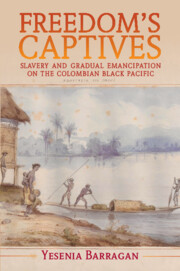
Freedom's Captives is a compelling exploration of the gradual abolition of slavery in the majority-black Pacific coast of Colombia, the largest area in the Americas inhabited primarily by people of African descent. From the autonomous rainforests and gold mines of the Colombian Black Pacific, Yesenia Barragan rethinks the nineteenth-century project of emancipation by arguing that the liberal freedom generated through gradual emancipation constituted a modern mode of racial governance that birthed new forms of social domination, while temporarily instituting de facto slavery. Although gradual emancipation was ostensibly designed to destroy slavery, she argues that slaveholders in Colombia came to have an even greater stake in it. Using narrative and storytelling to map the worlds of Free Womb children, enslaved women miners, free black boatmen, and white abolitionists in the Andean highlands, Freedom's Captives insightfully reveals how the Atlantic World processes of gradual emancipation and post-slavery rule unfolded in Colombia.
Recommend this
Email your librarian or administrator to recommend adding this to your organisation's collection.